






By: Nkosiyabusa Nsibande
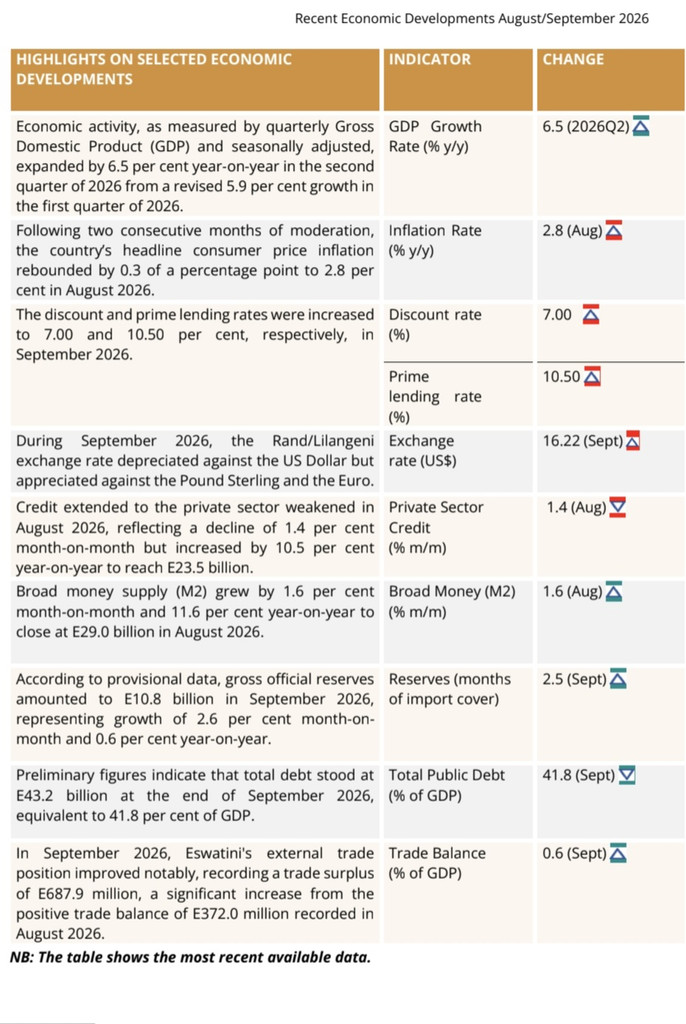
Eswatini’s merchandise trade surplus contracted by approximately E570 million to E2.65 billion in the first nine months of 2026, as exports declined while imports increased, according to the Central Bank of Eswatini’s Recent Economic Developments: August/September 2026. The figures expose a central challenge for the country’s export economy sustaining foreign earnings when a large share of sales depends on a limited number of products and a dominant regional trading partner.
Between January and September 2026, merchandise exports totaled E31.6 billion, down 1.2% from E32.0 billion in the corresponding period of 2025. Imports rose by 0.7% to E29.0 billion from E28.8 billion, reducing the trade surplus from E3.22 billion to E2.65 billion, according to the Central Bank. Although the country continued to export more goods than it imported, the narrowing surplus reflected a weaker margin between export receipts and import expenditure.
September delivered a stronger monthly performance, with exports increasing by 14.1% to E4.2 billion while imports rose by 6.0% to E3.5 billion. The resulting surplus reached E687.9 million, compared with E372.0 million in August. Higher sugar receipts and increased exports of soft drink concentrates supported the improvement, but September exports were only 1.0% above their level a year earlier. The monthly rebound therefore does not, on its own, establish a sustained recovery in export earnings.

The composition of exports presents a more structural concern. Soft drink concentrates, sugar and sugar products, textiles and apparel, and wood and wood articles collectively accounted for 84.0% of total exports in September. Soft drink concentrates generated E1.8 billion, sugar and sugar products contributed E1.0 billion, textiles and apparel brought in E402.6 million, while wood and wood articles accounted for E272.5 million, according to the Central Bank.
The concentration means that the performance of a small group of industries carries significant weight in the country’s monthly export receipts. Stronger sugar exports can support the overall position when another major category weakens, but the same structure leaves aggregate earnings exposed when several industries experience lower demand, reduced production, or less favorable trading conditions.
Recent figures show that these product categories are not moving in the same direction. Sugar exports reached E1.0 billion in September, up 43.4% year-on-year, while textile and apparel exports increased by 9.7% to E402.6 million. Soft drink concentrates generated E1.8 billion, down 5.7% year-on-year, while wood and wood articles fell 2.8% to E272.5 million. The uneven performance illustrates why headline export totals need to be assessed alongside the industries and products generating the receipts.
Geographical concentration compounds this exposure. South Africa accounted for 72.7% of Eswatini’s exports and 69.2% of its imports in September, according to the report. This relationship provides access to a major neighboring market and supports established regional supply chains, but it also links Eswatini’s exporters closely to changes in South African demand, industrial activity and transport networks. A disruption affecting major customers or supply chains could have consequences for businesses whose sales are concentrated in that market.
For exporters, diversification is a commercial and financial decision rather than simply a national trade objective. Businesses can reduce reliance on individual customers or destinations by developing additional markets, expanding product ranges, processing more domestic inputs, or moving into products with greater value-added. Such expansion, however, requires market research, reliable distribution, compliance with destination-country standards and sufficient working capital to finance production and payment delays. Entering a new market can spread risk, but the cost of acquiring customers and meeting regulatory requirements must be weighed against the expected returns.
Import trends also provide insight into the economy’s productive capacity. Energy imports stood at E649.8 million in September, up 8.6% year-on-year, despite falling by 4.0% from August because of lower diesel volumes. Machinery and electrical equipment imports increased by 22.8% month-on-month and 12.7% year-on-year to E382.6 million, reflecting equipment procurement by the manufacturing sector, according to the Central Bank.

The rise in machinery imports could support future production if the equipment improves capacity, efficiency or product quality. However, the report does not establish the extent to which the purchases will generate additional output. For businesses, the relevant financial question is whether imported capital equipment will raise productivity, lower unit costs or enable them to compete more effectively in export markets. The value of an import depends not only on the immediate foreign-exchange outflow but also on its potential contribution to future earnings.
The trade surplus itself must also be interpreted within its limits. It measures the difference between merchandise exports and imports over a specified period; it is not a measure of government revenue, corporate profitability or the country’s entire external financial position. A narrower surplus does not automatically mean that the economy is deteriorating, just as a stronger monthly balance does not prove that exporters have become more competitive. Productive investment, domestic value addition, market access and the durability of export demand all influence the quality of trade performance.
For businesses dependent on export markets, the figures underline the importance of managing concentration risk. Firms relying on a small number of products, buyers or destinations should assess how a fall in orders would affect cash flow, inventory and debt-servicing capacity. Those considering expansion need to compare the cost of entering new markets with the potential gains from a broader customer base. At the same time, manufacturers should evaluate whether investment in equipment can strengthen productivity and export competitiveness.
Eswatini recorded a positive merchandise trade balance during the first nine months of 2026, but the surplus was lower than a year earlier, and export earnings remained concentrated in a handful of product categories. The commercial challenge is to turn established export strengths into a broader, more resilient earnings base, one capable of generating foreign receipts across more products and markets, rather than relying heavily on the performance of a few industries and a single dominant trading partner.


Other Articles

E3.9 Billion in SME Credit as Corporate Lending Falls 8.9%
Manufacturing Grows 14% as Construction Contracts 7.9%


