







By: Nkosiyabusa Nsibande
E8 billion in revenue, 647,574 tonnes in sugar sales, and a 9.4 percent increase in sales volumes would ordinarily signal a strong financial year for Eswatini’s sugar industry. Yet the sector’s latest performance tells a more complex business story. Despite higher turnover during the 2025/26 season, returns to growers and millers declined, highlighting how mounting production costs and difficult global market conditions are increasingly offsetting rising revenues. For investors, agribusinesses, and policymakers, the results illustrate that profitability has become a greater challenge than production or demand.
639,998 tonnes of sugar were produced during the season, almost unchanged from 640,738 tonnes recorded in 2024/25. Maintaining production at this level despite adverse weather demonstrates the industry’s operational resilience and the effectiveness of existing production capacity. Meanwhile, sales volumes rose from 591,986 tonnes to 647,574 tonnes, while total revenue increased from E7.7 billion to E8 billion, representing a 3.9 percent improvement. These figures confirm that demand remained relatively strong even as international trading conditions became increasingly difficult.
E6.7 billion was distributed to growers and millers, down from E7.3 billion in the previous season, representing an 8 percent decline. This reduction is perhaps the most significant financial indicator in the results because it shows that higher revenues did not yield stronger returns for industry participants. For businesses, revenue reflects gross income generated through sales, while distributions represent the value ultimately returned to those who invest in production. When distributions decline despite revenue growth, it is usually a sign that operating costs, pricing pressures, or other external factors have compressed profit margins.
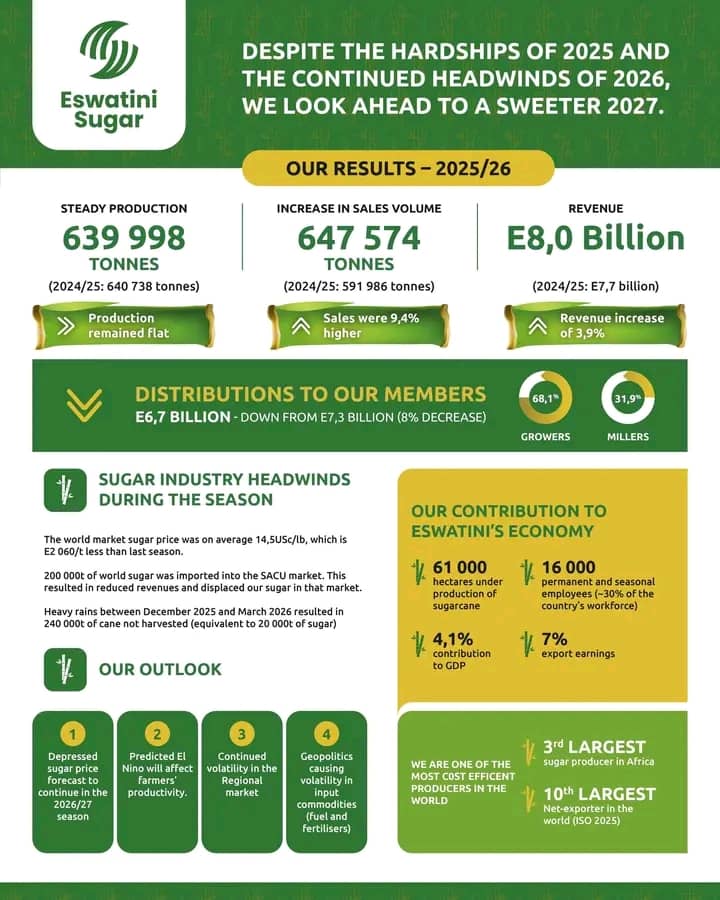
14.5 US cents per pound was the average global sugar price during the season, significantly lower than the previous year. Commodity prices remain one of the most important determinants of profitability in export-oriented agricultural industries. Lower international prices reduce earnings even when production volumes remain stable, making it increasingly difficult for producers to recover rising operational costs. Labor, irrigation, maintenance, transport, and energy expenses generally remain fixed or continue to increase, leaving businesses with shrinking margins despite maintaining output.
200,000 tonnes of imported sugar entered the Southern African Customs Union (SACU) market during the season, increasing competition for locally produced sugar. Greater supply within the regional market reduced pricing power for domestic producers and contributed to weaker revenues from regional sales. For a sector that depends heavily on both export and regional markets, increased competition directly affects financial performance by limiting the industry’s ability to negotiate stronger prices.
240,000 tonnes of sugarcane remained unharvested between December 2025 and March 2026 due to heavy rainfall, representing approximately 20,000 tonnes of sugar. Beyond the immediate production losses, such disruptions carry wider financial implications. Capital invested in planting, irrigation, fertilizer, and labor cannot generate expected returns when crops cannot be harvested on schedule. The result is lower cash flow, delayed revenue recognition, and reduced profitability for growers and millers alike.
61,000 hectares remain under sugarcane cultivation across Eswatini, supporting approximately 16,000 permanent and seasonal jobs. The industry contributes an estimated 4.1 percent to national Gross Domestic Product while generating around 7 percent of the country’s export earnings. These figures demonstrate why the financial performance of the sugar sector extends beyond agriculture. It remains one of Eswatini’s most important sources of employment, foreign exchange earnings and rural economic activity, making its long-term sustainability critical to the broader economy.
Third in Africa for sugar production and tenth globally as a net sugar exporter according to the International Sugar Organization’s 2025 rankings, Eswatini continues to enjoy a strong competitive position despite current market pressures. The industry is also recognized as one of the world’s most cost-efficient sugar producers, providing a solid foundation for long-term competitiveness. However, efficiency alone cannot fully offset declining global prices, volatile weather patterns, and rising production costs.
2026/27 is expected to remain another difficult operating year. Forecasts point to continued weakness in international sugar prices, the potential impact of El Niño on agricultural productivity, ongoing volatility in regional markets, and persistent uncertainty surrounding fuel and fertilizer costs. These conditions will require producers to place even greater emphasis on financial discipline, cost control, and operational efficiency to preserve profitability.
2025/26 ultimately demonstrates an important financial principle that extends beyond the sugar industry. Revenue growth alone is not a reliable measure of business performance. Profit margins, cash generation, and returns to shareholders or industry participants provide a more accurate assessment of financial health. Eswatini Sugar’s latest results show that businesses can increase sales, maintain production, and generate higher revenue while profitability declines when external economic conditions become less favorable. For the country’s largest export industries, protecting margins is becoming just as important as expanding sales.