





By: Nkosiyabusa Nsibande
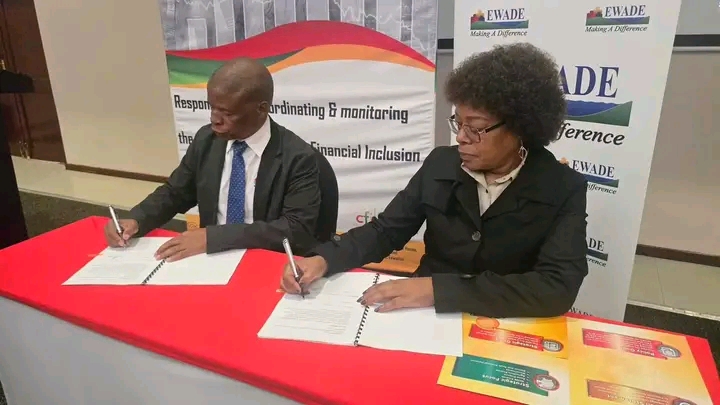
A strategic partnership between the Centre for Financial Inclusion (CFI) and the Eswatini Water and Agricultural Development Enterprise (EWADE) signals a decisive effort to safeguard years of investment in rural financial inclusion as the Financial Inclusion and Cluster Development (FINCLUDE) Project approaches its closure.
The two institutions have signed a Memorandum of Understanding aimed at strengthening implementation capacity during the project’s last months, with FINCLUDE scheduled to conclude in March 2027. The agreement comes at a critical stage for a program that has become one of Eswatini’s most significant interventions in expanding access to finance for smallholder farmers and rural enterprises.
While the agreement centers on operational cooperation, its broader significance lies in protecting the economic gains generated through a project that has helped connect thousands of excluded farmers and entrepreneurs to formal financial services.
FINCLUDE, a six-year initiative jointly funded by the Government of Eswatini and the International Fund for Agricultural Development (IFAD), tackled one of the country’s longstanding development challenges: limited access to finance in rural communities. The project has focused on helping smallholder farmers transition from subsistence production to commercially viable enterprises while improving their ability to access credit, markets, and financial services.
According to project figures, over 13,500 smallholder farmers and micro-entrepreneurs have benefited from FINCLUDE interventions. The program has supported developing agricultural commodity clusters, strengthened market linkages, and worked with financial institutions to develop financing models better suited to rural producers
For Eswatini’s financial sector, the significance extends beyond agriculture. Rural producers have faced difficulties in accessing bank finance because of limited collateral, irregular income streams, and weak integration into formal value chains. These factors often left farmers dependent on informal financing arrangements that constrained growth and investment.
FINCLUDE sought to address these barriers by organizing farmers into structured production clusters and strengthening their participation in value chains. The approach has improved visibility for lenders while creating opportunities for financial institutions to extend credit to underserved segments of the economy.
The latest partnership will see EWADE provide technical and project management support, while CFI remains the lead implementing agency under the Ministry of Finance. CFI’s mandate includes coordinating the country’s financial inclusion agenda and expanding access to financial services among underserved populations.
The arrangement also creates opportunities to align FINCLUDE activities with EWADE’s broader agricultural development programs, initiatives focused on market access, climate resilience, and smallholder commercialization. EWADE has positioned itself as a key driver of agricultural transformation through projects that support productivity, value-chain development, and market integration.
From an economic perspective, the partnership reflects a growing recognition that financial inclusion alone is insufficient without sound production systems and market access. Access to credit can only generate sustainable outcomes when borrowers have viable business opportunities, reliable markets, and the technical capacity to improve productivity.
The final phase of FINCLUDE will therefore be closely watched by policymakers, development partners, and financial institutions alike. Beyond meeting project targets, the larger question is whether the program can leave behind sustainable financial ecosystems that continue serving rural entrepreneurs after donor funding ends.
For Eswatini’s economy, the answer matters. Smallholder agriculture remains a major source of employment and income in rural communities, yet financing gaps continue to limit investment and productivity. If the gains achieved under FINCLUDE can be sustained, they could strengthen rural enterprise development, improve household incomes, and deepen participation in the formal financial system.
The new CFI-EWADE partnership is therefore more than an administrative arrangement. It represents an effort to preserve years of public and development-finance investment while ensuring that thousands of farmers and microenterprises remain connected to the financial opportunities that have emerged through the program.As the countdown to project closure begins, the focus will shift from implementation to legacy and whether FINCLUDE’s financial inclusion model can continue delivering economic benefits long after the program ends.

Other Articles