






By: Nkosiyabusa Nsibande
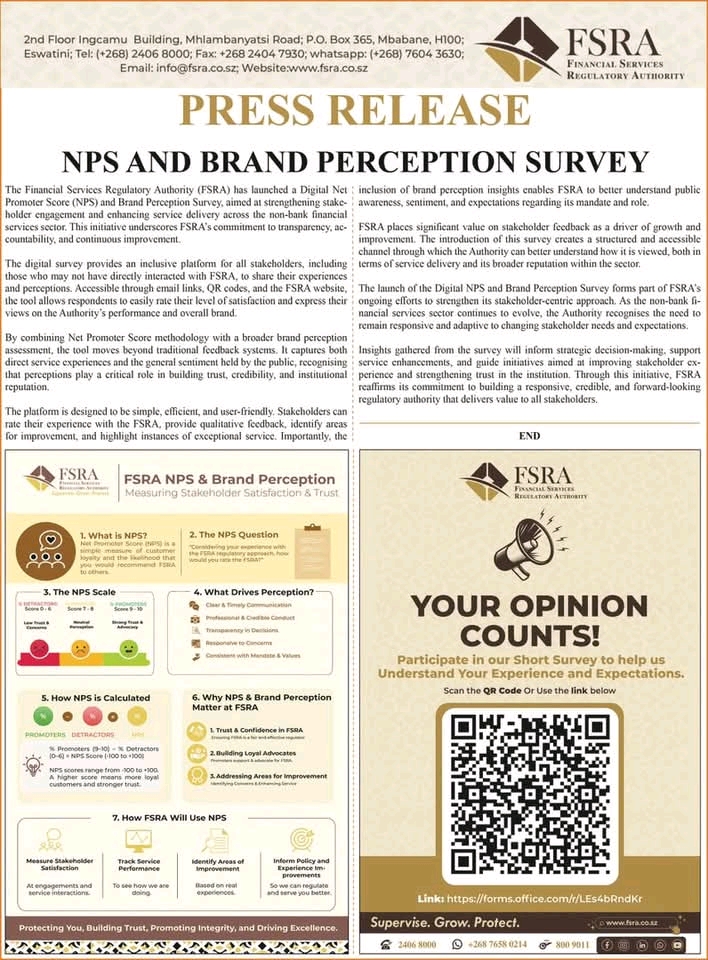
The Financial Services Regulatory Authority (FSRA) has launched a Digital Net Promoter Score (NPS) and Brand Perception Survey, signaling a growing recognition among regulators that effective oversight is no longer measured solely by compliance outcomes, but also by how institutions are perceived by the stakeholders they serve.
While the announcement may appear at first glance to be a routine stakeholder engagement exercise, it reflects a broader shift in regulatory thinking. Across financial markets globally, regulators are increasingly placing emphasis on transparency, responsiveness, and public trust as essential components of their institutional effectiveness. In Eswatini, where the non-bank financial services sector continues to expand in both size and complexity, the FSRA’s decision to formally measure stakeholder sentiment suggests an acknowledgment that regulation and reputation are becoming increasingly interconnected.
The survey combines the internationally recognized Net Promoter Score method with a wider assessment of public perceptions of the regulator’s brand and performance. Traditionally used by private sector organizations to measure customer loyalty and satisfaction, NPS has become an important management tool because it offers a relatively simple indicator of stakeholder confidence. For a regulator, however, the implications extend beyond customer satisfaction. The exercise provides an opportunity to evaluate whether market participants, consumers, and the wider public understand the Authority’s mandate, trust its decisions, and view it as an effective guardian of financial stability and consumer protection.
This distinction is particularly important in the context of the non-bank financial services sector. Unlike commercial banks, which interact with consumers on a daily basis, many of the institutions regulated by FSRA, including insurance companies, retirement funds, capital market participants, and collective investment schemes, operate within a framework where public confidence is heavily influenced by perceptions of regulatory credibility. A regulator that enjoys high levels of trust can strengthen market confidence, encourage participation, and support financial sector development. Conversely, weak public confidence can undermine the effectiveness of even the most robust regulatory framework.
The Authority’s emphasis on brand perception is therefore notable. Regulatory institutions have historically paid limited attention to branding, often viewing their legitimacy as deriving exclusively from legislation and enforcement powers. However, modern regulatory practice increasingly recognizes that public understanding and perception influence how institutions are viewed and how effectively they can carry out their mandates. Stakeholders who perceive a regulator as accessible, transparent, and responsive are generally more likely to engage with it, comply with regulatory requirements, and support its initiatives.
From a governance perspective, the survey also introduces a structured mechanism through which FSRA can gather qualitative and quantitative feedback from a wider audience.the Authority has opened participation beyond individuals and organizations that have directly interacted with it. This broadens the scope of the exercise from a traditional service satisfaction survey to a wider assessment of institutional reputation. Such an approach allows the regulator to identify potential gaps between how it views its performance and how it is perceived by the market it oversees.
The initiative arrives when expectations placed on financial regulators are increasing. Rapid technological developments, evolving financial products, and changing consumer behavior are transforming the regulatory environment. Regulators are increasingly expected not only to supervise markets but also to communicate effectively, educate consumers, and respond quickly to emerging risks. Understanding stakeholder expectations has therefore become a strategic necessity rather than a public relations exercise.
There is also a significant policy dimension to the survey. The information collected is expected to inform future strategic decision-making and service improvements within the Authority. If analyzed effectively, the findings could provide valuable insights into stakeholder priorities, areas of dissatisfaction, and opportunities for institutional strengthening. For a regulator tasked with supervising a sector that manages billions of emalangeni in assets and savings, such intelligence can help improve regulatory effectiveness and strengthen confidence in the broader financial system.
For Eswatini’s financial sector, the launch of the survey represents more than a feedback mechanism. It signals a regulator seeking to align itself with modern governance practices that place stakeholder engagement at the center of institutional development. In an environment where trust remains one of the most valuable assets any financial institution can possess, the ability of regulators to measure, understand, and respond to stakeholder sentiment may become a competitive advantage for the financial system as a whole.
The real test, however, will not be the collection of feedback but the actions that follow. Stakeholder surveys generate value only when their findings translate into measurable improvements in service delivery, communication, and regulatory performance. Should FSRA show that stakeholder input directly influences its decisions and operations, the initiative could become an important benchmark for accountability and institutional responsiveness within Eswatini’s public sector. For a regulator charged with safeguarding confidence in the financial system, listening may be just as important as supervising.