






By: Nkosiyabusa Nsibande
African Alliance says small and medium enterprises are critical to Eswatini’s economic growth and should be developed beyond serving domestic demand, with stronger local procurement and export capacity needed to turn locally owned businesses into larger, export-ready brands.
Small and medium enterprises may operate at a fraction of the scale of large corporations, but their combined contribution can become a significant source of economic activity, according to African Alliance, which is calling for greater investment in locally owned businesses and their progression into export markets.
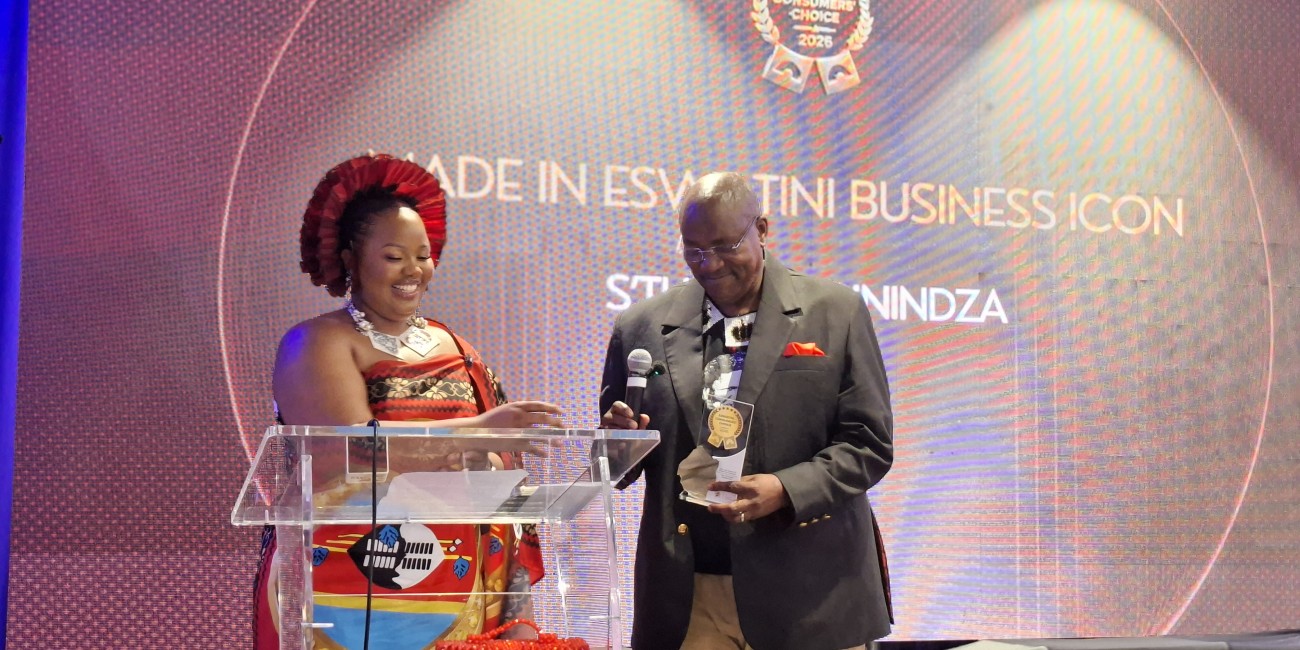
Speaking to FinGuard Magazine after the Made in Eswatini Consumers Choice Awards at Hilton Garden Inn on Thursday, September 17, African Alliance representative Sthofeni Ginindza, who received the Patrons Award: Made in Eswatini Business Icon Award, said the economic importance of SMEs should be understood through the aggregate value created by a large number of smaller businesses rather than the size of individual enterprises.

“The first thing that we need to appreciate is that no matter how small you are, whether a small or medium enterprise, your contribution to the economy is big,” Ginindza said, arguing that the cumulative effect of many small businesses can create a substantial economic contribution. He illustrated the point through the accumulation of small amounts of money, saying that when “10 cents, 20 cents, one lilangeni” are combined across a large number of participants, they ultimately form a much larger economic value.
Ginindza’s argument places SMEs within a broader capital-formation and economic-participation framework, where the strength of the sector lies not only in individual turnover but also in the number of businesses participating in production, trade, and income generation. “It’s not just the big companies that are meant to contribute to the well-being of our economy,” he said, adding that smaller enterprises can be significant contributors to economic activity.
The case for supporting SMEs is strengthened by their local ownership base. Ginindza said smaller companies are often businesses that originate in Eswatini, meaning that expanding their commercial capacity can increase the participation of locally owned enterprises in the domestic economy and potentially allow a greater share of economic value to remain within the country.
For African Alliance, one mechanism for achieving this is local procurement, with Ginindza pointing to the organization’s own commercial operations as an example of how demand from established businesses can create markets for smaller local suppliers. He said African Alliance’s Pick n Pay operations purchase local produce, while a new section at Mbabane Square has been established to source products from local businesses. “We support local because we see the benefits,” he said.

The significance of such procurement extends beyond the immediate transaction between a retailer and supplier. For an SME, access to a dependable buyer can provide the revenue base needed to increase production, improve systems, invest in equipment, and build a track record that may subsequently make the business more bankable or attractive to other forms of capital.
However, Ginindza said local procurement should not become the ceiling of SME development. His central argument was that businesses producing locally should ultimately be positioned to sell beyond Eswatini, allowing domestic production to translate into foreign-exchange earnings.
“While it’s all made local, let’s try to export, not just to satisfy local demand, because we need forex,” he said.
That shift from local supply to export capacity is relevant to Eswatini’s balance between domestic consumption and the need to generate foreign currency. A business that sells exclusively into the domestic market primarily circulates value within the local economy, while an enterprise capable of reaching external markets can bring foreign revenue into Eswatini and expand the potential market available to its products.
For SMEs, however, moving into export markets requires more than producing a product that can sell locally. Businesses need sufficient production capacity, consistent quality, reliable supply chains, appropriate packaging and standards, financial controls, and the working capital required to fulfill larger orders. Export growth, therefore, requires SMEs to transition from informal or small-scale commercial activity into businesses with the systems and financial discipline required to serve larger markets.
Ginindza said African Alliance’s own experience provides evidence that local ownership can support commercially viable businesses at scale. “All our businesses, by the way, are run by Swazis,” he said, highlighting local management and ownership as an existing feature of the organization’s operations.
The implication for Eswatini’s SME sector is that the development challenge is not simply about creating more small businesses. It is also about helping existing enterprises move through different stages of commercial growth: from securing customers, to increasing turnover, accessing appropriate finance, building production capacity, and eventually entering larger domestic and regional markets.

For financial institutions and investors, that creates an opportunity to view SMEs not only as borrowers or beneficiaries of development programs, but as businesses with the potential to become larger commercial assets if they can demonstrate sustainable cash flows, sound governance, and scalable business models.
The export dimension also changes the way “Made in Eswatini” can be understood. Local production does not have to be confined to satisfying a domestic consumer base; it can become the foundation for brands capable of competing in regional and international markets. Ginindza’s message therefore moves the SME conversation from simply buying local towards building businesses that can produce at scale, attract capital, create employment, and ultimately earn foreign exchange for Eswatini.
For a small economy, the financial significance lies in the consolidation of those individual enterprises. The objective is not necessarily for every SME to become a large corporation, but for a greater number of locally owned businesses to become commercially sustainable, productive, and capable of moving into higher-value markets. That is where local procurement can become a starting point for a much larger economical proposition: turning small businesses into scalable Eswatini brands with the capacity to compete beyond the country’s borders.


Other Articles

“Personal Brands Can Become a Financial Asset” – Sfiso Nxumalo Advises