







By: Nkosiyabusa Nsibande
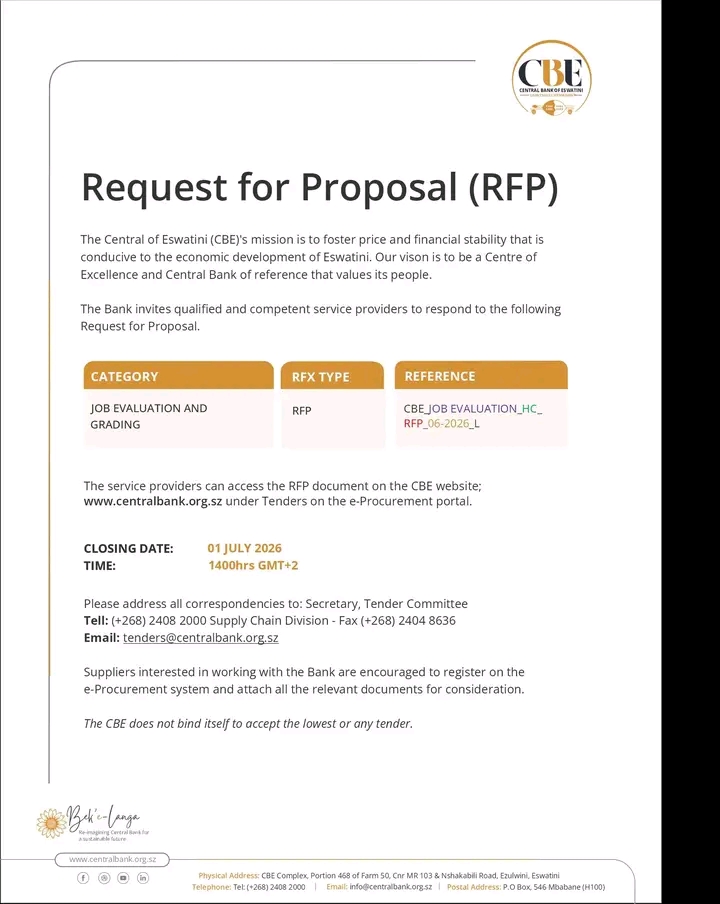
The Central Bank of Eswatini’s decision to seek external expertise for a comprehensive job evaluation and grading exercise reflects a growing challenge facing financial institutions across Africa: how to attract and retain highly specialized expertise in an competitive labor market.The bank has issued a request for proposals for project evaluation and grading services, inviting qualified firms to assess its organizational structure and remuneration framework. While the procurement notice appears administrative, the exercise has broader implications for institutional performance, governance, and the long-term sustainability of Eswatini’s financial sector.
According to the Central Bank’s vision statement, the institution seeks to become a center of excellence and a central bank of reference that values its people. Achieving that goal requires not only strong monetary policy and financial supervision but also the ability to recruit, develop, and keep the skilled professionals responsible for carrying out those functions.
Human Capital as a Financial Asset
For modern central banks, human capital has become one of the most important institutional assets. Economic researchers, banking supervisors, data analysts, cybersecurity specialists, payment systems experts, and financial stability professionals are difficult to recruit and keep as demand for specialized financial-sector skills grows across the region.
A job evaluation exercise helps organizations determine whether compensation structures reflect the complexity, responsibility, and strategic importance of different roles. It provides a framework for ensuring that employees performing work of similar value receive fair remuneration while creating clear career progression pathways.
For a central bank, this process is not about salaries. It is about ensuring that the institution remains capable of attracting the expertise required to maintain financial stability, supervise banks, manage reserves, and support economic development.
Why It Matters for the Economy
The effectiveness of a central bank depends on the quality of its workforce. When skilled professionals leave critical institutions because compensation structures lag market realities, the consequences can extend beyond the organization itself. Capacity constraints can affect regulatory oversight, policy implementation, and the overall resilience of the financial system.
According to the Central Bank’s corporate documents, developing institutional capability remains a key strategic objective. The bank has invested in leadership development, professional training, and innovation initiatives aimed at strengthening both its workforce and the broader financial sector.
We can therefore view the current job evaluation exercise as part of a wider effort to ensure that organizational structures keep pace with changing economic and technological demands.
Governance and Long-Term Sustainabilit
The review also carries important governance implications. Globally, job evaluation frameworks are used to promote transparency, accountability, and consistency in remuneration decisions. They help organizations reduce salary distortions, improve succession planning, and align workforce costs with strategic priorities.For public institutions in particular, the challenge is balancing competitiveness with prudent financial management. Compensation structures must be attractive enough to keep scarce expertise while remaining sustainable and defensible to stakeholders. The Central Bank’s move suggests a recognition that workforce planning is becoming a strategic issue rather than a purely administrative function.
Beyond an HR Exercise
As financial systems become more digital, interconnected, and data-driven, the skills required within central banks continue to develop. The growing importance of FinTech regulation, cybersecurity oversight, digital payments, and financial innovation means that institutions must assess whether their organizational structures are fit for purpose.
Viewed through that lens, the Central Bank of Eswatini’s job evaluation and grading exercise are not an internal human resources project. It is a strategic investment in institutional capacity, one that could influence how effectively the Bank delivers on its mandate of safeguarding financial stability in the years ahead.

Other Articles

Fiscal Policy – Steering the Economy’s Future