





By: Nkosiyabusa Nsibande
For many years, discussions about Eswatini’s financial sector have centred almost entirely on commercial banks, lending activity, and monetary policy. This narrow focus has often overlooked a much larger segment of the country’s financial system that quietly mobilizes billions of Emalangeni in savings and investments. According to the International Monetary Fund (IMF), following a technical assistance mission conducted with the Central Bank of Eswatini (CBE) and the Financial Services Regulatory Authority (FSRA), Eswatini is now expanding the scope of its monetary and financial statistics to capture the full scale of its financial sector. While this may appear to be a technical reform, it represents an important step towards strengthening financial transparency, improving economic policymaking, and creating a more informed investment environment.
Perhaps the report’s most revealing finding is that commercial banks are no longer the dominant force within Eswatini’s financial system. According to the IMF, other financial corporations, including pension funds, insurance corporations, collective investment schemes, and credit providers, account for approximately 66.2 percent of the country’s financial sector assets, excluding the Central Bank. By comparison, the entire banking sector represents only 33.8 percent, while commercial banks alone account for 27.9 percent of total financial assets. In value terms, the country’s non-bank financial sector controls assets worth E74.1 billion, contributing to a financial system valued at approximately E112 billion, excluding the Central Bank. This is equivalent to nearly 118 percent of Eswatini’s Gross Domestic Product, illustrating just how significant these institutions have become in the national economy.
For investors, these figures fundamentally change the understanding of where financial capital resides. According to the IMF, previous monetary statistics largely concentrated on banking institutions, leaving substantial segments of the financial sector outside the country’s official statistical framework. As a result, policymakers and market participants lacked a comprehensive understanding of long-term savings, investment flows, and financial linkages across the economy. Expanding financial statistics to include non-bank institutions provides a more complete picture of how capital moves through the financial system, allowing regulators to make better policy decisions while giving investors access to more reliable information when assessing market opportunities and risks.
Among the institutions reshaping Eswatini’s financial landscape, pension funds stand out as the country’s largest financial players. The IMF reports that pension funds alone manage assets valued at E51.6 billion, representing 69.7 percent of all non-bank financial sector assets and 46.1 percent of the country’s total financial assets, excluding the Central Bank. This means retirement savings have become the single largest source of long-term domestic capital in Eswatini. The report further notes that the Public Service Pension Fund (PSPF) accounts for approximately 73 percent of pension sector assets, while the Eswatini National Provident Fund (ENPF) contributes another 13 percent. Together, the country’s ten largest pension funds control about 93 percent of the retirement savings market, placing them at the centre of long-term investment, capital formation, and economic development.
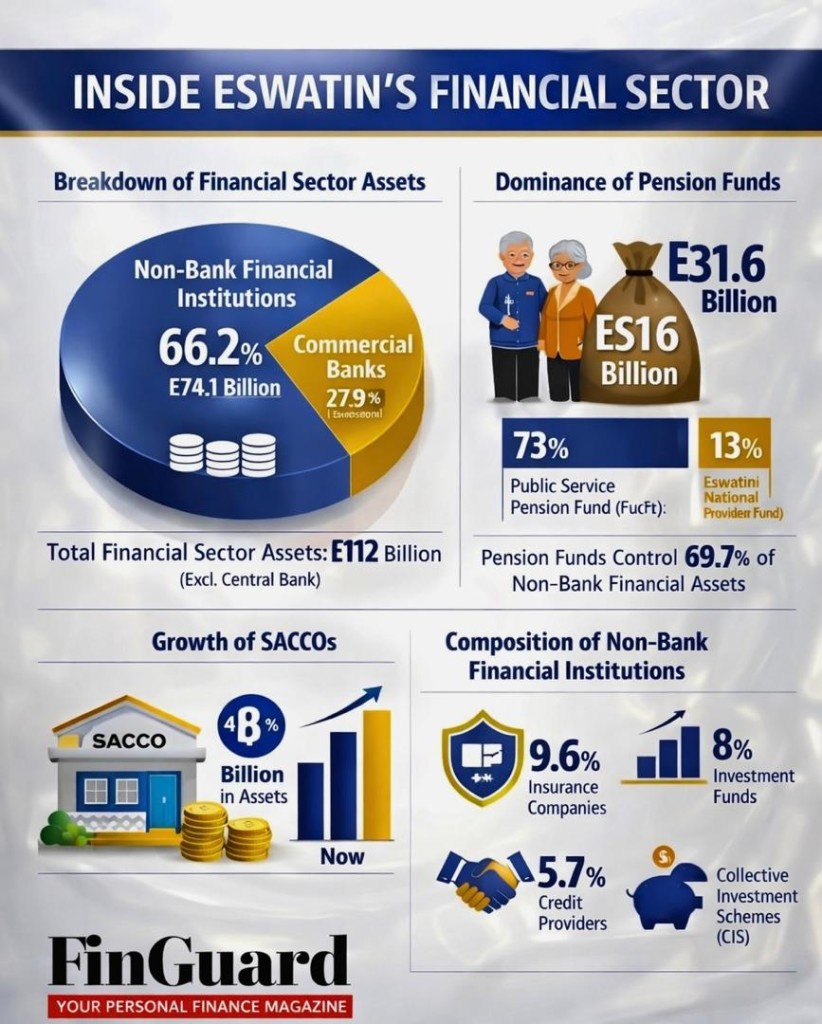
Insurance companies have also emerged as major institutional investors within the economy. According to the IMF, insurance corporations collectively hold assets worth E7.1 billion, accounting for 9.6 percent of the non-bank financial sector. Their investment portfolios contribute significantly to the mobilisation of long-term savings while supporting broader financial market activity. Collective investment schemes manage an additional E8.9 billion in assets, while licensed credit providers, including development finance institutions and money lenders,hold approximately E6.4 billion. Together, these institutions provide an important source of financing across multiple sectors of the economy and demonstrate that financial intermediation in Eswatini extends well beyond the traditional banking industry.
The report also highlights the growing importance of Savings and Credit Cooperative Organizations (SACCOs), institutions that often receive limited public attention despite their contribution to financial inclusion. According to the IMF, Eswatini’s 47 licensed SACCOs collectively manage assets exceeding E3 billion, representing 7.9 percent of the assets within the other depository corporation sector. Their inclusion in official monetary statistics significantly broadens the country’s understanding of household savings and lending activities. Since SACCOs primarily serve communities and individuals who may have limited access to commercial banking services, recognising their role provides policymakers with a more accurate picture of financial inclusion and domestic savings mobilisation.
Beyond revealing the size of these institutions, the IMF emphasises that improving financial statistics is about strengthening the country’s economic decision-making. According to the organisation, expanding the coverage of monetary and financial statistics enhances financial sector surveillance, improves monetary policy analysis, and provides regulators with better tools to identify emerging financial risks. More detailed information enables authorities to understand where credit is expanding, where savings are accumulating, and how different financial institutions are connected. For investors, greater transparency reduces uncertainty and supports more informed investment decisions, particularly in an increasingly complex financial environment.
Another important recommendation contained in the report is the adoption of the Balance Sheet Approach, an internationally recognised framework used to analyse financial relationships between households, businesses, government, and financial institutions. According to the IMF, this analytical tool enables policymakers to identify vulnerabilities before they develop into broader financial risks by examining how financial exposures are distributed throughout the economy. Once Eswatini completes the expansion of its financial statistics, the Balance Sheet Approach is expected to become an important instrument for strengthening financial stability and improving macroeconomic surveillance.
The report further stresses that achieving these objectives will require closer cooperation between the Central Bank of Eswatini and the Financial Services Regulatory Authority. According to the IMF, the two institutions should strengthen data sharing, harmonise reporting standards, and improve the classification of financial instruments to ensure consistent and reliable financial information across the sector. The recommendations also call for improvements in technical capacity, better reporting of currency exposures, and stronger institutional coordination, measures that would align Eswatini’s financial reporting practices with internationally recognised standards while enhancing confidence in the country’s financial system.
Ultimately, the IMF’s findings demonstrate that Eswatini’s financial system is considerably deeper and more diversified than many previously appreciated. Pension funds, insurance companies, investment funds, SACCOs, and credit providers now represent the majority of the country’s financial assets and play a central role in mobilising savings, financing investment, and supporting economic growth. Bringing these institutions fully into the country’s official financial statistics is more than a technical exercise, it is a strategic reform that improves transparency, strengthens policymaking, and gives investors a clearer understanding of where financial strength truly lies within Eswatini’s economy.