





By: Nkosiyabusa Nsibande
His Majesty King Mswati III International Airport is set to become the centerpiece of Eswatini’s latest green infrastructure investment after the Government of Japan committed a grant of USD693, 333 (approximately E12 million) towards a project that combines renewable energy with digital innovation. Beyond its environmental benefits, the investment signals a growing recognition that modern transport infrastructure has become a critical driver of trade competitiveness, investment attraction, and long-term economic growth.
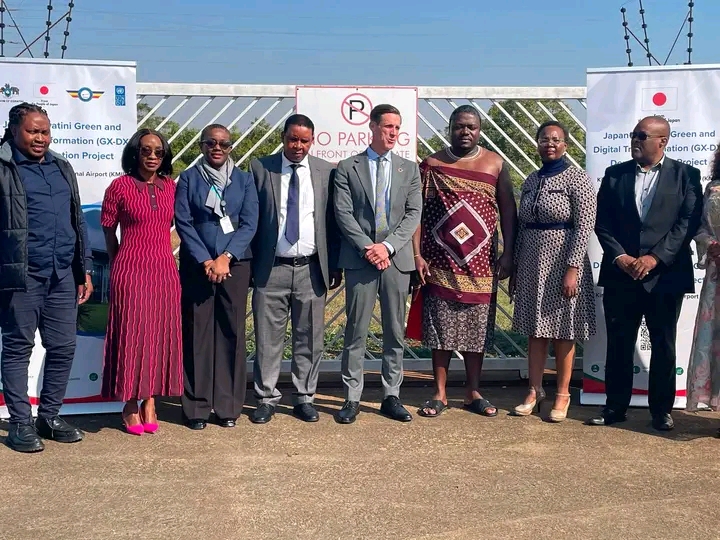
The Minister of Public Works and Transport, Mabulala Maseko officially launched the Japan–Eswatini Green and Digital Transformation Demonstration Project, alongside United Nations Development Programme (UNDP) Resident Representative Henrik Franklin, representatives of the Government of Japan, and other stakeholders. The project will introduce renewable energy systems and smart digital technologies at King Mswati III International Airport with the objective of improving operational efficiency, modernizing cargo handling processes, and reducing the airport’s environmental footprint. According to the project partners, the airport will also serve as a demonstration site for Japanese green and digital technologies, creating opportunities for future technology transfer and investment.
From a financial perspective, the project represents more than an infrastructure upgrade. Airports increasingly compete not only on passenger numbers but also on cargo efficiency, energy costs, and environmental performance. By integrating renewable energy into airport operations, Eswatini is expected to reduce electricity expenditure over the long term while insulating one of its most strategic transport assets from rising energy costs. At the same time, digitalizing cargo operations has the potential to shorten processing times, improve customs efficiency, and strengthen supply chain reliability for exporters and importers.

Minister Mabulala Maseko described the initiative as an important milestone in modernizing the country’s transport infrastructure and advancing sustainable development. He said the partnership demonstrates how international cooperation can deliver practical investments that improve public infrastructure while supporting economic transformation. The minister noted that integrating green energy with digital technologies will strengthen the country’s aviation sector and improve the efficiency of logistics services that are essential for trade and investment.
For Eswatini, where export competitiveness depends heavily on efficient transport networks, improvements at King Mswati III International Airport could generate wider economic benefits beyond aviation. Faster cargo processing can reduce costs for exporters of agricultural products, manufactured goods, and high-value commodities, while enhanced operational efficiency strengthens the country’s attractiveness as a logistics gateway within the Southern African region. Such investments become increasingly important as global markets demand quicker delivery times and more environmentally sustainable supply chains.
UNDP Resident Representative Henrik Franklin has consistently argued that investments in renewable energy should be viewed as economic investments rather than purely environmental interventions. Speaking recently at another green infrastructure project, he remarked, “It is about building institutional capacity, strengthening national systems, and ensuring that the benefits continue long after the project period has ended.” That philosophy is reflected in the airport project, which combines infrastructure development with technology transfer and institutional strengthening.

The latest investment also aligns with Eswatini’s broader strategy of transitioning towards a low-carbon economy while maintaining economic growth. The country is currently advancing its Long-Term Low Emission Development Strategy and continues expanding renewable energy across public infrastructure with support from international development partners. Recent projects have included solar installations at public institutions, renewable energy support for businesses, and rural electrification initiatives, all aimed at reducing operating expenses while improving resilience against future energy price shocks.
Japan’s decision to finance the airport project further reinforces the growing economic partnership between the two countries. Beyond development assistance, Japan has increasingly positioned itself as a strategic partner supporting infrastructure, technology, clean energy, and human capital development across Africa. By selecting Eswatini as a demonstration site for Japanese green and digital technologies, the project provides an opportunity to showcase solutions that could be replicated across other sectors of the economy, including logistics, manufacturing, and public infrastructure.
For investors and the business community, the significance of the project lies in its long-term implications. Modern airports are no longer viewed solely as transport facilities; they are economic assets that influence investment decisions, export performance, and national competitiveness. By investing nearly E12 million into green energy and digital transformation at its principal international airport, Eswatini is taking a strategic step towards building infrastructure capable of supporting future trade growth while lowering operational costs and strengthening environmental sustainability.