






Opinion Piece
By: Nkosiyabusa Nsibande
The controversy surrounding the Central Bank of Eswatini’s E2.79 billion headquarters project has exposed a fundamental tension at the heart of the country’s economic development strategy. While public debate has largely focused on whether a contractor with foreign participation should have been awarded one of the country’s largest construction contracts, the issue extends far beyond a single procurement decision. The debate touches on broader questions about the structure of the economy, the competitiveness of local industries, the country’s approach to foreign direct investment, and the extent to which major public projects are being used to build domestic productive capacity. In many respects, the dispute has become a test case for how Eswatini intends to balance citizen economic participation with its continued reliance on foreign capital and expertise.
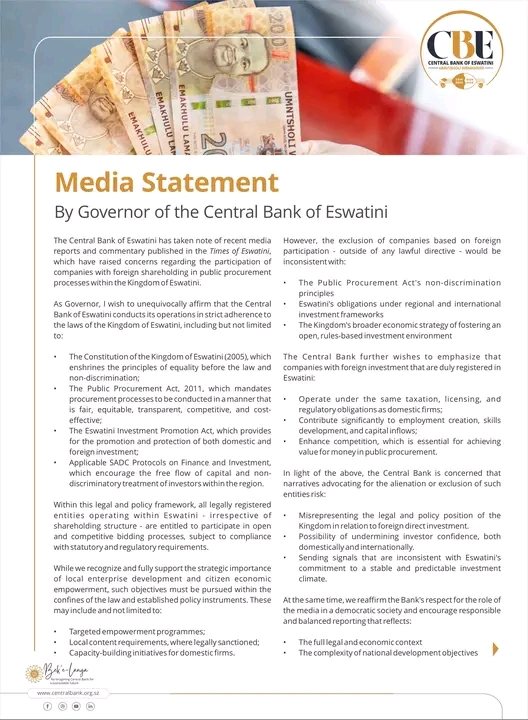
The Central Bank’s response to criticism was notable not only for its defence of the procurement process but also for what it revealed about the realities of the domestic construction sector. Governor Dr. Phil Mnisi argued that the tender process complied with all relevant legal and regulatory requirements and pointed out that all legally registered entities operating in Eswatini are entitled to participate in competitive bidding processes irrespective of their shareholding structures. More significantly, the bank disclosed that the three highest-ranked local contractors participating in the tender process had all partnered with foreign firms. While intended as a defence of the award process, that revelation offers a useful insight into the current state of the country’s construction industry and raises questions about whether the debate should be focused on foreign participation itself or on the capacity constraints that make such partnerships necessary.
At the centre of the discussion is the issue of industrial capability. Large-scale engineering and construction projects require substantial financial resources, specialized equipment, advanced project management systems, and technical expertise that are often accumulated through years of experience on similarly complex developments. Across much of the developing world, governments have sought to increase local participation in strategic infrastructure projects, but many have discovered that localization targets alone do not automatically create globally competitive domestic firms. The challenge is particularly pronounced in smaller economies where the pipeline of major projects is limited and opportunities for local contractors to build large-scale experience are relatively scarce. Under such circumstances, partnerships with foreign firms frequently become less a matter of choice than a commercial necessity.
This is what makes the Central Bank’s disclosure particularly significant. If the country’s largest contractors were themselves relying on foreign partners to compete for the project, it suggests that the debate is not simply about whether foreign firms should be involved in public contracts. Rather, it highlights the extent to which foreign expertise and domestic participation have become intertwined within key sectors of the economy. The reality is that many infrastructure projects across Africa are delivered through consortiums and joint ventures that combine international technical capacity with local market knowledge, labor, and supplier networks. Such arrangements often allow governments to achieve multiple objectives simultaneously, including project delivery, skills transfer, and local enterprise participation.
The bank’s insistence on maintaining a minimum local participation threshold of 30 percent despite requests from contractors to reduce it to 10 percent demonstrates an effort to ensure that domestic firms benefit from the project. However, participation and empowerment are not necessarily synonymous. A local participation requirement may guarantee that local companies secure a portion of the contract value, but it does not automatically ensure that those firms gain the expertise, technology, or financial strength needed to independently lead future projects. The more important question from a long-term development perspective is whether such projects leave behind stronger domestic companies that are capable of taking on increasingly sophisticated work without relying on foreign partners.
This distinction is critical because procurement decisions can have consequences that extend far beyond the immediate construction phase. A project valued at nearly E3 billion represents a significant economic intervention capable of influencing employment, supplier development, technical training, and business growth across multiple sectors. If structured effectively, such projects can help create domestic capabilities that continue generating economic value long after construction has been completed. If structured poorly, they can become isolated transactions that deliver physical infrastructure without materially improving the competitiveness of local industries. The true developmental impact of a project, therefore, depends not only on who wins the contract but also on how the project is leveraged to build local capacity.
The Central Bank also sought to address concerns that a substantial share of the project’s value would ultimately leave the country. According to the bank, the contract is denominated in emalangeni, and all payments are being made through local banking institutions. It further argued that even companies widely regarded as local businesses routinely import machinery, materials, and specialized services from outside the country. This argument reflects a broader structural characteristic of the Eswatini economy, which remains deeply integrated with regional supply chains and highly dependent on imported inputs. The bank noted that approximately 70 percent of imports originate from South Africa, while nearly 68 percent of exports are destined for the same market, underscoring the extent of this economic integration.
While the bank’s argument is economically valid, it also highlights another challenge confronting policymakers. The dependence on imported materials, equipment, and technical expertise means that large infrastructure projects inevitably generate economic leakages regardless of who secures the contract. As a result, the debate about localization cannot be confined to ownership structures alone. It must also address the broader question of how Eswatini can develop domestic industries capable of supplying a greater share of the goods and services required by major projects. Without progress in this area, concerns about capital outflows are likely to persist even when contracts are awarded to firms with significant local ownership.
Ultimately, the significance of the Central Bank tender dispute lies in what it reveals about the country’s stage of economic development. The challenge facing Eswatini is not whether to choose foreign investment over local participation. Foreign capital remains essential for financing growth, introducing technology, and expanding productive capacity. At the same time, sustainable economic transformation requires the emergence of strong domestic firms capable of competing, innovating, and leading major projects. The real policy challenge, therefore, lies in ensuring that foreign investment serves as a catalyst for building local capability rather than becoming a permanent substitute for it. Until that balance is achieved, disputes such as the one surrounding the Central Bank project will continue to surface because they are ultimately reflections of a deeper national conversation about ownership, competitiveness, and the future direction of the economy.