






By: Nkosiyabusa Nsibande
For many years, the location in Eswatini has been described through landmarks, local knowledge, and informal directions. While that system has served communities reasonably well, it has created an invisible cost for the country’s property market. Properties that cannot be easily identified are often more difficult to value, manage, insure, and integrate into formal economic activity. As Eswatini begins implementing the National Addressing Standards (ISO 19160), the reform has the potential to become a significant investment in the country’s real estate and municipal finance ecosystem.
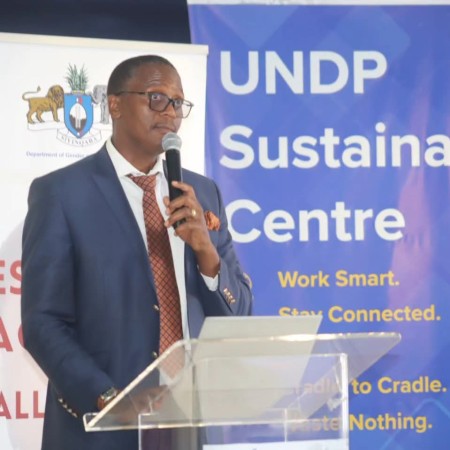
Speaking at the launch of the National Addressing Standards at Happy Valley Hotel on Thursday, Minister for Housing and Urban Development, Appolo Maphalala, positioned the initiative as more than a technical exercise. He described it as an essential component of the country’s plans and management of future growth. According to the minister, “National Addressing Standards are far more than technical tools. They are a foundational enabler of effective urban planning and service provision. Accurate and standardized addressing helps us identify and manage properties, plan infrastructure more efficiently, and improve access to public and emergency services.”
Although the immediate public discussion has centered on emergency response and navigation, the longer-term financial implications extend far beyond that. A standardized addressing system creates an organized inventory of residential, commercial, and public properties. For municipalities, that translates into improved planning for roads, water networks, electricity infrastructure, and future housing developments. Better property identification also enables local authorities to allocate resources more efficiently, as infrastructure decisions can be informed by accurate spatial information rather than fragmented records.

For investors, particularly those involved in property development, construction, and housing finance, reliable addressing reduces uncertainty. Developments become easier to identify, register, and integrate into municipal planning systems. That lowers administrative risks associated with land development, while improving confidence that infrastructure expansion can be planned around accurate property information. Over time, this could make urban expansion more predictable and reduce some of the hidden costs that developers encounter when working in poorly documented areas.
The Minister acknowledged that the absence of formal addresses has imposed economic costs that often go unnoticed. He observed that communities have relied on informal references such as landmarks and verbal directions because they had little alternative. However, he cautioned that “we have made it work because our communities are resourceful, but we should be honest about what this has cost us.” He noted that the country has paid that price through delayed emergency responses, inefficient utility planning, and barriers to financial services.
Perhaps the most commercially significant observation from the Minister related to the financial sector itself. He pointed out that “it has cost us in commerce, where banks and insurers hesitate to extend services to customers whose residence cannot be formally verified, and where a growing generation of online sellers and delivery services simply cannot reach certain customers at all.” That statement highlights an often-overlooked constraint on financial inclusion. Residential verification forms part of customer due diligence for banks, insurers, and many regulated financial institutions. A nationally recognized addressing framework could simplify those verification processes while reducing compliance costs associated with confirming customer locations.

The reform also carries important implications for municipal finances. Local governments depend on accurate property records to administer rates, plan infrastructure investments, and maintain service networks. Where addresses are inconsistent or incomplete, municipalities face greater difficulty maintaining reliable property databases. A nationally standardized addressing framework strengthens the administrative foundation upon which municipal revenue systems can operate. As more properties become formally identifiable, local authorities may also improve billing accuracy and long-term infrastructure budgeting.
Another economic benefit lies in supporting the formalization of the property market. Every numbered property creates a clearer identity within the national economy, making transactions easier to document and monitor. Housing developments, industrial parks, and commercial centers can be integrated into national spatial planning from the outset rather than documented retrospectively. That improves the quality of data available to planners, investors, and policymakers who rely on accurate property information when making investment decisions.
Recognizing that implementation will determine the program’s success, Maphalala appealed directly to local authorities to ensure that the standards move beyond policy documents and into practical application. He revealed that pilot implementation had already been undertaken in Matsapha and Ezulwini, where residents will soon begin seeing street name signs and house numbering labels installed. He urged councils to actively engage with communities so that residents understand the economic value of formal addresses rather than viewing them as unnecessary bureaucracy.
The Minister argued that local leaders should help communities recognize that addressing is “an investment that will make their homes and businesses easier to find, easier to serve, and easier to protect.” That investment extends beyond convenience. For property owners, recognized addresses improve visibility within the formal economy. For businesses, this reduces logistical costs and improves customer accessibility. For municipalities, they strengthen planning capacity. Collectively, those improvements contribute to a more efficient property market capable of supporting future urban growth.
As Eswatini continues to invest in housing, industrial development, and municipal infrastructure, the National Addressing Standards may ultimately prove to be one of the country’s quieter economic reforms. While road construction and housing projects are highly visible investments, the creation of a reliable national property addressing framework builds the administrative infrastructure that allows those physical investments to generate greater long-term economic value. In that sense, every street name and every house number represents more than an address; it becomes part of the financial architecture required for a modern, investable property economy.