






By: Nkosiyabusa Nsibande
Corporate social investment is no longer measured solely by the amount of money donated. Increasingly, its value lies in how effectively it strengthens the economic foundations upon which future businesses, workers, and consumers depend. As financial institutions compete to build sustainable markets, investments in education, entrepreneurship and community resilience are becoming as strategically important as investments in branches, digital banking platforms and new financial products.
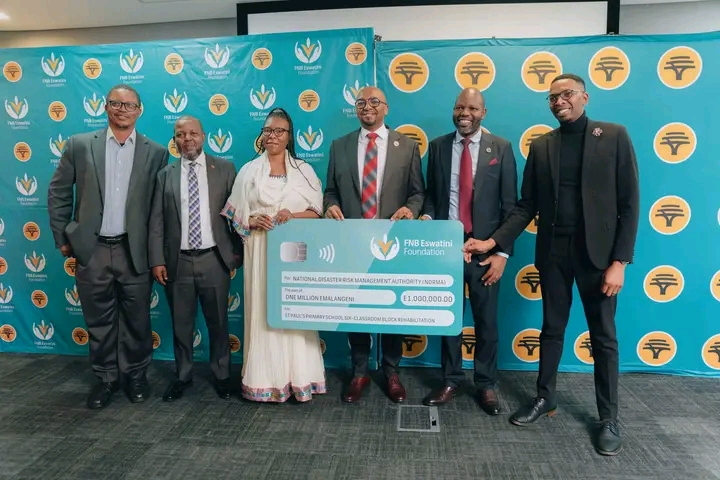
Against this backdrop, FNB Eswatini and the FNB Eswatini Foundation have committed E1 666 448 to seven organizations and 12 public schools, signaling that the bank views community investment as part of a broader economic growth strategy rather than a standalone corporate social responsibility exercise. Announced yesterday at the bank’s headquarters in Ezulwini by Chief Executive Officer Thokozani “TK” Dlamini, the sponsorship package spans education, disaster recovery, women-owned enterprises, youth employability, community health, sports development, and support for vulnerable learners.
Although the beneficiaries operate in different sectors, the underlying investment thesis is remarkably consistent. Stronger schools produce a more skilled workforce, resilient communities reduce economic disruption, thriving small businesses expand local commerce, and improved access to opportunity creates more financially active citizens. Together, these outcomes strengthen the ecosystem in which banks lend, businesses invest, and households accumulate wealth.

This represents an increasingly important shift in the role of corporate social investment within the financial sector. Rather than evaluating success solely by short-term visibility or charitable impact, banks are recognizing that long-term commercial growth depends on the health of the broader economy. Investments that improve education, expand entrepreneurship, and reduce social vulnerabilities ultimately create stronger customers, more sustainable enterprises, and deeper financial inclusion.
Education accounts for a significant share of the latest funding commitments. Support will help rebuild classrooms at St Paul’s Primary School, while additional resources will improve learning conditions across public schools and provide school shoes for underprivileged learners. Beyond addressing immediate educational needs, these interventions strengthen human capital by improving school attendance, learning outcomes, and the long-term quality of Eswatini’s future workforce.
Another strategic area receiving support is the promotion of science, technology, engineering, and mathematics (STEM) education among young women. As economies become increasingly digital, demand for technical and analytical skills continues to grow across financial services, manufacturing, and technology industries. Expanding female participation in STEM, therefore, represents an investment in workforce competitiveness and broadens economic opportunities for women in higher-value sectors.

The sponsorship program also targets women-owned small businesses operating in rural communities. Limited access to finance remains one of the most significant barriers facing female entrepreneurs across Africa. Supporting enterprise development alongside financial inclusion helps strengthen local supply chains, expand household incomes, and create businesses better positioned to access formal banking products and commercial finance in the future.
Youth employability remains another central pillar of the investment. By supporting programs that equip young people with market-relevant skills, the bank helps reduce structural unemployment while strengthening the pipeline of economically active citizens. Greater workforce participation not only benefits households but also expands the customer base for savings, credit, insurance, and other financial services that underpin economic development.
The funding further extends to disaster relief and community health initiatives, recognizing that economic resilience depends on more than business performance alone. Natural disasters and public health challenges often disrupt local economies, reduce household income, and weaken productivity. Investing in preparedness and recovery helps communities withstand economic shocks while reducing longer-term financial losses.

Sport and community development initiatives included in the sponsorship package similarly deliver wider economic value. Beyond promoting recreation, organized sport supports youth development, stimulates local economic activity through events, and strengthens community cohesion. These outcomes contribute to healthier and more productive communities capable of supporting broader economic participation.
The latest commitments also reinforce a long-term corporate social investment strategy that FNB Eswatini has steadily expanded in recent years. According to the bank’s 2025 Integrated Report, more than E3.8 million was invested in corporate social investment initiatives across entrepreneurship, education, healthcare, environmental sustainability and sport during the previous financial year. Separately, the FNB Eswatini Foundation distributed over E1.59 million towards projects supporting the knowledge economy, gender inclusion and humanitarian development. The Foundation’s funding model, which allocates up to one percent of the bank’s after-tax earnings to community investment, embeds social development within the institution’s broader governance and capital allocation framework.
The latest sponsorships also come as FNB Eswatini continues to expand its commercial footprint through branch development, SME Growth Forums, and entrepreneurship support initiatives. Viewed collectively, these investments suggest a business strategy that recognizes long-term profitability is closely linked to the strength of the economy in which the bank operates.
For Eswatini’s financial sector, the significance of the E1.67 million commitment extends well beyond corporate philanthropy. It reflects a growing recognition that sustainable banking requires sustained investment in the country’s productive capacity. By directing capital towards education, enterprise development and community resilience, FNB Eswatini is not simply funding social programs; it is investing in the future customers, entrepreneurs, employees and businesses that will shape the country’s next phase of economic growth.