






By: Nkosiyabusa Nsibande
Eswatini’s banking sector is lending more aggressively than it has in years, with private sector credit reaching a record E23.2 billion by the end of March 2026, a development that Central Bank Governor Dr Phil Mnisi says reflects growing confidence in the economy and a banking industry that is increasingly performing its core function of financing productive economic activity.
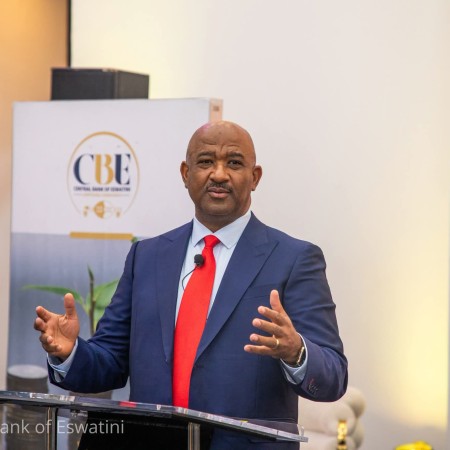
Addressing journalists during the Central Bank of Eswatini’s Annual Media Engagement at Sibebe Resort today, Dr Mnisi described the growth in lending as one of the clearest indicators of how the country’s financial sector has evolved over the past three years. The latest figures show that private sector credit expanded by 0.9 per cent between February and March, continuing an upward trend that has steadily gathered momentum since the post-pandemic recovery period.
For policymakers, the significance of the E23.2 billion figure extends beyond the banking sector itself. Credit growth is widely viewed as a measure of economic confidence because it reflects the willingness of banks to take risk and the willingness of businesses and households to borrow for investment, expansion and consumption. In Eswatini’s case, the latest numbers suggest that financial institutions are deploying a greater share of their deposits into the real economy rather than relying primarily on fee-based income streams.

Dr Mnisi noted that only a few years ago, credit extended to the private sector stood at approximately E15 billion. The fact that lending has now moved decisively beyond the E20 billion threshold, he argued, demonstrates a substantial strengthening of financial intermediation within the banking system. “Around 2023, we were sitting and actually stuck at credit to the private sector of about E15 billion. About two or three years later, we are now tripping over the E20 billion mark, which is very good,” he said
The composition of that growth is perhaps even more significant than the headline figure. Business borrowing has emerged as the principal driver of the expansion, with credit to firms rising by 2.6 per cent during the month to reach E12.7 billion. According to Central Bank data, lending growth was recorded across several productive sectors, including manufacturing, construction, tourism, agriculture and real estate, suggesting that investment activity remains relatively broad-based despite global economic uncertainty.
Manufacturing was among the strongest-performing sectors, reflecting continued investment in one of Eswatini’s most important sources of exports and employment. Construction activity also contributed to the increase, pointing to ongoing infrastructure development and private sector investment projects. The breadth of the lending growth indicates that businesses continue to seek financing for both expansion and operational requirements despite persistent concerns surrounding geopolitical tensions, supply chain disruptions and rising operating costs internationally.

The Governor stressed that the ultimate economic benefit of rising credit depends on how borrowed funds are utilised. “Hopefully that goes to stimulate growth and that lending is not going to consumption but going to capital formation and investment,” he told journalists. The distinction is important because credit directed towards productive investment typically generates a stronger long-term impact on economic growth, productivity and employment than borrowing used primarily for short-term consumption.
The latest lending figures also support a broader narrative emerging from recent Central Bank assessments of the economy. In his Monetary Policy Statement delivered earlier this year, Dr Mnisi reported that Eswatini’s economy expanded by 5.6 per cent in 2025, supported by resilient domestic activity despite an increasingly volatile global environment. The continued expansion of private sector credit suggests that businesses remain sufficiently confident to pursue growth opportunities even as external risks persist.
Equally important is the condition of the banking sector itself. While rapid credit growth can sometimes raise concerns about deteriorating loan quality, the Central Bank believes the sector remains stable. Dr Mnisi indicated that local banks continue to be adequately capitalised and that asset quality indicators have shown modest improvement. The non-performing loan ratio has eased, suggesting that while some credit risks remain, banks have generally managed to maintain control over problem loans. Similar observations have appeared in recent Central Bank assessments, which noted improvements in the quality of banks’ loan books and a declining non-performing loan ratio.
Against this backdrop, the Governor also addressed the ongoing intervention at Eswatini Bank, where the Central Bank has intensified supervisory support aimed at restoring long-term financial sustainability. The regulator’s intervention includes a structured transformation programme focused on strengthening the bank’s balance sheet, improving governance structures and enhancing risk management systems. According to Dr Mnisi, the initiative should be viewed as a proactive effort to preserve a strategically important development finance institution rather than a sign of systemic weakness within the broader banking sector.
“This programme is designed to strengthen Eswatini Bank’s balance sheet, enhance corporate governance, reinforce risk management frameworks and improve overall operational resilience with the ultimate objective of restoring financial stability and positioning the bank for sustainable long-term growth,” he said.
The Governor disclosed that an experienced consultant supported by a specialised technical team is already working with the institution to implement turnaround measures. “The consultant is already on-site and commenced this assignment. We are working closely with him to implement key turnaround measures, strengthen governance and operational effectiveness, and restore Eswatini Bank to financial sustainability and long-term viability,” he said.
For the broader economy, however, the central message from Friday’s engagement was that the flow of credit into businesses continues to strengthen. At a time when governments across the region face fiscal constraints and limited room for public-sector-led expansion, the ability of banks to mobilise savings and channel them into productive investment becomes increasingly important.
The record E23.2 billion in private sector credit therefore represents more than a banking milestone. It is an indication that financial institutions are playing a larger role in funding economic activity and that businesses continue to seek capital for growth. Whether that momentum translates into higher investment, stronger productivity and sustainable job creation will ultimately determine the long-term significance of the country’s latest credit record. For now, the figures provide one of the clearest signals yet that financial intermediation is deepening and that the banking sector is becoming a more active participant in Eswatini’s growth story.