





By: Nkosiyabusa Nsibande
The Eswatini Revenue Service (ERS) has taken a significant step in its digital transformation agenda by formalizing a partnership with the University of Eswatini (UNESWA) aimed at building artificial intelligence (AI) capabilities within the country’s revenue administration system.
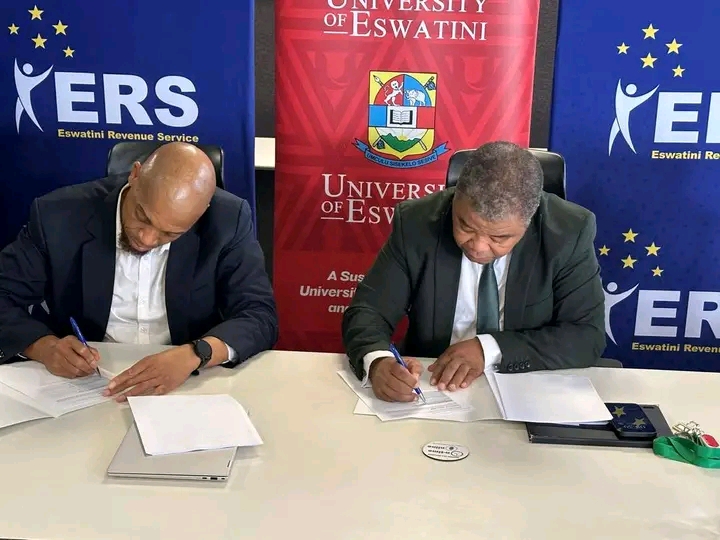
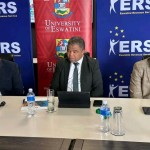
The Memorandum of Understanding, signed at ERS headquarters in Ezulwini on Thursday, establishes a framework for collaboration between the two institutions and launches an AI Literacy Programme that will train ERS employees to operate effectively in an increasingly data-driven tax environment.
While the agreement centers on AI training, both institutions presented it as a broader strategic partnership designed to strengthen public-sector innovation, evidence-based policymaking, and workforce readiness for emerging technologies.
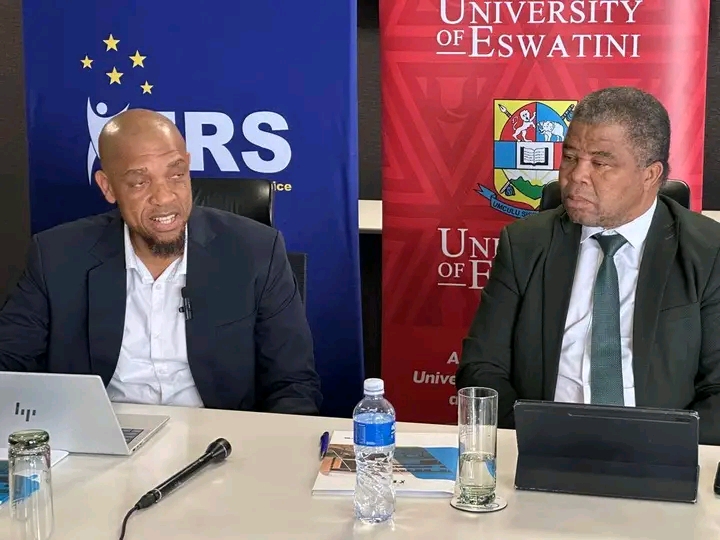
Speaking at the signing ceremony, UNESWA Vice Chancellor Professor Justice Thwala said the partnership reflects a deliberate effort to ensure that Eswatini’s adoption of artificial intelligence is guided by skilled professionals and responsible governance.
“The agreement we are about to sign is more than a contract for the supply of training,” he said. “It is a deliberate step by two national institutions to ensure that Eswatini’s entry into the age of artificial intelligence is informed, responsible, and grounded in capable people.”
The initiative comes as organizations worldwide grapple with the opportunities and risks presented by generative AI technologies. According to Professor Thwala, the UNESWA AI Academy was established in 2024 after growing demand from professionals, institutions, and communities seeking a deeper understanding of AI and its practical applications.
Since its establishment, the academy has developed specialized programs for educators, legal practitioners, and professionals across various sectors. However, Professor Thwala noted that experience had shown that generic AI training often falls short of meeting the operational requirements of specialized organizations.“A tax officer who handles confidential taxpayer records works under obligations that are not the same as those of a teacher preparing lesson plans,” he said. “A customs officer assessing risk on imported goods needs different tools and judgement than a lawyer reviewing a contract. General AI training cannot fully address these differences because the differences are not at the surface of the work. They are at its core.”
The customized program being developed for ERS will therefore focus on the practical realities of revenue administration, including AI fundamentals, prompt engineering, legal compliance, ethical use of AI, workflow automation, and governance controls.
The partnership aligns closely with ERS’s ongoing modernization strategy, which seeks to shift the organization from traditional, paper-based processes towards a more digital and data-driven operating model.
Professor Thwala described the transition as essential for improving efficiency, taxpayer service, and risk management, noting that “a data-driven revenue authority can serve taxpayers better, collect revenue more fairly, identify risks earlier, and operate more efficiently.” However, he cautioned that digital transformation efforts often fail when technology adoption outpaces workforce development.
“The risk is that the technology moves faster than the people,” he said. “Systems are upgraded. Platforms are deployed. Dashboards are built. And somewhere in the middle of all this, the staff who do the actual work of revenue administration are left behind.” He further warned that organizations pursuing AI adoption without adequate governance structures risk undermining public trust and exposing themselves to operational and legal challenges.
“For a revenue authority, where confidentiality and public confidence are everything, this is a risk that cannot be taken lightly,” he said, referring to the dangers of deploying AI without proper safeguards for taxpayer information and oversight mechanisms. ERS Commissioner General Brightwell Nkambule positioned the agreement as an investment in both institutional capability and national development.
“For the ERS, this event also marks the launch of our AI Literacy Programme,” Nkambule said. “With the AI Literacy Programme, we equip our staff with the knowledge and skills required to thrive in the age of artificial intelligence.”He emphasized that the partnership extends beyond employee training and could create opportunities for collaborative research, behavioral studies, policy analysis, and technology development that support improved tax administration. At the center of ERS’s strategy is its pursuit of voluntary tax compliance, which the Commissioner General argued requires a deeper understanding of taxpayer behavior and service needs.
“The answers to these questions cannot be based on assumptions,” he said while discussing compliance challenges. “They must be informed by evidence, research, and data.” Through the partnership, ERS expects university researchers and students to contribute insights that could shape taxpayer education programmes, service delivery models and compliance strategies. The collaboration also reflects a growing recognition that universities can play a more direct role in addressing national economic challenges by translating academic expertise into practical solutions.
Nkambule pointed to examples in other African countries where revenue authorities have partnered with universities to develop technology and innovation solutions tailored to local conditions. Similar collaborations, he argued, could help Eswatini strengthen its tax administration capabilities while reducing dependence on imported solutions.
The AI Literacy Programme forms part of a broader vision for ERS’s digital future. Nkambule revealed that the organization’s transformation journey is evolving beyond simple automation towards more advanced AI-enabled operations.
“At ERS, our digital transformation journey is evolving from automated processes to autonomous processes,” he said. “We envision a future where intelligent systems and AI agents perform routine and repetitive work, enabling our employees to focus on higher-value activities such as taxpayer education, customer service, compliance management, innovation, and strategic decision-making.”
Despite the technological ambition, both leaders stressed that people remain central to the transformation process. Nkambule underscored this point when he stated that “technology alone does not create value. People create value,” adding that AI literacy is a necessary foundation before more advanced AI systems can be successfully deployed.
Looking ahead, the two institutions envisage expanding their collaboration into areas such as data analytics, financial crime investigations, forensic accounting, tax intelligence, and regulatory compliance. Professor Thwala also encouraged ERS to consider scholarships and sponsorship programmes that would support talented students facing financial barriers to higher education.
For Eswatini’s public sector, the partnership offers a glimpse into how institutions may combine academic expertise, digital innovation, and workforce development to improve operational efficiency and service delivery. More broadly, it reflects an emerging understanding that the economic value of artificial intelligence will depend not only on access to technology but also on the ability of organizations to develop the skills, governance frameworks, and human capital needed to use it effectively.
As Nkambule concluded, the agreement represents “an investment in collaboration, an investment in knowledge, an investment in innovation, and, an investment in the Kingdom’s future of Eswatini.”

Other Articles
⚠️ Public Warning – Coin Purchase Scam Hits Eswatini