





A Steady Hand in Uncertain Times
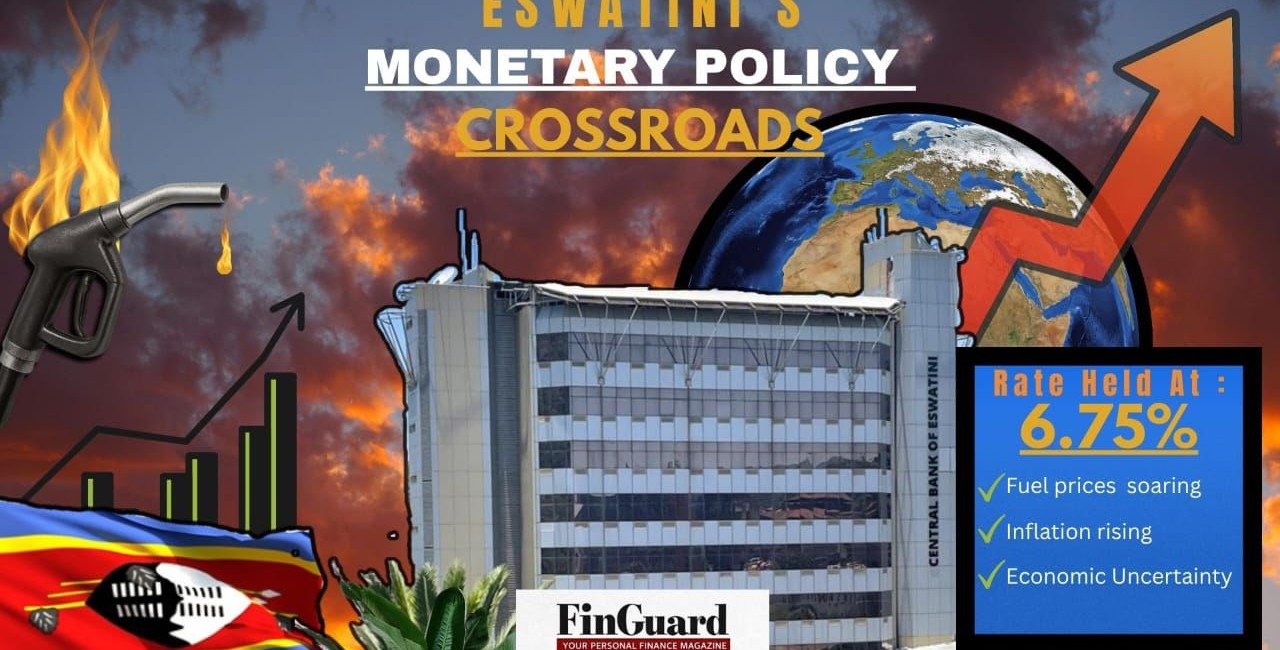
The Central Bank of Eswatini (CBE) has left its policy rate unchanged at 6.75 percent, following its latest monetary policy decision announced by Governor Dr. Phil Mnisi. For consumers, this means borrowing costs remain stable ,no increase, no reduction-keeping loan repayments and credit conditions steady amid global uncertainty.
This decision comes as households and businesses face pressure from rising fuel prices, tariff adjustments, and broader cost‑of‑living increases. By maintaining the rate, the Bank signals a cautious stance aimed at supporting price stability while assessing inflation trends, economic activity, and regional monetary conditions within the Common Monetary Area.

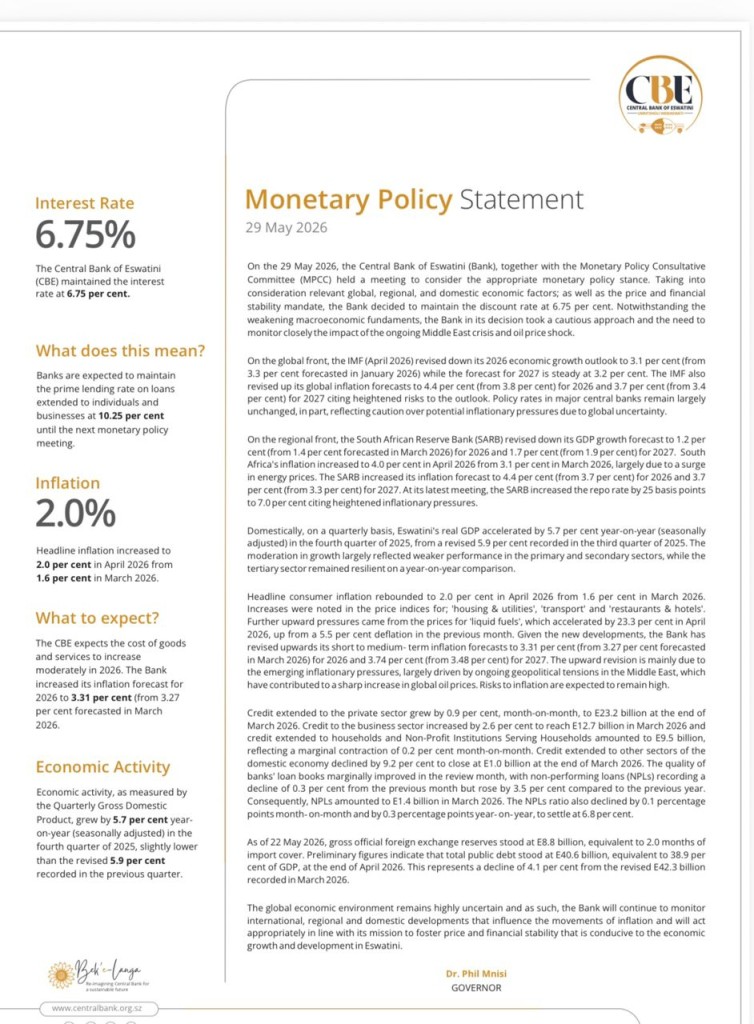
Monetary Policy Statement-22 May 2026
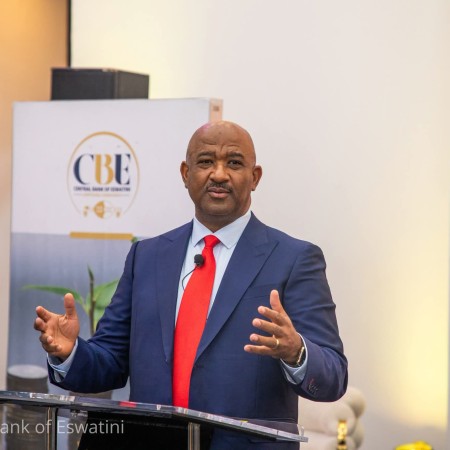
Governor Dr. Phil Mnisi delivered the Monetary Policy Statement with clarity and resolve:
“The Bank convened to deliberate on policy measures, taking into account global, regional, and domestic economic conditions as well as price and financial stability. The mandate maintained the discount rate at 6.75%, reflecting a cautious approach and the need to assess how the ongoing Middle East crisis and an oil price shock will affect the domestic economy and for how long.”
On the global front, the IMF has revised growth downward, citing heightened uncertainty largely driven by geopolitical tensions. In particular, the ongoing war in the Middle East is anticipated to weigh heavily on global economic activity, disrupting trade flows and fueling inflationary pressures. Inflation is slowly picking up, driven by surging oil and gas prices, with second‑round effects expected to exert further upward pressure.
Domestically, interest rates remain broadly steady, though banks are applying a more questioning stance given global uncertainties. Annual headline consumer inflation rebounded to 2.0% in April, up from 1.6% in March, driven mainly by housing, utilities, and transport. The bank revised its short‑ to medium‑term inflation forecast to 3.31% (from 3.27% in March), primarily due to ongoing geopolitical tensions.
Credit extended to the private sector increased by 0.9% month‑on‑month, reaching E23.2 billion in March 2026. Non‑performing loans declined by 0.3% month‑on‑month, closing at E1.4 billion, representing an NPL ratio of 6.8%. Gross official reserves stood at E8.8 billion, equivalent to two months of import cover. Total public debt was recorded at E40.6 billion, representing 38.9% of GDP.
Dr. Mnisi concluded:
“The direction of monetary policy will continue to be guided by the assessment of risks and uncertainties in the international, regional, and domestic economy. Stability today does not mean comfort tomorrow—vigilance is our compass.”
Oil Shocks and Inflationary Pressures
Fuel prices surged by 23.3% in April 2026, reversing a deflationary trend from March. This sharp increase, driven by Middle East tensions and global oil volatility, is already filtering into housing, transport, and hospitality costs. Headline inflation rose to 2.0%, with forecasts revised upward to 3.31% for 2026 and 3.74% for 2027.
The bank warns that risks remain high, as oil shocks continue to ripple through the economy, a reminder that global events can quickly reach Eswatini’s doorstep.
Growth and Resilience
Despite inflationary pressures, Eswatini’s economy remains resilient. GDP grew 5.7% year‑on‑year in Q4 2025, driven largely by the services sector. Agriculture and industry slowed, but the tertiary sector-retail, transport, and communication,continues to anchor growth.
Private sector credit expanded to E23.2 billion, with businesses borrowing more while households tightened spending. Non‑performing loans declined slightly to 6.8%, showing cautious improvement in loan quality.
Regional and Global Context
Globally, the IMF revised 2026 growth down to 3.1%, while raising inflation forecasts to 4.4%. Regionally, the South African Reserve Bank increased its repo rate to 7.0% after inflation rose to 4.0%. These developments influence Eswatini, reinforcing the need for prudence and stability.
What This Means for Eswatini
• Households: Expect higher living expenses, especially fuel and utilities.
• Entrepreneurs: Brace for tighter margins; innovate and cut inefficiencies.
• Government: Maintain fiscal discipline and safeguard reserves.
• Nation: Stability is fragile but achievable with vigilance and resilience
The Central Bank’s decision to hold the policy rate at 6.75% reflects a balance between caution and confidence. It acknowledges the strain of rising costs while safeguarding the economy against deeper shocks.
Eswatini stands at a crossroads, facing global turbulence yet guided by steady leadership and prudent policy. The message is clear: stability demands vigilance, and resilience remains the nation’s strongest currency.