







By: Nkosiyabusa Nsibande
A capital investment estimated at between E15 million and E16 million is reshaping the future of one of Eswatini’s locally owned poultry enterprises, highlighting the growing role of domestic agribusinesses in advancing industrial development, food security, and private sector-led economic growth. The expansion by Aron’s Farms Produce represents more than an increase in production capacity; it reflects a broader shift towards commercial agriculture driven by local entrepreneurs willing to invest in modern technology and scalable business models.
Speaking during an official site visit to the company’s new production facility in Nokwane on Monday, the Minister of Commerce, Industry, and Trade, Hon. Manqoba Khumalo, described the investment as an example of the kind of enterprise the government wants to see replicated across the country. He said supporting businesses capable of expanding production, embracing technology, and creating employment remains central to the Ministry’s industrialization agenda.
“As the Ministry of Commerce, Industry, and Trade, our core mandate is to foster an environment where local businesses thrive, where industrial innovation is realized, and where emaSwati take centre stage in driving our national economy. Today, visiting Aron’s Farms Produce, I am looking at the literal embodiment of that vision,” Khumalo said.

The Minister traced the company’s growth over the past 26 years, presenting it as a case study in entrepreneurial development rather than rapid expansion driven by external capital. Founded in 2000, the business emerged after its proprietor gained practical experience distributing poultry products across Eswatini before identifying an opportunity to participate directly in local production.
Starting with a modest flock of 7,500 chickens, the business steadily expanded its infrastructure until production capacity reached 40,000 birds. As the domestic poultry market opened further to local participation, the company secured a 4% equity stake within the supply network, strengthening its commercial position while creating a platform for future expansion.
Further investment later increased production by another 20,000 chickens, raising total capacity to 60,000 birds while also increasing the company’s equity participation by an additional 2%. According to Khumalo, continued market growth after 2018 ultimately necessitated the construction of the new Nokwane facility, signaling the company’s transition from a growing family enterprise into a significant commercial producer.
Beyond the financial value of the expansion, the Minister placed significant emphasis on the operational efficiencies delivered through modern poultry production technology. He noted that the new facility incorporates advanced biosecurity and environmental management systems designed to minimize disease risks while increasing production efficiency.
The technology allows Aron’s Farms Produce to safely rear 22 chickens per square meter, compared to approximately 17 birds per square meter under conventional poultry housing systems. The productivity improvement effectively enables higher output without proportionally increasing production space, strengthening the company’s competitiveness through improved asset utilization. “This plant does not just comply with industry standards; it exceeds them,” the Minister said.
He added that modern agricultural investments of this nature would become increasingly important as Eswatini seeks to strengthen domestic food production while improving the competitiveness of locally owned businesses. “This is the exact kind of agricultural modernization and efficiency our kingdom needs to ensure national food security and compete globally,” Khumalo said.
From a financial perspective, the Nokwane development demonstrates how incremental reinvestment can gradually transform a small enterprise into a sizeable commercial operation. Rather than relying on rapid expansion, the company has consistently increased production capacity in line with market demand while strengthening its ownership position within the poultry value chain.
The planned next phase is even more ambitious. Management intends to increase production capacity to 120,000 chickens, effectively doubling current output. The expansion strategy also incorporates waste recycling systems that will convert poultry waste into organic agricultural inputs, creating additional commercial opportunities while reducing environmental costs.
The planned diversification reflects a growing trend among agricultural businesses to extract greater value from existing production systems through circular economy practices, reducing waste while creating supplementary revenue streams. While automation and technology have improved operational efficiency, the Minister noted that the company’s expansion has also translated into increased employment opportunities within the surrounding community. Operations that initially relied on three permanent employees supported by six part-time workers during busy production periods have now expanded to six permanent employees and six part-time workers. Although the workforce remains relatively modest, the increase reflects sustainable employment growth aligned with the scale of the business rather than labour expansion disconnected from productivity gains.
For rural economies, where commercial agricultural employment remains limited, such enterprises contribute to household incomes while supporting secondary economic activity through procurement, transport, and supplier relationships.
Khumalo also highlighted the company’s corporate social investment initiatives, arguing that successful businesses should contribute to broader community development alongside commercial performance. Among the projects undertaken by Aron’s Farms Produce are contributions towards church construction in Ngonini, sponsorship of a local football team, rehabilitation of community roads using the company’s own heavy machinery in partnership with Micro Projects, and payment of school fees for vulnerable children within the Nhlambeni community.
Although these initiatives fall outside the company’s core operations, they demonstrate how locally owned businesses increasingly integrate community investment into their long-term business strategy, strengthening relationships with surrounding communities while contributing to local development.
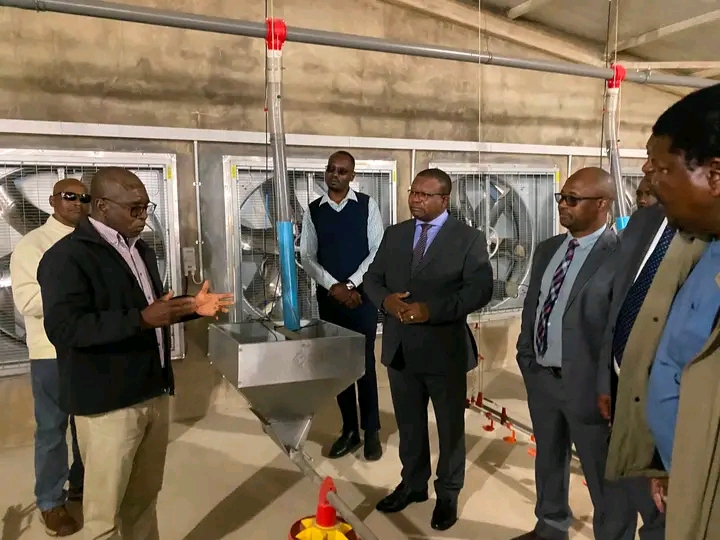
The site visit also carried an important policy message regarding the government’s approach to domestic enterprise development. Rather than focusing exclusively on attracting foreign investment, the ministry signaled its intention to continue supporting established local businesses capable of expanding productive capacity and creating value within Eswatini. Addressing the company’s management and employees, Khumalo reaffirmed the government’s commitment to creating an enabling environment for locally owned enterprises.
“To the management and staff of Aron’s Farms Produce, I want to assure you that the Ministry of Commerce, Industry, and Trade stands fully behind you. We will continue to protect, support, and foster policies that enable local trailblazers like you to expand your wings even further.” He concluded by describing the company as evidence that domestic businesses can compete successfully through sustained investment, innovation, and long-term planning.
“You are proof that Eswatini can produce, Eswatini can innovate, and Eswatini can lead,” the Minister said.