






By: Nkosiyabusa Nsibande
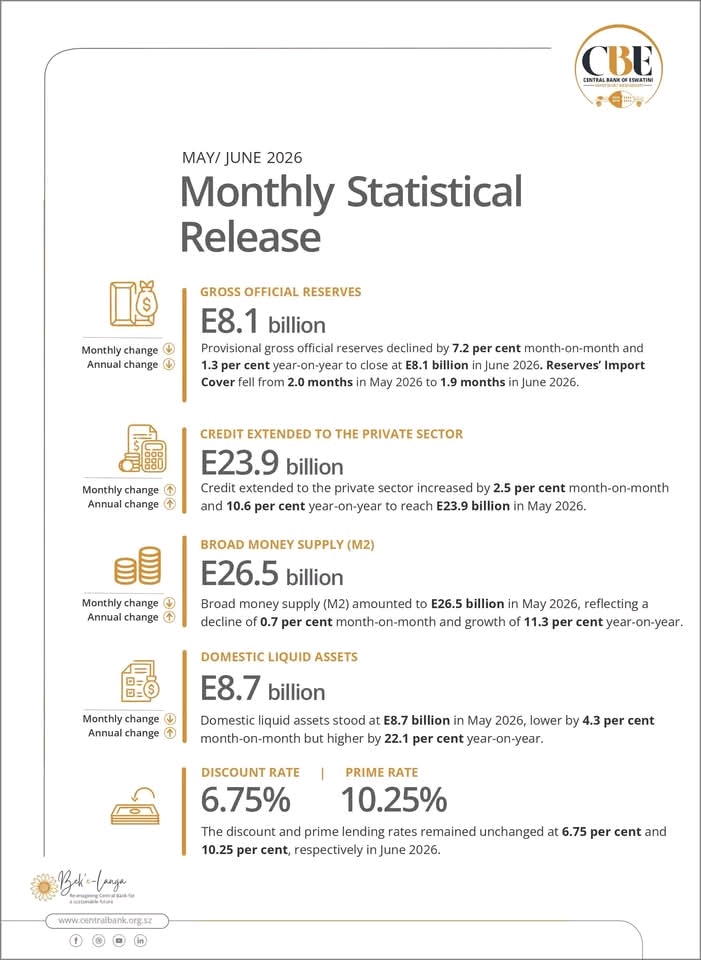
While headlines often focus on interest rates or inflation, the most significant message emerging from the Central Bank of Eswatini’s Monthly Statistical Release for May and June 2026 is that the country’s banking sector continues to finance economic activity at an accelerating pace. Private sector credit reached E23.9 billion, representing annual growth of 10.6 percent, with lending increasing across productive industries and households despite signs of tightening external liquidity.
For businesses, this is an important indicator because bank lending is one of the clearest measures of confidence within an economy. Financial institutions extend more credit when they believe businesses will remain profitable and borrowers are capable of servicing their obligations. Likewise, companies borrow when they expect future demand to justify investment in expansion, equipment, inventory, and working capital. The latest figures therefore suggest that, despite global uncertainty and domestic economic challenges, investment activity within the private sector continues to gather momentum.
Corporate lending climbed to E13.2 billion, reflecting annual growth of 9.8 percent, with some of the strongest gains recorded in sectors directly linked to production and economic output. Lending to agriculture and forestry expanded by 12.9 percent, construction increased by 11.4 percent, and distribution and tourism recorded growth of 6.9 percent. These sectors are among the country’s largest employers and contribute significantly to domestic economic activity, making their improved access to finance a positive signal for overall economic performance.

The composition of business lending also provides an interesting picture of the country’s corporate landscape. Large enterprises accounted for 68.5 percent of total business credit after borrowing increased to approximately E9.0 billion, growing 9.0 percent over the year. Small and medium-sized enterprises experienced a mixed performance, with monthly borrowing declining by 4.7 percent, although annual credit still expanded by 11.6 percent. This suggests that while SMEs remain an important source of credit demand, larger corporations continue to dominate formal bank financing, reflecting their stronger balance sheets and easier access to commercial lending.
Household borrowing also continued to strengthen, rising to E9.8 billion, an annual increase of 14.4 percent. Much of this expansion was driven by unsecured personal loans, which climbed to E4.1 billion, alongside increases in housing finance and vehicle loans. While stronger household borrowing supports consumer spending and economic growth, it also requires careful monitoring. Excessive dependence on unsecured lending can increase financial vulnerability if income growth fails to keep pace with debt obligations. For retailers, property developers, and motor vehicle dealers, however, the continued expansion of household credit provides support for consumer demand across several sectors of the economy.
Not every monetary indicator pointed towards stronger financial conditions. Broad money supply, commonly referred to as M2, declined 0.7 percent during May to E26.5 billion, although it remained 11.3 percent higher than a year earlier. The monthly decline reflected lower demand deposits, savings deposits, and time deposits, suggesting that businesses and households drew down some of their cash balances during the month. Although liquidity within the economy remains substantially above last year’s level, the moderation in money supply indicates that financial conditions have become less accommodative than earlier in the year.
Liquidity within the banking system followed a similar pattern. Domestic liquid assets declined by 4.3 percent during May to E8.7 billion, while the banking sector’s liquidity ratio fell from 34.5 percent to 33.0 percent. Even so, liquidity remains 22.1 percent higher than a year ago, suggesting that commercial banks continue to maintain comfortable funding positions capable of supporting further lending activity. From a financial stability perspective, the banking sector remains well capitalized and continues to hold liquidity comfortably above regulatory requirements.
The greatest concern emerging from the report lies outside the domestic banking system. Eswatini’s gross official reserves declined from E8.7 billion in May to E8.1 billion in June, representing a monthly fall of 7.2 percent. Import cover also declined from 2.0 months to 1.9 months, reflecting reduced foreign currency buffers following government fiscal payments and foreign exchange transactions with local banks.
Foreign exchange reserves perform a critical role in protecting economies against external shocks. They support the country’s ability to finance imports, stabilize the exchange rate, and maintain investor confidence. Although the recent decline does not immediately threaten macroeconomic stability, the movement reinforces the importance of rebuilding reserve buffers as global financial markets remain volatile. Investors and international lenders often view reserve adequacy as an important indicator of a country’s financial resilience.
Interest rate conditions remained unchanged during the review period, with the Central Bank maintaining the discount rate at 6.75 percent, while commercial banks’ prime lending rate remained at 10.25 percent. Stable borrowing costs provide businesses with greater certainty when planning investment decisions and help preserve the momentum currently evident in private sector lending.
Taken together, the latest monetary statistics portray an economy that continues to generate domestic credit growth despite increasing pressure on external balances. Businesses are investing, households continue to spend, and banks remain willing to lend. However, declining foreign reserves serve as a reminder that sustaining this momentum will require stronger export performance, prudent fiscal management, and continued confidence in the financial system.
For corporate executives, investors, and entrepreneurs, the report offers a balanced message. Domestic economic activity continues to strengthen through expanding access to finance, particularly within productive sectors of the economy. The weakening external reserve position highlights the importance of monitoring global risks and maintaining policies that preserve macroeconomic stability. The challenge for Eswatini will ensure that today’s strong credit growth translates into higher productivity, greater export competitiveness, and sustainable long-term economic expansion rather than increased financial vulnerability.