





By: Nkosiyabusa Nsibande
Eswatini’s trade surplus narrowed dramatically in May 2026 as imports surged ahead of exports, a development that may initially appear concerning but also reflects improving domestic demand and increased economic activity across key sectors of the economy.
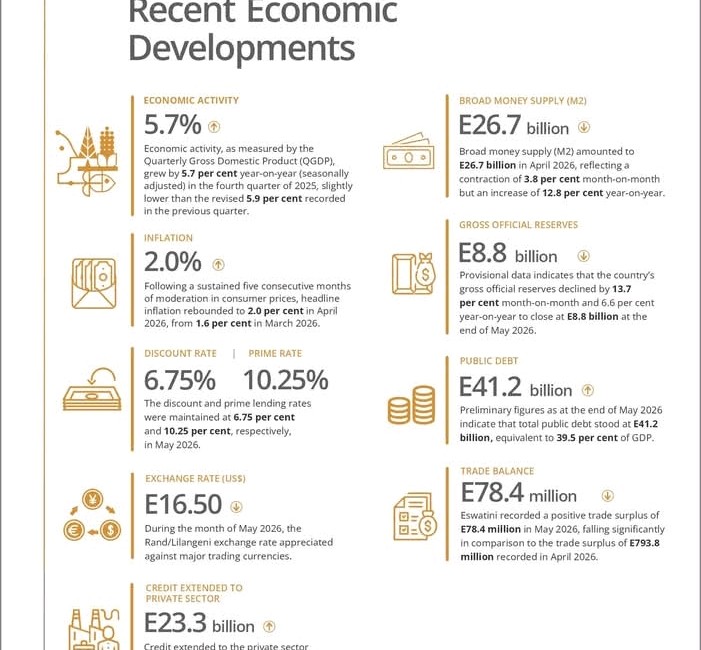
According to the Central Bank of Eswatini’s latest economic report, the country recorded a trade surplus of E78.4 million in May, a sharp decline from the E793.8 million surplus registered in April. The reduction was driven primarily by a substantial increase in imports combined with a modest decline in exports.
Monthly Trade Position
MonthTrade Surplus
April 2026 E793.8 million
May 2026 E78.4 million
Trade Balance Trend
April 2026 ██████████████████████████████ E793.8m
May 2026 ███ E78.4m
Imports rose by 21.9 percent month-on-month to E3.5 billion during May, largely reflecting increased purchases of food products and textile inputs. Exports, meanwhile, declined by 2.3 percent to E3.6 billion as sugar exports weakened during the period under review.
Viewed in isolation, the shrinking surplus may suggest weakening trade performance. However, a closer examination of the underlying figures reveals a more nuanced picture. Import growth is often associated with rising domestic consumption, business investment, and industrial activity, particularly when firms import raw materials and intermediate goods required for production.
The annual trends are especially revealing. Despite the monthly decline, exports were 19.2 percent higher than a year earlier. Growth was supported by stronger exports of soft drink concentrates and textiles, two sectors that continue to play an important role in Eswatini’s manufacturing and export landscape. Imports increased by a much more modest 3.0 percent year-on-year, indicating that the sharp monthly increase in May may reflect temporary factors rather than a structural deterioration in the country’s trade position.
Perhaps the strongest evidence of underlying external sector resilience comes from cumulative trade performance. During the first five months of 2026, Eswatini recorded a cumulative trade surplus of E2.0 billion, representing a 33.1 percent increase from the E1.5 billion surplus recorded during the same period in 2025.
January–May Trade Performance
Indicator 2025 -2026
Trade Surplus E1.5 billion – E2.0 billion
Export Growth—+2.9%
Import Growth—-0.The year-to-date figures show exports reaching E17.3 billion, 2.9 percent higher than the previous year, while imports totalled E15.3 billion, marginally lower than the corresponding period of 2025. This indicates that the country’s external trade position remains stronger than it was a year ago despite the weaker monthly result.
Trade patterns also continue to demonstrate Eswatini’s deep economic integration with South Africa. During May, South Africa accounted for 72.0 percent of Eswatini’s exports and 70.8 percent of imports, reinforcing the country’s reliance on regional trade relationships and supply chains.
Currency movements provided additional support for external sector stability. During May, the Rand/Lilangeni appreciated against the US Dollar, Pound Sterling and Euro. The exchange rate strengthened from an average of E16.54 per US Dollar in April to E16.50 in May.
The appreciation was supported by favorable global prices for precious metals, particularly gold and platinum group metals, which continued to underpin investor sentiment toward the Rand. Improved perceptions of South Africa’s economic outlook also contributed after Moody’s revised the country’s outlook to positive while maintaining its Ba2 credit rating.
While the narrower trade surplus highlights ongoing vulnerabilities within the external sector, the broader data suggest that Eswatini’s trade performance remains fundamentally healthy. Export earnings continue to benefit from manufacturing activity, cumulative trade balances remain positive and import growth appears linked to strengthening domestic demand rather than excessive consumer dependence.
For businesses, the figures point to an economy where domestic activity is gaining momentum even as external conditions remain challenging. The key question for the remainder of 2026 will be whether exporters can sustain recent gains in manufacturing and value-added production while managing the effects of fluctuating commodity markets, regional demand patterns, and global supply chain pressures.
If current trends continue, the country may see a gradual shift from trade surpluses driven primarily by restrained imports toward a more balanced model supported by stronger domestic investment and expanding industrial output.