




By: Nkosiyabusa Nsibande
Eswatini’s inflation rate accelerated for the first time in several months during May, signaling that while overall price pressures remain relatively subdued, important shifts are occurring beneath the surface of the economy that could shape consumer spending patterns, business costs, and policy decisions over the remainder of the year.
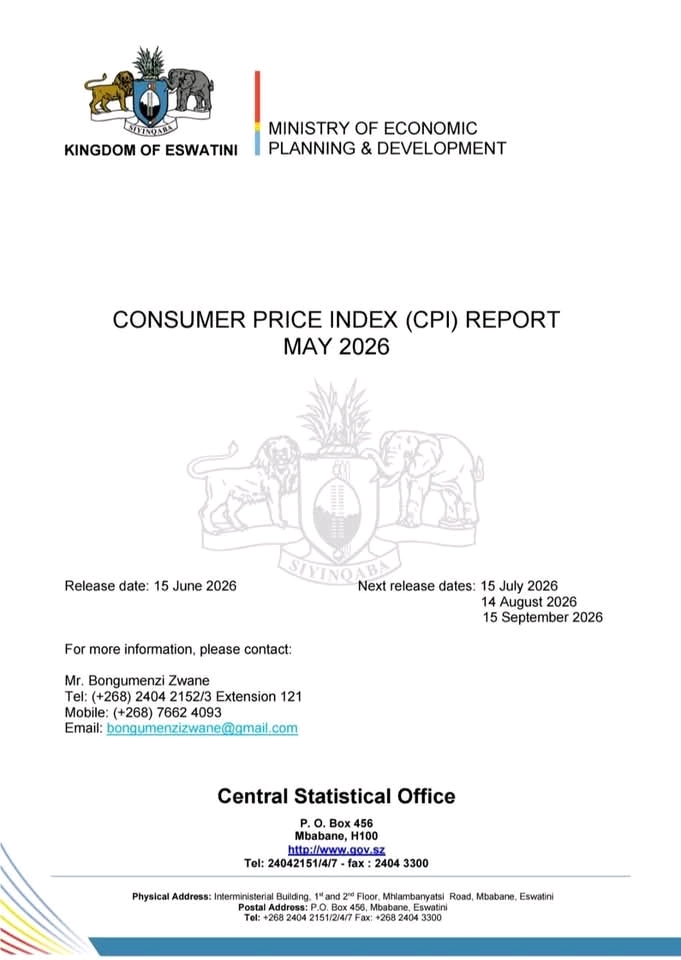
The latest Consumer Price Index report released by the Central Statistical Office shows that annual inflation rose to 2.7 percent in May 2026 from 2.0 percent in April. Although the increase represents a notable acceleration, the figure remains below the 3.2 percent recorded during the corresponding month last year and significantly lower than the inflation levels that characterized much of the post-pandemic period. The country’s inflation environment therefore remains comparatively stable, but the composition of inflation is changing in ways that warrant closer attention. A closer examination of the data reveals an economy where declining food prices are helping to shield consumers from broader cost pressures emerging in housing, utilities, transport, and other administered sectors.
Food and non-alcoholic beverages, which account for more than one-fifth of the consumer basket, recorded annual deflation of 1.8 percent in May. This represents a sharp reversal from the 3.2 percent inflation recorded in the category a year earlier. Particularly significant were declines in bread and cereal prices, which fell by 5.4 percent year-on-year, while oils and fats declined by 1.7 percent. Vegetables also remained in negative territory, falling 1.1 percent compared with the same period last year.
For households, especially lower-income consumers who allocate a substantial portion of their income to food purchases, the decline offers important relief against rising costs elsewhere in the economy. Food inflation has historically been one of the most visible drivers of household financial stress, and its current moderation is helping contain the overall inflation rate.
Yet while consumers are benefiting at grocery stores, they are increasingly encountering higher costs in sectors that are more difficult to avoid or substitute. Housing, water, electricity, gas and other fuels emerged as the largest contributor to inflation during May, accounting for 1.9 percentage points of the overall 2.7 percent headline inflation rate. The category recorded annual inflation of 6.6 percent, making it one of the fastest-rising components of the consumer basket.
The data show that energy-related costs are becoming a particularly significant source of pressure. Electricity prices increased by 15.1 percent compared with May last year, while liquid fuels surged by 48.2 percent. Actual rental costs also rose by 3.3 percent, adding further pressure on household budgets.
The significance of these increases extends beyond consumers. Housing and utility costs form an important component of business operating expenses. Rising electricity costs, in particular, can affect manufacturers, retailers, hospitality operators, and service providers, potentially feeding through into future prices if firms attempt to recover higher operating costs.
Transport costs are emerging as a second major inflation driver. Annual transport inflation reached 4.0 percent during May, with fuel costs for personal transport increasing by 23.2 percent. The operation of personal transport equipment recorded inflation of 14.4 percent, while air passenger transport prices rose by 20.8 percent year-on-year.
Transport inflation carries broader economic implications because of its ability to influence costs across multiple sectors. Rising fuel and logistics expenses can increase distribution costs for retailers, raise production costs for manufacturers and reduce disposable income available for other household spending.
The contrast between falling food prices and rising transport and utility costs suggests consumers are not experiencing uniform relief despite the relatively low headline inflation figure. Many households may continue to feel financially constrained because expenditure categories that are difficult to reduce, such as electricity, transport, and housing, are rising faster than overall inflation. Another important development emerging from the report is the growing gap between administered prices and market-driven prices.
The CPI for administered prices increased by 8.6 percent during May, substantially higher than the overall inflation rate of 2.7 percent. In contrast, non-administered prices rose by only 1.1 percent. This divergence is significant because administered prices often include costs influenced by regulatory decisions, public utilities, and other controlled services. The trend suggests that a growing share of inflation is originating from regulated sectors rather than broad-based demand pressures within the economy.
From a policy perspective, this distinction matters. Inflation driven by administered prices requires different responses from inflation caused by excessive consumer demand. While monetary policy tools are generally effective at moderating demand-driven inflation, they have less influence over regulated price adjustments and utility tariff increases. The analytical measures within the report reinforce the view that underlying inflation remains relatively contained despite the rise in headline inflation.
When food and non-alcoholic beverages are excluded, inflation rises to 4.0 percent, highlighting the extent to which declining food prices are suppressing the overall inflation figure. However, inflation excluding housing and utilities drops to only 1.5 percent, demonstrating that a substantial portion of current inflationary pressure is concentrated within housing-related categories. Similarly, inflation excluding energy stands at 1.9 percent, suggesting that energy costs are exerting a disproportionate influence on current price trends.
The distinction between goods and services inflation provides further insight into evolving price dynamics. Goods inflation accelerated to 3.2 percent while services inflation remained relatively subdued at 1.9 percent. This pattern indicates that cost pressures are still more evident in physical products and commodities than in labor-intensive service sectors.
From a broader macroeconomic perspective, the latest figures present a favorable inflation environment compared with recent years. Annual inflation averaged 5.0 percent in 2023 and 4.0 percent in 2024 before slowing to 3.1 percent in 2025. Despite the May increase, inflation remains well below those levels, suggesting that overall price stability has improved considerably.
However, the latest data also indicates that inflation risks have not disappeared. The rise from 1.6 percent in March to 2.7 percent in May represents a noticeable shift in momentum. If fuel, energy, and administered price increases continue to accelerate, they could eventually spill over into broader consumer prices.
For businesses, the current environment presents a mixed picture. Lower food inflation and moderate consumer price growth help support purchasing power and consumer demand. Rising energy, transport, and utility costs threaten profit margins and could place pressure on operating budgets across multiple industries.
For policymakers, the report offers evidence that inflation remains under control but also highlights the need to monitor cost pressures originating from utilities, energy markets, and regulated sectors. Concentrating inflation within these categories suggests that future inflation trends may be shaped less by consumer demand and more by developments in energy pricing and administered cost structures.
The May inflation figures therefore tell a more nuanced story than the headline number suggests. While consumers are benefiting from falling food prices and historically moderate inflation, the economy is simultaneously experiencing a steady build-up of cost pressures in housing, utilities, and transport. Whether those pressures remain isolated or spread more broadly across the economy will likely determine the direction of inflation during the second half of 2026.