




By: Nkosiyabusa Nsibande
Eswatini’s strategy to recover from the economic damage caused by the 2025 Foot-and-Mouth Disease (FMD) outbreak is increasingly centred on restoring investor confidence in the livestock industry and reopening premium export markets that once generated valuable foreign exchange earnings for the country.
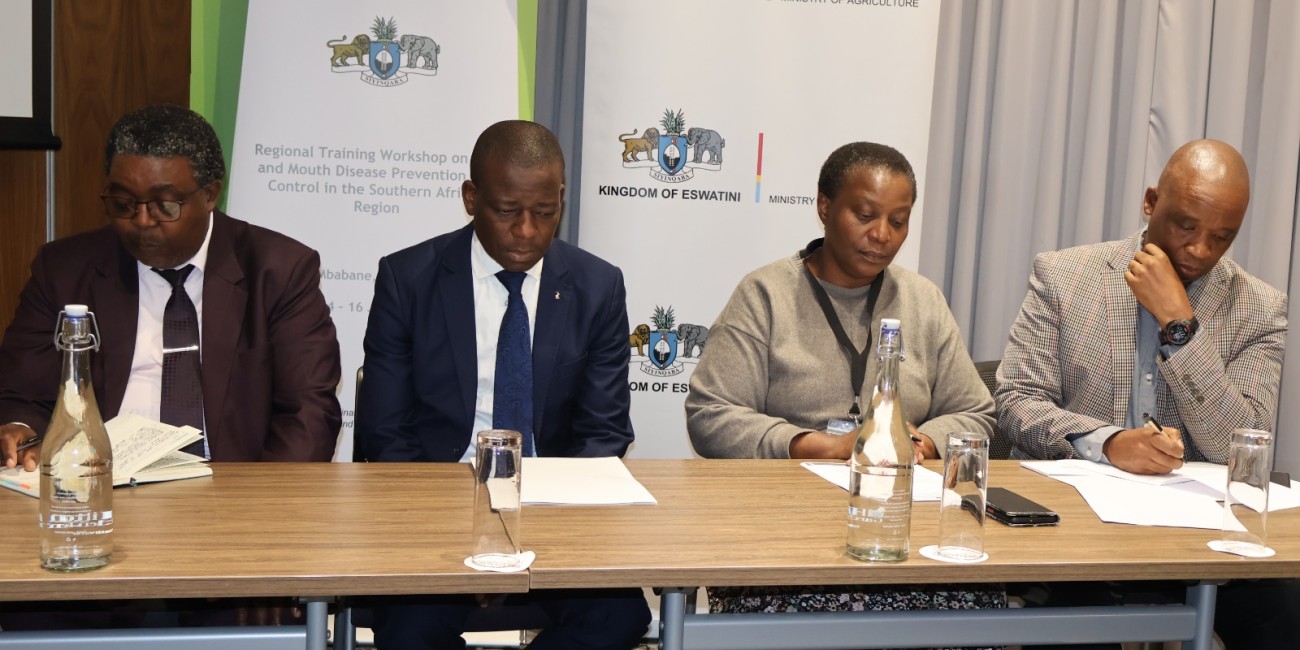
Addressing delegates during the official opening of the Southern Africa Sub-Regional Workshop on Foot-and-Mouth Disease Prevention and Control at the Hilton Garden Inn this morning, Minister of Sports, Culture, and Youth Affairs Bongani Ndzima, who was the representative of Minister of Agriculture Mandla Tshawuka, presented disease control as a long-term economic investment that will determine the future competitiveness of Eswatini’s livestock sector. While the workshop brought together veterinary experts and representatives from all 16 SADC member states to strengthen regional capacity in combating FMD, the Minister’s message extended beyond animal health to the broader financial implications of protecting one of Eswatini’s most valuable productive industries.
The workshop, organised with the support of the World Organisation for Animal Health (WOAH), comes at a pivotal moment for Eswatini’s agricultural economy following an outbreak that disrupted domestic livestock trade and forced the country out of lucrative international beef markets. For producers, processors, and exporters, the consequences have extended beyond temporary production losses to include reduced export revenues, weakened market confidence, and diminished opportunities for future investment.

Tshawuka noted that livestock production remains one of the foundations of Eswatini’s economy, particularly in rural communities where cattle ownership supports household incomes, employment, and food security while serving as an important store of wealth.
“Livestock production remains a cornerstone of Eswatini’s agricultural economy. It contributes significantly to food sovereignty, household incomes, employment creation, and the cultural heritage of our people,” he said.
Although livestock carries immense cultural importance in Eswatini, the Minister’s remarks highlighted its equally important role as an economic asset. Healthy livestock populations sustain commercial agriculture, support value-added processing industries, and enable access to export markets that generate foreign currency for the national economy. Protecting animal health, therefore, is increasingly becoming a matter of safeguarding productive capital and preserving the competitiveness of the agricultural sector.
The Minister reflected on the severe financial consequences of the country’s most recent outbreak, describing it as the most damaging FMD incident in Eswatini’s history. While previous outbreaks in 1965, 1969, and 2000 were successfully contained, the outbreak that emerged in May 2025 proved considerably more disruptive to both domestic production and international trade.

“This 2025 outbreak has been the hardest to contain; it disrupted livestock productivity, affected domestic trade, and cost the Kingdom most of her international markets, including the EU beef market,” Tshawuka said.
The loss of the European Union beef market represents more than a decline in export volumes. It affects every stage of the livestock value chain, from communal and commercial farmers to feed suppliers, transport companies, meat processors, veterinary service providers, and financial institutions that support agricultural production. Reduced export opportunities also place downward pressure on livestock prices, weaken producer profitability, and delay investment decisions that are essential for expanding agricultural output.
Against this backdrop, the regional workshop represents an investment in restoring the institutional capacity needed to support future market access. Rather than focusing exclusively on responding to outbreaks after they occur, government is prioritizing prevention through improved surveillance systems, earlier disease detection, stronger veterinary services, and enhanced technical skills among animal health professionals.
“Effective prevention and control of Foot and Mouth Disease require more than emergency responses. It demands a well trained workforce, strong surveillance systems, rapid detection and reporting, coordinated disease control measures, and close collaboration between government, farmers, veterinary professionals, animal scientists, the private sector, and our development partners,” the Minister said.
From an investment perspective, these measures strengthen one of the key factors international trading partners consider before opening their markets. Countries importing livestock and animal products increasingly require assurance that exporting nations possess credible disease surveillance systems, effective veterinary governance, and internationally recognised biosecurity standards. Investments in these systems therefore reduce commercial risk while improving the country’s ability to compete in global agricultural markets.

The Minister further emphasised that strengthening national capacity alone would not be sufficient because Foot-and-Mouth Disease remains a transboundary animal disease that moves freely across borders.
“Diseases do not recognize national borders or frontier lines. Consequently, our surveillance systems, information sharing, emergency preparedness, and response mechanisms must equally transcend borders,” he said.
This reinforces the economic importance of regional cooperation. By strengthening partnerships through institutions such as WOAH, SADC, COMESA and the Food and Agriculture Organization (FAO), countries can improve information sharing, coordinate disease responses, and reduce the risk that outbreaks in one jurisdiction disrupt agricultural trade throughout Southern Africa. Such cooperation ultimately contributes to greater stability across regional food systems and livestock markets.
The Minister also reaffirmed Eswatini’s commitment to implementing internationally accepted animal health standards, describing compliance with WOAH requirements as essential to restoring confidence among global trading partners.
“We still commit that we will do everything in our power to continue applying WOAH standards until we regain our regional and international markets, which we lost in May 2025,” Tshawuka said.
For Eswatini, that commitment represents a strategic investment in rebuilding export competitiveness. Modern veterinary infrastructure, laboratory capacity, skilled personnel, farmer education programmes and effective disease reporting systems require sustained public investment, yet they also form the foundation upon which international agricultural trade is built. Without those systems, premium export markets remain difficult to access regardless of production capacity.
The Minister expressed confidence that the expertise shared during the three-day workshop would strengthen veterinary services beyond the conference room by equipping participants with practical knowledge that can be transferred throughout the livestock sector.
“The knowledge and skills acquired during this workshop will not remain within the four walls of this conference room but will contribute significantly to improving Foot-and-Mouth Disease preparedness and control, protecting our livestock resources, safeguarding farmers’ livelihoods, and promoting sustainable agricultural development,” he said.
As Eswatini works to recover from one of the most costly animal disease outbreaks in its history, the country’s success will be measured not only by the containment of Foot-and-Mouth Disease but also by its ability to restore export earnings, attract renewed confidence across the livestock value chain, and reposition agriculture as a stronger contributor to economic growth. The workshop in Mbabane signals that the government views disease prevention not simply as a veterinary responsibility but as a strategic investment in rebuilding one of Eswatini’s most important export industries.