






By: Nkosiyabusa Nsibande
Eswatini’s push toward an artificial intelligence-enabled financial sector took a decisive step forward yesterday during the future of finance summit hosted by Khula Group, an Eswatini-based finance and technology company, which was appaulded by Honourable Minister of Finance Neal Rijkenberg as an institution charged with preparing the country’s finance professionals for the transition. The commitment emerged during the opening address at the inaugural Future of Finance Executive Forum (Eswatini Edition), a gathering convened by Khula Group under the theme “AI, Digital Transformation & Intelligent Automation for Economic Growth” and attended by chief financial officers, finance directors, and a cross-section of industry panelists tasked with mapping out the sector’s next decade.
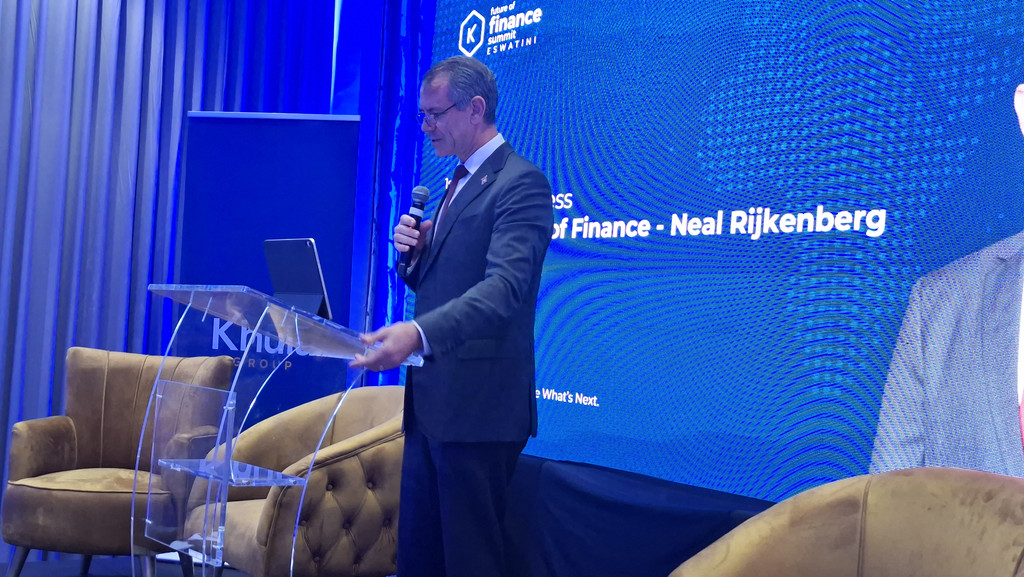
Delivering the keynote, Minister of Finance Neal Rijkenberg used the occasion to lay out the government’s three-pillar vision for what he termed “Digital Eswatini, Competitive Eswatini,” a framework built around digital public infrastructure, intelligent finance for growth, and people and partnerships. It was under this third pillar that the Khula Group commitment took shape, with the Minister arguing that none of the country’s technology ambitions would matter without a workforce capable of putting them to use. Addressing delegates directly, he put the point in blunt terms, noting that “technology without talent is just hardware” before going on to confirm that the government is “working with institutions like Khula to upskill our finance professionals.”
That framing matters because it repositions the upskilling drive as something closer to national infrastructure than corporate social responsibility. The Minister’s broader remarks made clear that the capabilities now expected of Eswatini’s finance sector are neither incremental nor optional. He told the forum that artificial intelligence “can detect fraud in milliseconds” and that digital platforms are already able to “bring a loan to MSMEs in the rural areas in 24 hours,” outcomes that depend as much on trained personnel as on the underlying software. He extended the point to back-office operations as well, arguing that intelligent automation “can free our finance teams from 1,000 spreadsheets, so they can focus on strategy and growth” a statement that reframes automation less as a cost-cutting exercise and more as a means of freeing skilled staff to do higher-value work, provided those staff have been trained to operate in that environment.
The partnership also lands at a moment when Eswatini’s underlying digital finance infrastructure is already showing measurable traction, giving the skills commitment a foundation to build on rather than a vacuum to fill. Government figures cited during the address showed that 61% of adults in Eswatini made or received a digital payment in 2024, ahead of the roughly 51% average recorded across Sub-Saharan Africa, with more than half of adults surveyed also holding a mobile-money account. Those numbers, the Minister suggested, represent a platform from which a genuinely digital economy can now be built, extending well beyond payments into taxation, lending, insurance, business registration, and support for small and medium enterprises.
The government’s own role in that transition was framed narrowly and deliberately: setting policy, de-risking investment, and constructing public infrastructure such as national identification systems, digital payment rails, and sovereign data and compute capacity. The private sector, by contrast, was cast as the engine of innovation and job creation, with Khula Group named explicitly as a “critical partner” in delivering on the intelligent finance pillar of the government’s strategy. That division of labor, the Minister argued, is the collaboration model the country now needs, and he credited Khula Group with having “set the tone by convening us today.”
The skills commitment was also tied directly into the government’s regulatory posture. The Minister described a commitment to “smart regulation,” regulation that protects consumers but also encourages innovation, positioning workforce readiness as a companion to, rather than a substitute for, sound oversight of AI deployment in financial services. He was equally direct about the pace at which the sector’s leadership needs to move, telling bank and insurance executives that “the Return on Investment on AI is no longer a question of ‘if,’ but ‘when and how fast.’” He went further, arguing that “the banks that use AI to understand their customers better will win deposits” and that “the insurers that automate claims will win loyalty,” effectively framing AI adoption and, by extension, workforce upskilling as a competitive necessity rather than a discretionary investment.
In closing, the Minister situated the entire initiative within a larger narrative of national ambition, describing Eswatini’s opportunity as one of leapfrogging rather than catching up “Just as the Asian Tigers did with manufacturing, we can do with digital finance.” He challenged delegates to leave the forum having secured “concrete partnerships, pilot projects, and a shared roadmap,” with the Khula Group skills commitment standing as an early and tangible example of the kind of collaboration he was calling for. He closed the address on that note of resolve, telling the room that “the Kingdom of Eswatini is ready. The future is calling. And together, we will answer.

Other Articles

Eswatini Aims To Position Itself as Southern Africa’s AI Finance Hub