





By: Nkosiyabusa Nsibande
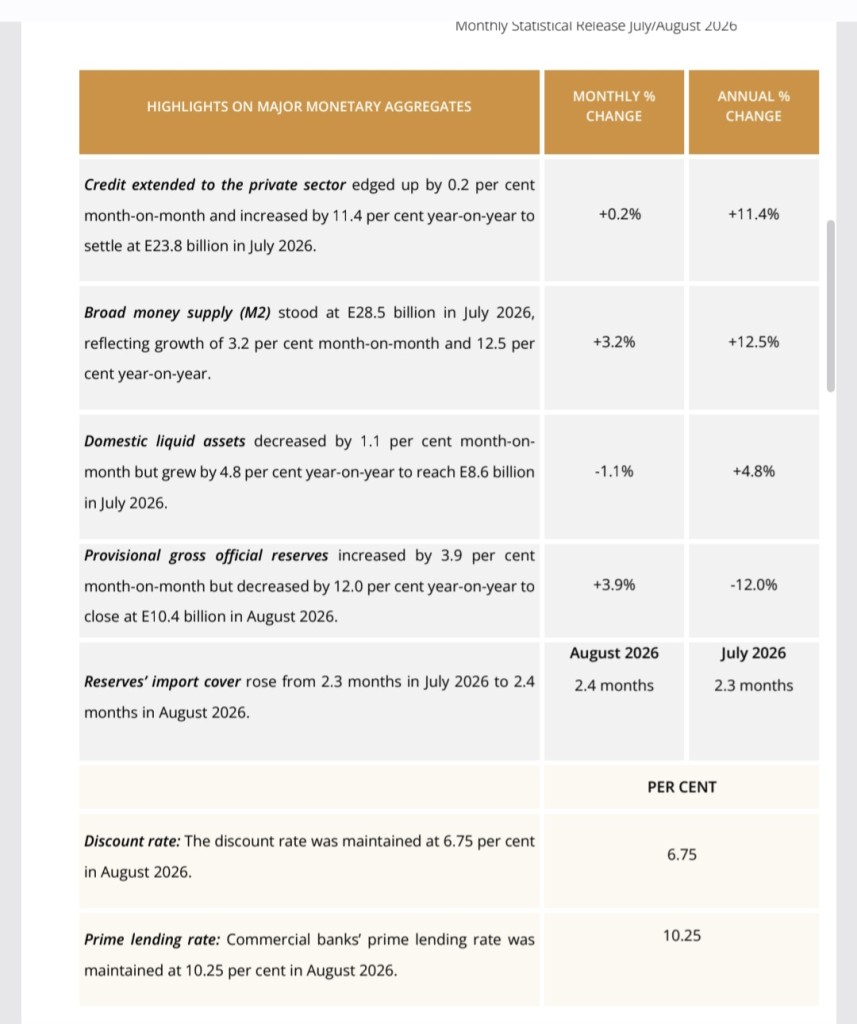
The latest Central Bank of Eswatini’s Monthly Statistical Release, July/August 2026, has revealed an economy benefiting from robust credit expansion, with private sector credit rising by 11.4% year-on-year to E23.8 billion. Under ordinary circumstances, such growth would be interpreted as a positive indicator of business confidence, increased economic activity, and stronger demand for investment capital. However, a closer examination of the underlying data suggests that the gains are not being shared equally across the business landscape. Instead, the figures point to an emerging credit divide between large corporations and smaller enterprises, raising important questions about the future composition of economic growth in Eswatini.
The most striking development within the report is the contrasting trajectory of lending to large businesses and SMEs. Credit extended to large enterprises increased by 17.5% compared to the same period last year, reaching E9.2 billion. On a monthly basis, lending to this segment also continued to expand, recording growth of 1.9%. In contrast, SME credit declined by 1.8% year-on-year and contracted by 4.9% over the month to E3.6 billion. The divergence is significant because it highlights a banking sector that is becoming increasingly selective in allocating capital, with larger and more established businesses attracting a growing share of available funding.
From a risk management perspective, the preference for larger borrowers is understandable. Large corporations typically possess stronger balance sheets, more predictable cash flows, diversified revenue streams, and greater collateral coverage. For financial institutions operating in a highly regulated environment, these characteristics translate into lower lending risk and more attractive risk-adjusted returns. During periods of economic uncertainty, lenders often gravitate towards borrowers perceived as financially resilient, reducing their exposure to segments considered more vulnerable to market fluctuations or operational challenges.
However, while the movement towards lower-risk lending may strengthen bank portfolios, it also introduces broader economic concerns. SMEs remain a critical component of Eswatini’s economic structure, serving as a major source of employment, innovation, and entrepreneurial activity. When credit flows to this segment begin to contract despite overall growth in the banking sector, it may signal that smaller businesses are facing increasing difficulties in obtaining working capital, financing expansion plans, or investing in productivity improvements. Over time, these constraints can limit business formation, reduce competitiveness, and slow job creation.
The sectoral composition of business lending further reinforces the view that credit conditions remain uneven across industries. Several productive sectors recorded declines in borrowing activity, including manufacturing, agriculture, and construction. These industries are often regarded as key drivers of economic diversification and long-term growth. A slowdown in credit uptake within these sectors could reflect weaker investment demand, heightened lending standards, or broader operational challenges facing businesses. Regardless of the underlying cause, the trend warrants attention, particularly at a time when economic policymakers are seeking sustainable growth beyond consumption-led activity.
The broader monetary environment remains supportive of expansion. The broad money supply grew by 12.5% year-on-year to E28.5 billion, indicating increased liquidity circulating within the economy. Typically, growth in money supply and private sector credit is associated with stronger economic momentum, increased business transactions, and rising consumption. Yet the simultaneous decline in SME lending suggests that the transmission of liquidity into the productive economy may be occurring unevenly. Rather than supporting a broad spectrum of enterprises, available financing appears to be flowing disproportionately toward larger corporate entities.

For investors and financial market observers, the developments highlighted in the report reveal an important shift in the structure of credit growth. Aggregate lending figures continue to paint a positive picture of banking sector activity, but aggregate data alone no longer tells the full story. The quality, distribution, and accessibility of credit are becoming equally important indicators of economic health. An environment where credit growth is concentrated among large corporates may support short-term financial stability, but it risks creating structural imbalances if smaller enterprises are increasingly excluded from formal financing channels.
The current trend also raises important policy considerations. Financial inclusion has long been recognized as a cornerstone of sustainable economic development. While lending institutions must maintain prudent credit standards, the persistent decline in SME financing may require renewed attention from policymakers, development finance institutions, and industry stakeholders. Expanding credit guarantee schemes, strengthening business support programs, and encouraging alternative financing mechanisms could become increasingly important interventions if the objective is to ensure that economic growth remains broad-based and inclusive.
The Central Bank of Eswatini’s latest credit data tells two very different stories. The first is one of strength, with double-digit growth in private sector credit, reflecting a banking sector that remains active and confident in supporting economic activity. The second story, however, is more cautionary. It speaks to a widening gap between businesses that can readily access capital and those that are finding financing increasingly difficult to secure. As lending continues to expand, the critical question for both policymakers and financial institutions will not simply be how much credit is being created, but who is receiving it and what that means for the future direction of the economy.
For now, the numbers suggest that Eswatini’s credit market is growing, but it is not growing evenly. That distinction may prove to be one of the most crucial focusing points of the economy in 2026.

Other Articles

Broad Money Supply Surges 12.5% as Reserves Drop 12%