




By: Nkosiyabusa Nsibande
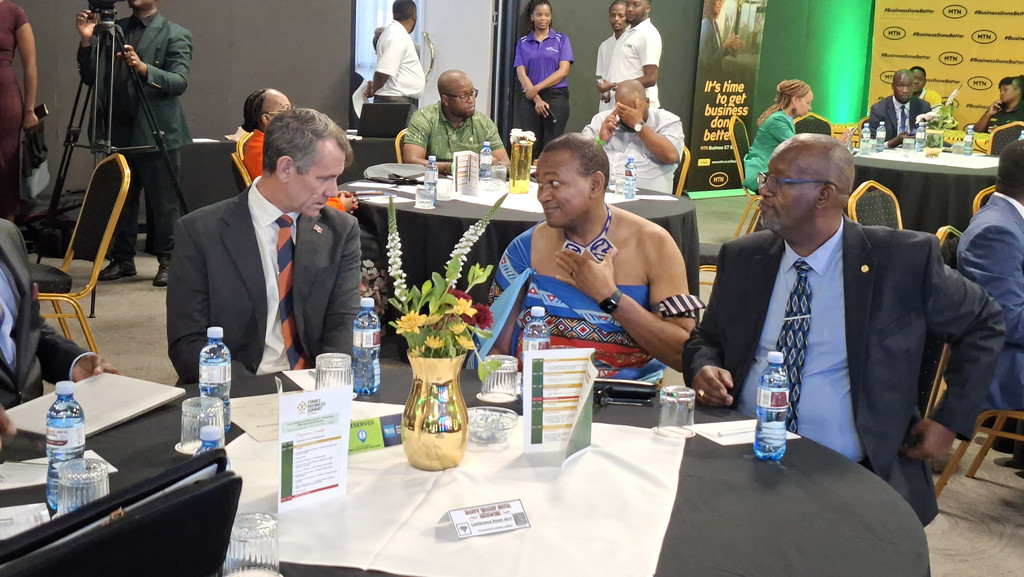
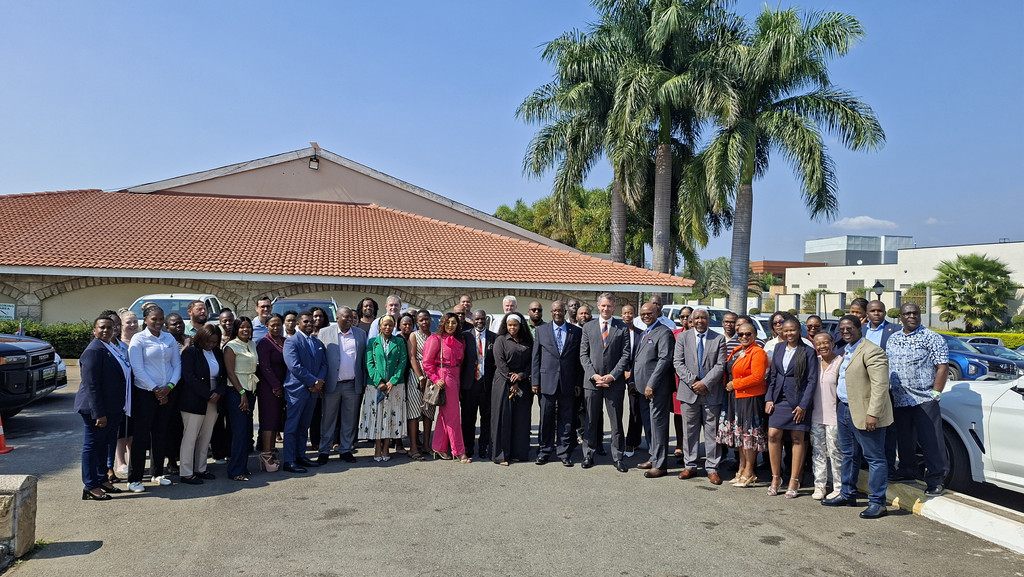
Eswatini’s family businesses face a problem that extends beyond succession: the country risks losing productive capital when enterprises fail to outlive the people who built them. Finance Minister Neal Rijkenberg, representing Commerce, Industry, and Trade Minister Manqoba Khumalo at the Family Business Summit at Happy Valley Hotel, said the country needs family enterprises that can expand, professionalize their governance, and transfer wealth across generations rather than collapse with the departure of their founders.
A family business that cannot survive its founder has created income, but it has not yet created enduring wealth. That distinction is becoming increasingly important in Eswatini, where the government is calling on family-owned enterprises to move from founder-dependent operations towards professionally governed businesses capable of surviving changes in ownership and leadership.
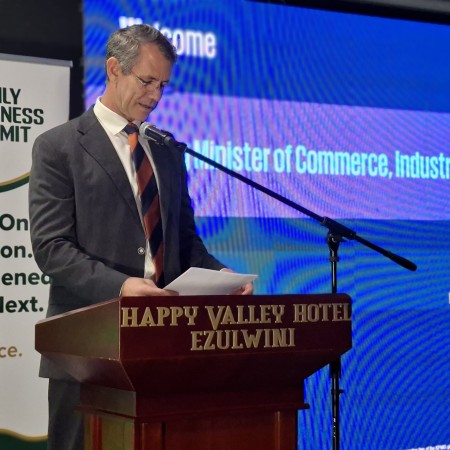
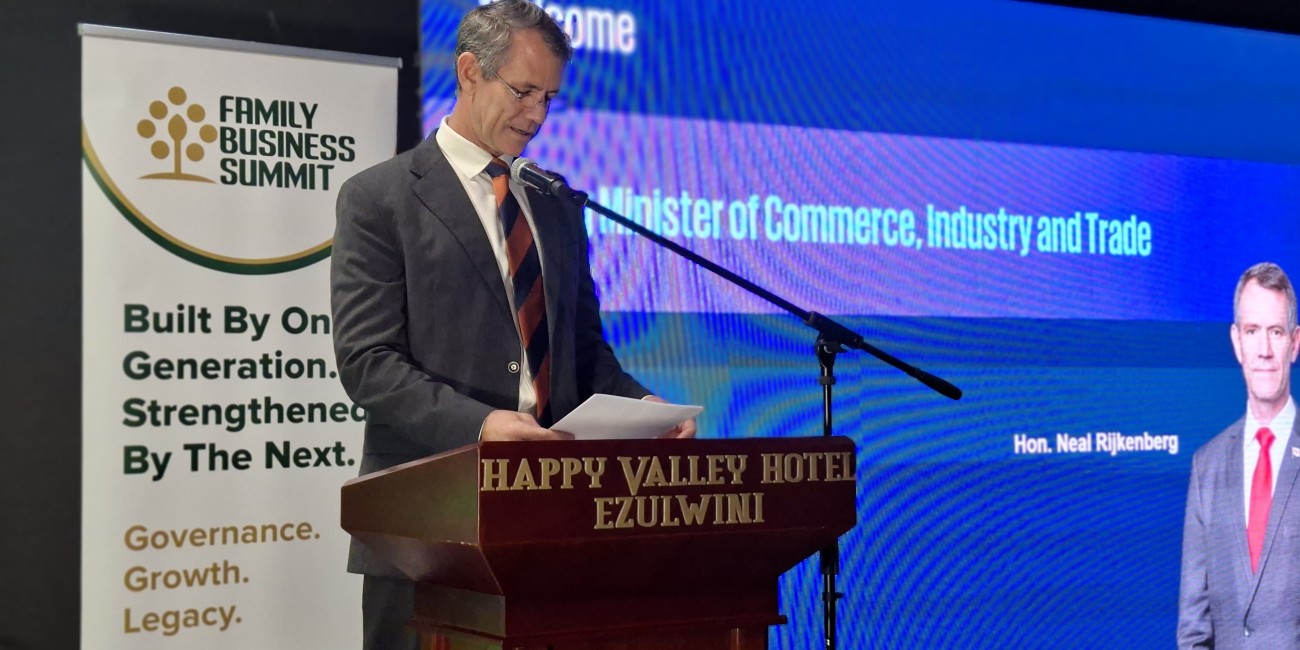
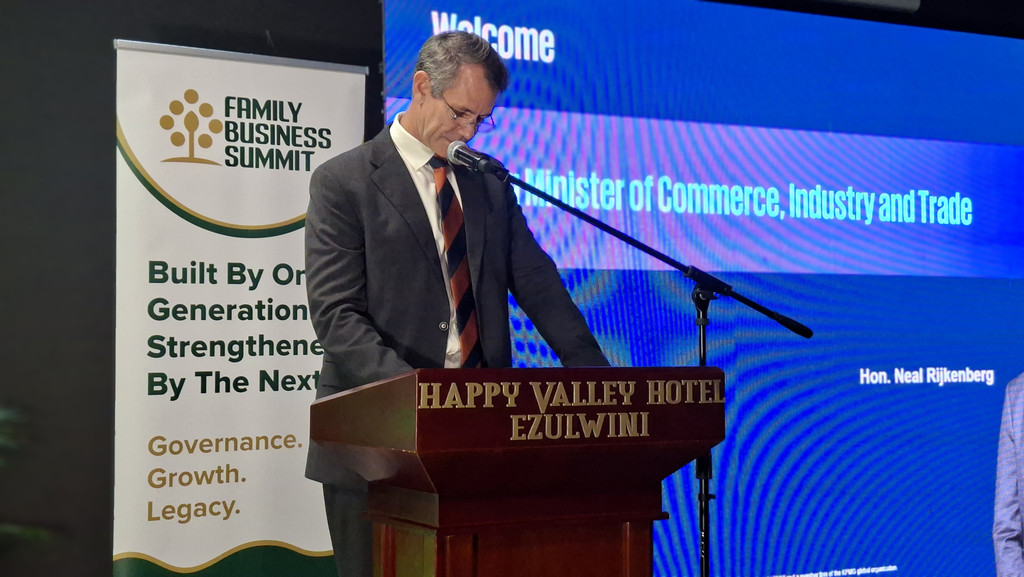
Finance Minister Neal Rijkenberg, representing Minister of Commerce, Industry and Trade Manqoba Khumalo at the Family Business Summit at Happy Valley Hotel on Thursday, said the central challenge facing family businesses was not simply starting or growing an enterprise, but building one capable of surviving beyond the generation that established it.
The minister said his own involvement in family business gave him a direct appreciation of the issue, noting that family enterprises need to “thrive, expand territories, and survive beyond our lifetime.” The remark goes to the heart of a financial problem that is often treated as a personal or family matter: when a business dies with its founder, the loss extends beyond the family balance sheet to employees, suppliers, creditors and the wider economy.
For Eswatini, the succession problem is particularly significant because family businesses occupy an important part of the domestic private sector. Their contribution is not limited to the wealth accumulated by owners. They provide employment, purchase from local suppliers, and generate economic activity in the communities in which they operate. When an established enterprise collapses because ownership or management cannot transition effectively, those economic relationships can disappear with it.
Khumalo said the country still sees family businesses “generally collapse after the demise of the founder,” contrasting this with markets where family enterprises have survived across generations. He said the objective should be to establish businesses that leave behind “a legacy and intergenerational wealth.”
The distinction between a successful founder and a successful family business is therefore becoming critical. A founder can make every major decision, maintain relationships personally, control finances, and carry the institutional knowledge of the business in his or her head. That model may work when the enterprise is small and concentrated around one entrepreneur. It becomes considerably more fragile when the business grows and ownership passes to people who did not build it.
At that point, governance becomes a financial issue. The business needs clearly defined ownership, management responsibilities, financial controls, and mechanisms for resolving disagreements before those disagreements begin to affect operations. Without such structures, family relationships can become entangled with commercial decisions, turning disputes over control into disputes over capital.
Khumalo specifically called for “proper governance structures” capable of preventing conflicts that could destroy otherwise viable businesses. That is significant because succession does not necessarily destroy value through a lack of money. In many cases, value can be lost through uncertainty over who controls the company, how decisions are made, and whether the next generation has the capacity to manage the assets it inherits.
The minister also identified one of the defining financial advantages of family businesses: patience. “One of the primary strengths of family businesses lies in their long-term perspective,” he said, arguing that family-owned enterprises can prioritize sustainability over immediate gains and withstand economic downturns.

But a long-term investment horizon is useful only when it is supported by long-term institutional structures. Patient capital cannot compensate indefinitely for weak governance, unclear succession arrangements, or an overreliance on the founder. If the business is expected to become a family asset rather than merely the founder’s livelihood, the governance architecture has to evolve alongside the balance sheet.
That becomes even more important as family enterprises seek financing and expansion. A business seeking bank finance, investment capital, or new markets must increasingly demonstrate that its operations do not depend entirely on one individual. Lenders and investors ultimately care about the durability of the cash flows supporting the business, and durability becomes harder to establish when management, ownership, and institutional knowledge are concentrated in a single founder.
Khumalo said he hoped Eswatini’s family businesses could eventually become global brands, pointing to the fact that some internationally recognized companies originated as family enterprises. “It is my hope that the family businesses in this country can also reach the level where they become global brands,” he said, while signaling the government’s willingness to support that ambition.
The ambition matters because international expansion changes the nature of the family-business equation. Once a company moves beyond its original market, its competitiveness depends increasingly on systems, capital allocation, management depth, intellectual property, financial reporting, and governance. The founder remains important, but the business cannot remain structurally dependent on the founder if it is to operate at scale.
The government has pointed to several policy instruments intended to strengthen local enterprise development, including the Citizens Economic Empowerment Act, the MSME National Policy, and the Ingelo Certification Scheme. Khumalo said the initiatives were intended to support local enterprises and improve their participation in economic activity.
Yet policy support can only take an enterprise so far. Market access, certification, and empowerment programs may create opportunities for growth, but the responsibility for converting those opportunities into durable businesses ultimately rests with the enterprises themselves. Growth without institutionalization can simply create a larger business with the same underlying succession risk.

That is why succession planning should be viewed less as an event at the end of a founder’s career and more as part of financial planning from the beginning. The question is not simply who will inherit the business. It is whether the business will still have the governance, management capacity, financial discipline, and strategic direction required to generate returns after ownership changes hands.
For families that have spent decades building businesses, the stakes are therefore considerably higher than preserving a name above the door. The objective is to preserve the productive assets, cash-generating capacity, and institutional knowledge accumulated over time.
Eswatini’s family-business challenge is ultimately a capital challenge. Every enterprise that collapses because it cannot navigate succession represents wealth that was created but not successfully transferred. Every enterprise that survives its founder demonstrates something more valuable: that private wealth can be converted into an enduring economic institution.
The test of a family business should not be whether the founder can build it. It should be whether the family can build a system strong enough to ensure that the business no longer needs its founder to survive.


Other Articles

70 Parastatal Professionals Trained To Turn Projects Into Results
Banks Lend Against Cash Flow, While Convinced By Passion