





By: Noncedo Shabangu
The Central Bank of Eswatini (CBE) raised its discount rate by 25 basis points to 7% on September 25, 2026, citing heightened external inflation risks, elevated global energy prices, and continued geopolitical uncertainty, despite lowering its 2026 inflation forecast to 2.52% from 3%. Domestic headline inflation rose to 2.8% in August from 2.5% in July, while private sector credit reached E23.8 billion and non-performing loans declined to E1.4 billion, bringing the NPL ratio down to 6.6%. Meanwhile, foreign reserves stood at E11.4 billion, providing 2.6 months of import cover, while public debt reached E43.1 billion, equivalent to 41.4% of GDP, underscoring the need for continued monitoring of financial and economic risks.
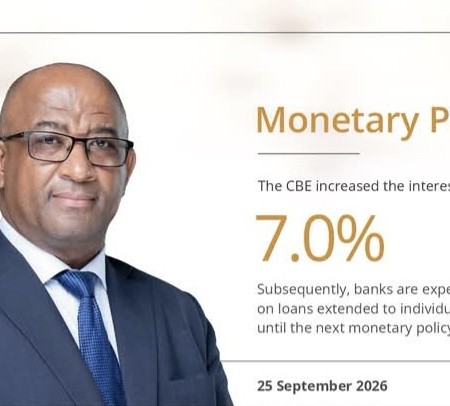
On September 25, 2026, the Central Bank of Eswatini (CBE) increased its discount rate by 25 basis points to 7%. The bank pointed to growing external inflation pressures and ongoing global economic uncertainty as the primary drivers behind the move.
The decision came out of a meeting between the CBE and the Monetary Policy Consultative Committee. The committee evaluated domestic, regional, and global economic conditions alongside the bank’s mandate to preserve price and financial stability. According to the Central Bank’s Governor Dr. Phil Mnisi, the hike is a measured reaction to risks surrounding the inflation outlook. While domestic conditions have shown progress, high global energy costs and worldwide economic instability continue to worry officials.

In Eswatini, annual headline inflation ticked up to 2.8% in August, moving up from 2.5% in July. Even with this monthly increase, the CBE revised its overall 2026 inflation forecast downward to 2.52%, compared to the 3% projection issued in July. The bank attributed this lower forecast to decelerating food price growth and an anticipated strengthening of the exchange rate.
Nonetheless, the CBE stressed that risks to the inflation outlook remain elevated. This monetary policy adjustment arrives amid rising inflation in major world economies, largely fueled by higher global energy prices resulting from oil supply disruptions tied to continuing Middle East conflicts. Furthermore, the CBE noted that global economic growth stays subdued, held back by geopolitical friction and restrictive monetary policies.
During September, several prominent central banks hiked their policy rates including the U.S. Federal Reserve, the European Central Bank, and the Bank of Japan while the Bank of England opted to leave its rate steady. Within the region, the South African Reserve Bank lifted its repo rate by 25 basis points to 7.25% in September. For commercial borrowers and local businesses, the CBE’s decision coincides with a 0.2% month on month increase in private sector credit, reaching E23.8 billion in July 2026.

Additionally, the banking sector saw a decrease in non-performing loans. These troubled loans dropped by 2.7% month on month down to E1.4 billion in July, driving the non-performing loan ratio down by 0.2 percentage points to 6.6%. On the external front, Eswatini’s foreign reserves reached E11.4 billion as of September 18, 2026, providing 2.6 months of import cover.
Preliminary data also indicated that total public debt hit E43.1 billion by the close of August, representing 41.4% of GDP. The CBE emphasized that the risks associated with these debt figures require close supervision. Looking forward, the central bank stated that upcoming monetary policy choices will rely entirely on evolving developments, risks, and uncertainties across the domestic, regional, and international arenas.

Other Articles
CBE Tightens Policy as 2026 Price Outlook Improves