


By: Nkosiyabusa Nsibande
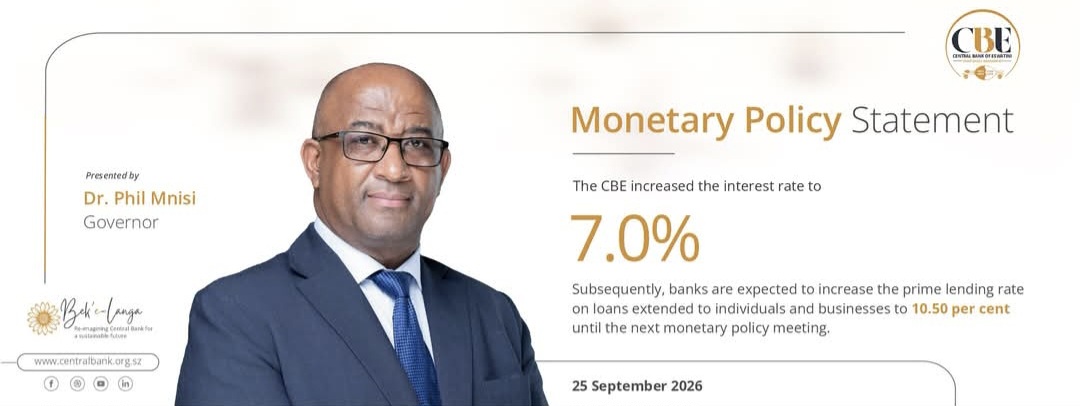
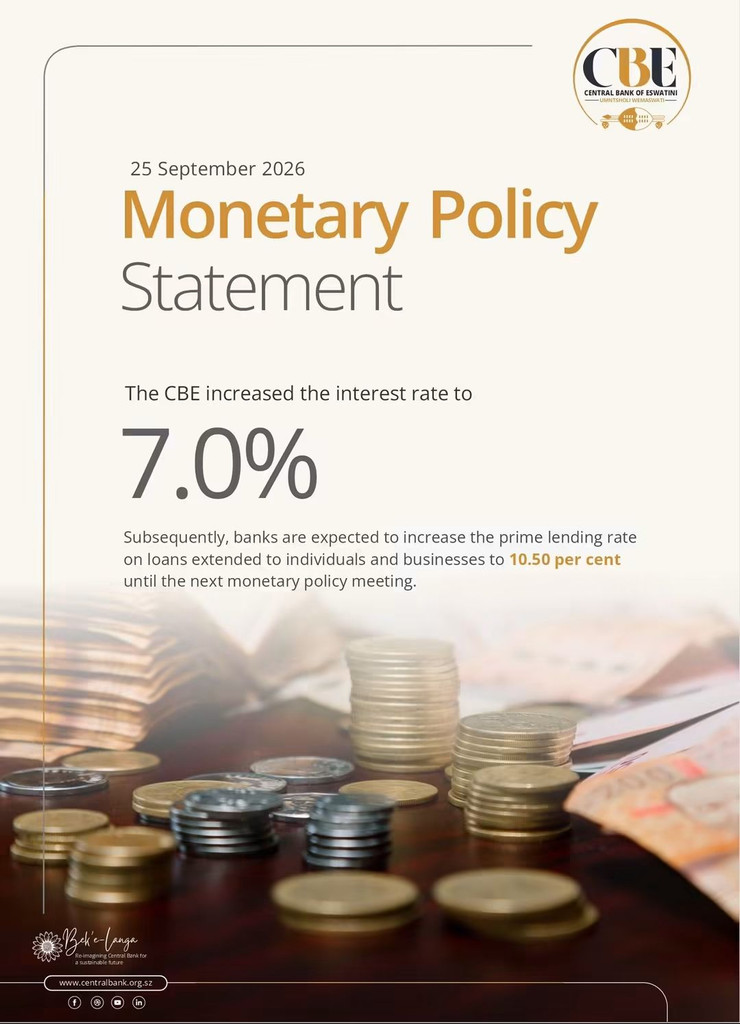
The Central Bank of Eswatini has delivered an apparent monetary-policy contradiction: it expects inflation to be lower than previously forecast, yet it has tightened monetary conditions. On September 25, the Central Bank, together with the Monetary Policy Consultative Committee, increased the discount rate by 25 basis points from 6.75% to 7%, effective September 26, while simultaneously cutting its 2026 inflation forecast from 3% to 2.52%.
At face value, the two decisions point in opposite directions. A lower inflation forecast would ordinarily strengthen the case for maintaining or easing monetary conditions, particularly where policymakers are also concerned about economic growth, credit extension, and investment. Instead, the CBE has chosen to tighten, signaling that the inflation forecast itself is only one component of its policy assessment and that the risks surrounding that forecast have become sufficiently material to warrant a more cautious monetary stance.
The distinction is important because the CBE is not responding to an uncontrolled surge in domestic inflation. Annual headline inflation rose to 2.8% in August from 2.5% in July. Still, the Bank simultaneously revised its 2026 inflation outlook downward because recent inflation outcomes were lower than expected, food price increases had slowed, and the exchange rate outlook had become more favorable. The contradiction, therefore, does not lie in the data themselves but in the different directions of the baseline inflation outlook and the risks surrounding it.
The policy problem lies further ahead. The Bank expects inflation to remain relatively contained, but it sees a significant possibility that external shocks could alter that trajectory. Its medium-term inflation forecasts were also revised downward to 3.86% for 2027 and 3.45% for 2028. Yet the Bank maintained that inflation risks remain elevated due to ongoing tensions in the Middle East and the potential effects of an expected El Niño.
This is the essence of the CBE’s latest decision: the central bank is not necessarily fighting today’s inflation; it is attempting to prevent tomorrow’s external inflation shock from becoming a domestic financial problem. That distinction is particularly important for Eswatini, where international energy and commodity prices can feed into domestic transport, production, and household costs through the country’s high exposure to imported goods and regional supply chains.

Governor Dr. Phil Mnisi had already indicated the bank’s cautious approach when global inflationary pressures intensified earlier in the year. In June, he said, “Through our monetary policy stance, we take a cautionary approach,” explaining the need for policymakers to consider developments beyond Eswatini’s borders when determining the appropriate monetary-policy response. The September decision represents a continuation of that approach, but with the balance of risks now sufficiently elevated for the bank to tighten monetary conditions despite the improved domestic inflation outlook.
The external environment has become an important part of that calculation. The latest CBE statement points to higher global energy prices following disruptions to oil supply chains associated with tensions in the Middle East. Major central banks have also responded to renewed inflation pressures, with the US Federal Reserve, European Central Bank and Bank of Japan raising policy rates in September, while the Bank of England maintained its rate. Regionally, the South African Reserve Bank increased its repo rate by 25 basis points to 7.25%.
For Eswatini, the regional dimension matters because domestic monetary conditions cannot be assessed in isolation from the country’s close financial and economic ties with South Africa. A more inflationary South African environment, combined with higher international energy prices, creates the possibility that external price pressures could eventually feed into domestic inflation. The CBE therefore faces a policy trade-off between maintaining financial conditions that support credit and investment and ensuring monetary conditions remain sufficiently tight to contain inflationary risks should the external environment deteriorate further.

The Bank’s own credit data illustrate why the decision carries an economic cost. Private-sector credit increased by only 0.2% month-on-month to E23.8 billion in July, although credit was 11.4% higher year-on-year, with business credit reaching E12.9 billion. The increase in the policy rate is therefore entering an economy where access to financing remains an important channel for household consumption, business expansion, and investment.
The transmission from monetary policy to the real economy occurs through the cost of credit. As commercial banks adjust lending rates in response to the higher policy rate, borrowers may face higher financing costs, particularly for variable-rate loans. For households, this can affect mortgage, vehicle, and personal-loan repayments, while businesses can face higher costs for working capital, expansion, and capital expenditure. The consequence is that a policy decision intended to protect future price stability can simultaneously place pressure on current economic activity.
The CBE’s latest decision, therefore, raises a broader question about the cost of preventing inflation before it materializes. If external energy prices remain elevated and geopolitical tensions continue to disrupt global supply chains, the Bank may judge that maintaining tighter monetary conditions is preferable to allowing imported inflation to become embedded in domestic prices. But if those external risks subside, the economy could be left carrying higher financing costs despite the relatively benign domestic inflation trajectory.

This tension becomes even more significant when viewed alongside public finances. Preliminary figures indicate that public debt stood at E43.1 billion at the end of August, equivalent to 41.4% of GDP, after rising from E41.6 billion in July. Although monetary policy is primarily concerned with price and financial stability rather than the direct management of Government debt, a higher interest-rate environment can influence the cost of domestic borrowing and refinancing, depending on the structure, maturity, and pricing of the debt portfolio.
The interaction between monetary tightening and Government financing therefore warrants closer scrutiny. If elevated rates persist, the Treasury may face higher costs when raising new domestic funding or refinancing debt that is exposed to prevailing market rates. This could place additional pressure on fiscal space at a time when Government is seeking to finance infrastructure and development while also managing debt vulnerabilities.
The critical issue is consequently not simply the size of the public-debt stock, but the Government’s debt-management structure: the proportion of debt carrying fixed or variable rates, the maturity profile, the cost of new borrowing and the extent to which existing obligations will have to be refinanced under tighter financial conditions. These factors will determine how strongly the monetary-policy shift ultimately feeds into the Government’s financing position.
The CBE’s decision is therefore less contradictory than it initially appears. The 2.52% inflation forecast represents the Bank’s central outlook, while the tightening of monetary conditions reflects its assessment of the risks surrounding that outlook. A central bank can simultaneously expect inflation to decline and believe that the potential cost of an adverse inflation shock has increased enough to justify a precautionary response.

Dr Mnisi reinforced that risk-based approach in the latest monetary-policy communication, stating that “the direction of monetary policy will continue to be driven by the assessment of risks and uncertainties in international, regional and domestic economy.” The statement captures the central dilemma facing policymakers: monetary policy is being determined not only by where inflation is today, but by the risks that could change where inflation is heading.
For households, businesses and Government, however, the distinction between a precautionary tightening and a response to already elevated inflation may offer limited immediate relief. The financial transmission is ultimately through the cost of money. Borrowers face tighter financial conditions, businesses must reassess investment decisions and Government must consider the implications for future financing costs.
The central question for the coming months is therefore whether the external risks identified by the CBE will materialise strongly enough to overturn the favourable domestic inflation trajectory. If energy prices and geopolitical disruptions continue to push global inflation higher, the Bank’s cautious approach could prove central to containing imported price pressures. If those risks recede, however, the 2.52% forecast will become an increasingly important reference point for determining whether tighter monetary conditions remain justified.
For now, the paradox remains at the heart of Eswatini’s monetary-policy outlook inflation is expected to fall, but the risks around that forecast have become serious enough for the central bank to tighten rather than ease financial conditions.

Other Articles

CBE Rate Hike Puts Borrowing Costs In Focus
The Economic Cost of Losing Eswatini’s Men To Suicide