





By: Nkosiyabusa Nsibande
Opinion Piece
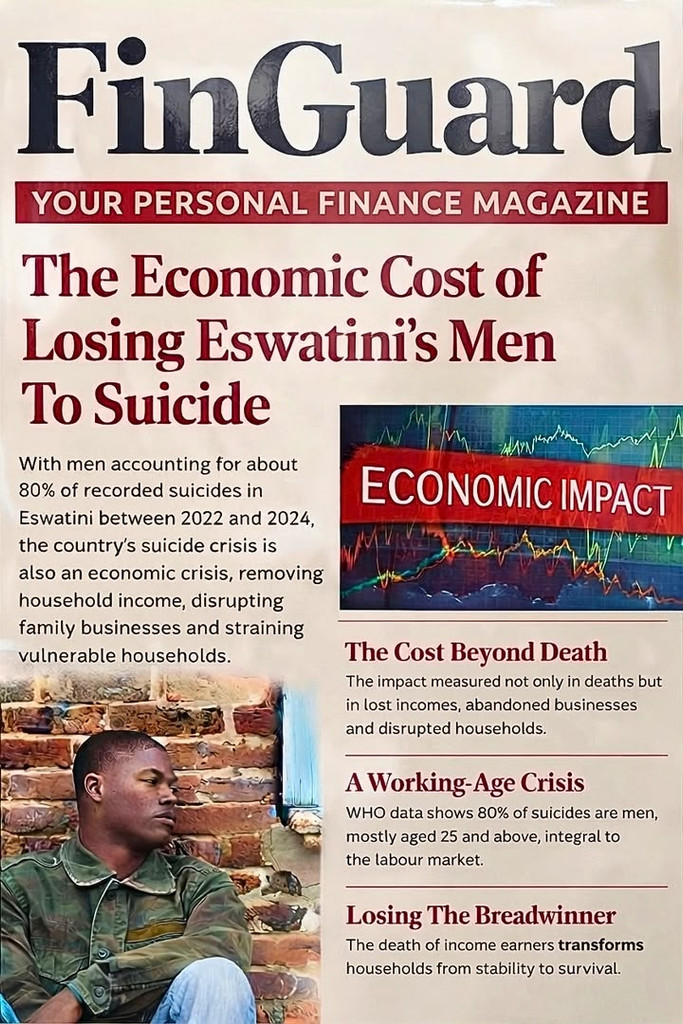
With men accounting for about 80% of recorded suicides in Eswatini between 2022 and 2024, the country’s suicide crisis is also an economic crisis. The loss of predominantly working-age men removes household income, disrupts family businesses, erodes productive capacity and places additional pressure on already vulnerable families, communities and public finances. For a country seeking stronger growth, employment and private-sector development, the economic cost of losing productive citizens cannot be treated as a peripheral consequence of a mental-health problem.
The Cost Beyond Death
Eswatini’s suicide crisis is usually measured in deaths. It should also be measured in lost incomes, abandoned businesses, disrupted households, reduced production and years of economic activity that will never take place. When four out of every five recorded suicide deaths are men, as reported by the World Health Organization (WHO) using Royal Eswatini Police Service data for 2022 to 2024, the issue extends beyond public health and into the balance sheets of households, businesses and the economy.
A Working-Age Crisis
According to WHO Eswatini, 486 completed suicides were recorded between 2022 and 2024, with men accounting for 80% of the deaths, while 69% of victims were aged 25 years and above. The age profile matters economically. These are not predominantly people at the beginning of their economic lives; they are people who, in many cases, are already participating in the labour market, operating businesses, supporting children, servicing loans, managing farms or contributing to family enterprises. The death therefore removes not only a human life, but an existing and future stream of economic activity.
Men In The Labour Market
The distinction is particularly important for Eswatini because men remain deeply embedded in several of the productive occupations that underpin the formal and informal economy. The 2023 Integrated Labour Force Survey, produced by the Ministry of Labour and Social Security and the Central Statistical Office, recorded 131,586 employed men out of 260,356 employed people, meaning men represented approximately 50.5% of the employed population. Men also recorded a 54.1% labour-force participation rate, compared with 48.0% for women, while their employment-to-population ratio stood at 36.2%, compared with 29.9% for women.
That does not mean men are the sole economic backbone of Eswatini, nor does it mean their economic contribution is inherently more valuable than that of women. Women own the majority of MSMEs in the country, according to FinMark Trust’s 2023 FinScope MSME survey, which found women accounted for 60% of MSME ownership against 40% for men. The economic argument is instead about concentration: men are heavily represented in particular occupations and sectors, and the loss of large numbers of working-age men therefore has consequences for specific productive activities.

Where Men Work
The labour-force data show that men are particularly concentrated in agriculture, construction, transport, machinery and craft-related occupations. The 2023 labour-force survey found that 18.2% of employed men worked in agriculture, forestry and fishing, while 12.1% worked in construction and 13.8% in plant and machine operation and assembly. These are occupations where the sudden disappearance of an experienced worker can have consequences beyond the individual’s salary because skills, institutional knowledge and physical productive capacity disappear with the worker.
The First Financial Shock
The first balance sheet to absorb that shock is the family. For a household, the death of a working-age income earner can transform an apparently stable financial position into an immediate liquidity crisis. A salary disappears, business revenue may fall, loan repayments remain due, school fees do not disappear, and food and housing costs continue. If the deceased was involved in farming or a family enterprise, the household may also lose productive assets that depended on his labour and management.
Losing The Breadwinner
Eswatini’s vulnerability assessments provide evidence of how damaging the loss of a primary breadwinner can be. The 2018 Eswatini Vulnerability Assessment reported that the death of a primary breadwinner accounted for 31.1% of recorded household death-related impacts. That statistic does not establish that 31.1% of households depend on men, but it demonstrates the financial significance attached to losing a principal income provider.
The financial consequences can extend well beyond the immediate loss of earnings. Families may be forced to sell livestock, savings, or other productive assets to meet funeral expenses or compensate for lost income. A household that previously used its income to build savings, finance education, or invest in a small business may instead begin consuming its capital simply to maintain basic living standards.

When Income Becomes Survival
This is where suicide becomes a financial issue rather than simply a social one. Capital that would otherwise have been accumulated becomes consumption. Investments that would have generated future income are liquidated. Children may leave school or reduce their educational opportunities. A surviving spouse may enter an already difficult labour market with additional dependents. The household’s ability to borrow may also deteriorate because the income against which financial commitments were structured has disappeared.
The Family Business Risk
The same shock becomes more complicated when the deceased is involved in a family business. A family business does not always have a clean separation between ownership, management, and labour. The same individual may be the shareholder, manager, salesperson, bookkeeper, driver, and relationship holder with suppliers and customers. His death can therefore remove several functions simultaneously. A business can survive the loss of an employee by recruiting another. Replacing an owner-manager who holds critical knowledge, relationships, and decision-making authority is considerably more difficult.
The SME Impact
This vulnerability is particularly relevant in Eswatini’s MSME economy. FinMark Trust’s 2023 FinScope MSME findings show the scale of entrepreneurship across the country, while World Bank research has found stronger male representation in certain segments, including high-impact SMEs and trade firms. The World Bank reported that men owned 69% of high-impact SMEs in one analysis, while another World Bank study found men owned and/or managed 72% of trade firms.
Those figures should not be interpreted as evidence that men dominate Eswatini’s entire business sector. They do, however, demonstrate why the death of economically active men can have consequences for particular categories of businesses. Where a man’s death removes a founder, technical specialist, manager, or principal decision-maker, the resulting loss can affect suppliers, employees, customers, and creditors as well as the deceased’s family.

Losing Productive Capacity
For a small enterprise operating on narrow margins, the consequences can be immediate. A construction company can lose a skilled site manager. A transport business can lose an experienced operator. An agricultural enterprise can lose someone responsible for production decisions. A trading business can lose the person who maintains relationships with suppliers and customers. In each case, the economic loss is larger than the individual’s monthly income because the business may also experience lower turnover, disrupted operations, and additional recruitment and training costs. There is a second-order effect that is less visible in official suicide statistics: the loss of productivity.
The Productivity Bill
International economic research consistently finds that suicide generates substantial costs through lost productivity and premature mortality. The precise value varies by country and methodology, so international estimates should not simply be applied to Eswatini as though they were local measurements. But the economic principle is straightforward. When a person dies decades before the end of his potential working life, the economy loses years of labour, consumption, taxation, entrepreneurship, and household production.
For Eswatini, this matters because the country is already attempting to increase employment, private investment, and productive capacity. The 2023 labour-force survey recorded male unemployment at 33.1%, illustrating that the economy has a substantial pool of men who are not fully integrated into productive employment. Losing working-age citizens to suicide, therefore, compounds an existing labour-market challenge: the country is simultaneously struggling to create enough productive opportunities while losing some of the people who could otherwise participate in economic activity.
The GDP Question
The impact eventually reaches GDP. GDP does not measure human suffering, family grief, or the value of relationships, but it does measure market production. When a productive worker dies, the economy may lose the output that person would have generated. When a business closes or scales down following the death of an owner, production can fall further. When a household loses income and cuts consumption, businesses selling goods and services experience another reduction in demand.
This creates a chain that can be described economically as human-capital loss → household-income shock → business disruption → lower production and consumption → weaker tax and economic activity.

The Hidden Economic Loss
The effect will not necessarily appear in national accounts under a line item called “suicide.” A decline in the output of a small construction company may simply appear as weaker construction activity. A farm producing less food may appear as having lower agricultural output. A family business that closes may disappear from the formal economy without anyone recording the closure as an economic consequence of suicide. That invisibility should not be mistaken for insignificance.
Pressure On The State
There is also a fiscal dimension. When a household loses an income earner, its demand for social assistance and public services can increase. Children may require greater support. Surviving family members may need healthcare or psychosocial services. Police, health facilities, and other public institutions also bear costs associated with suicide response and prevention.
The WHO has identified financial difficulties, relationship problems, social isolation, alcohol-use disorders, and other factors among the circumstances associated with suicidal behavior. These should not be interpreted as a simple causal formula: poverty does not automatically produce suicide, nor does unemployment mean a person will become suicidal. But where financial pressure, social isolation, substance abuse, and limited access to mental-health services intersect, economic vulnerability can become part of a much wider risk environment.
Agriculture and Access to Means
The methods recorded in Eswatini add another economic dimension. WHO Eswatini reported that insecticide poisoning accounted for 52% of recorded suicides between 2022 and 2024, while hanging accounted for 44%. The prevalence of insecticide poisoning is particularly significant in an economy where agriculture remains an important source of livelihoods. It demonstrates how suicide prevention can intersect with agricultural policy, pesticide management, health systems, and rural economic development.

The Cost Of Inaction
For policymakers, therefore, the question should not simply be how much money Eswatini spends responding to suicide. It should also be how much economic value the country loses by failing to prevent avoidable deaths among working-age citizens. That requires better data.
Measuring The Economic Damage
Eswatini currently has useful information from the Royal Eswatini Police Service, WHO, the Ministry of Labour and Social Security, the Central Statistical Office, and vulnerability assessments. But the country still lacks a comprehensive economic-costing framework that quantifies the household income lost, business disruption, years of productive life lost, tax revenue forgone, and public-service costs associated with suicide. Such a framework would allow the country to move beyond describing suicide as a tragedy and begin measuring it as a national economic risk.
Prevention as Investment
The financial argument for prevention is therefore stronger than the cost of a counseling program or crisis service. If prevention keeps a working-age entrepreneur alive, the return may include the survival of a business, preservation of jobs, continued school fees for children, continued loan repayments, continued tax contributions, and years of household consumption. If it keeps a skilled employee alive, the benefit extends to the employer, colleagues, customers, and the wider supply chain. The most important point, however, is that men should not be reduced to economic units simply because their deaths have economic consequences. The value of a human life cannot be captured by GDP, wages, or tax contributions. The economic case merely provides another way of demonstrating the scale of what is lost.
A National Economic Concern
Eswatini’s suicide statistics are telling the country something that financial policymakers should not ignore. When 80% of recorded suicide deaths are men, when the majority of victims are aged 25 and above, and when men constitute roughly half of the employed workforce while remaining highly concentrated in several productive sectors, the consequences extend into the country’s economic architecture. The question is no longer only how many men Eswatini is losing. It is how many households are losing incomes, how many businesses are losing leaders, how many children are losing economic security, how many firms are losing productive capacity, and how much future economic output disappears each time a working-age man dies by suicide. For a country trying to expand GDP, create employment, and strengthen household financial resilience, preventing those losses is not merely a social obligation. It is an investment in Eswatini’s human capital.

Government Looks to Parastatals to Convert Financing into Growth – Neal