





By: Nkosiyabusa Nsibande
The defining question for the next generation of family businesses may not be who inherits the chief executive’s office, but whether the family should occupy it at all. Global research presented by KPMG Private Enterprise suggests that only 12% of family businesses could still be family-run by 2035, down from 47% today, signaling a structural separation between family ownership and corporate management.
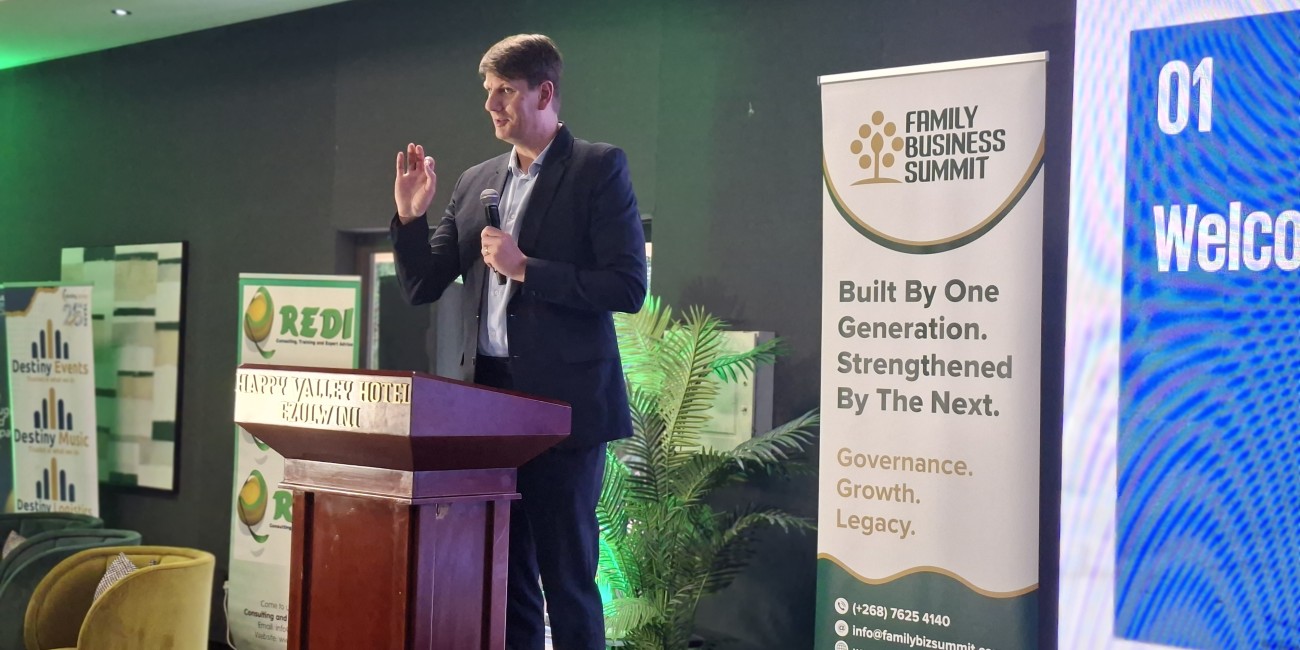
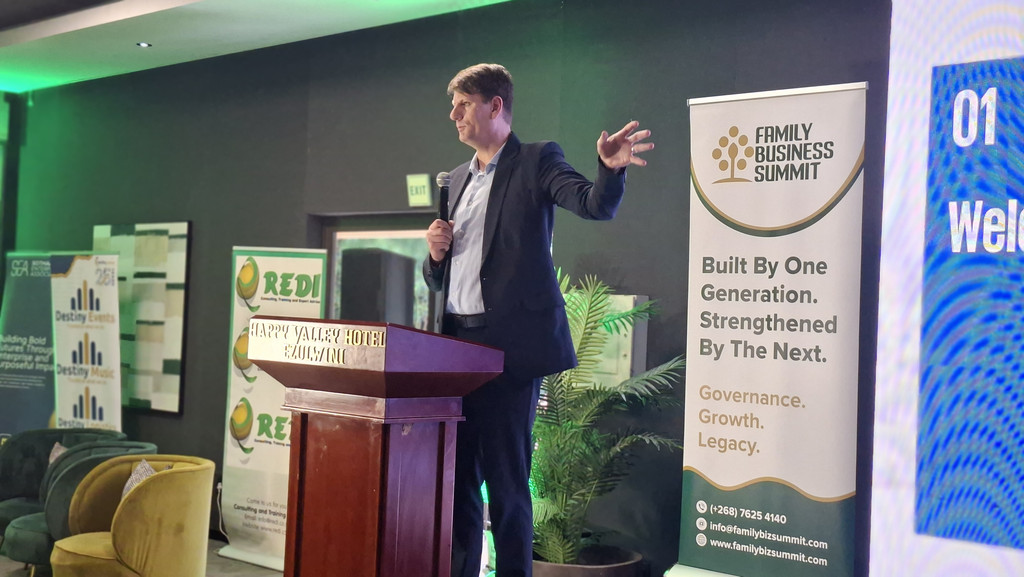
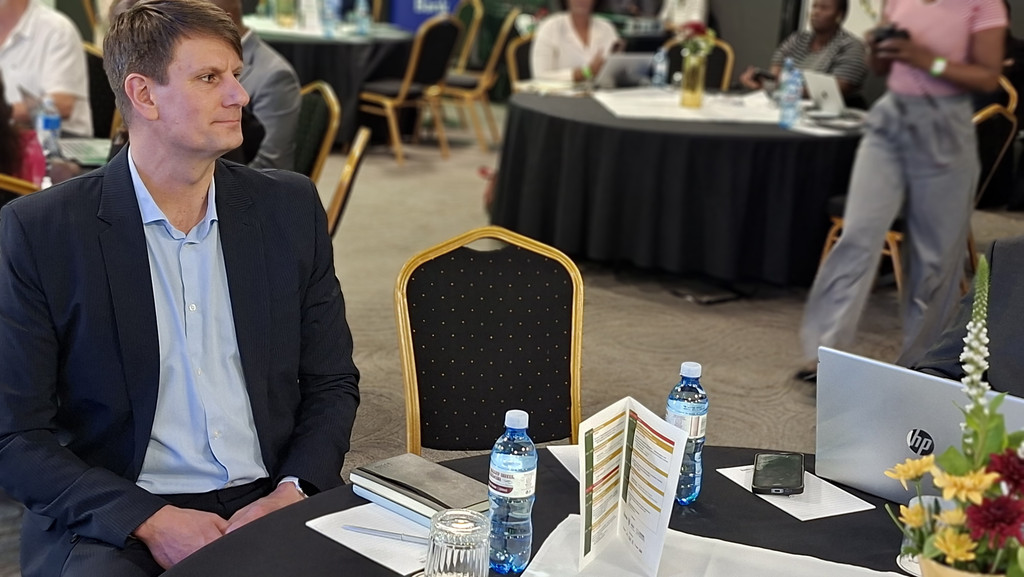
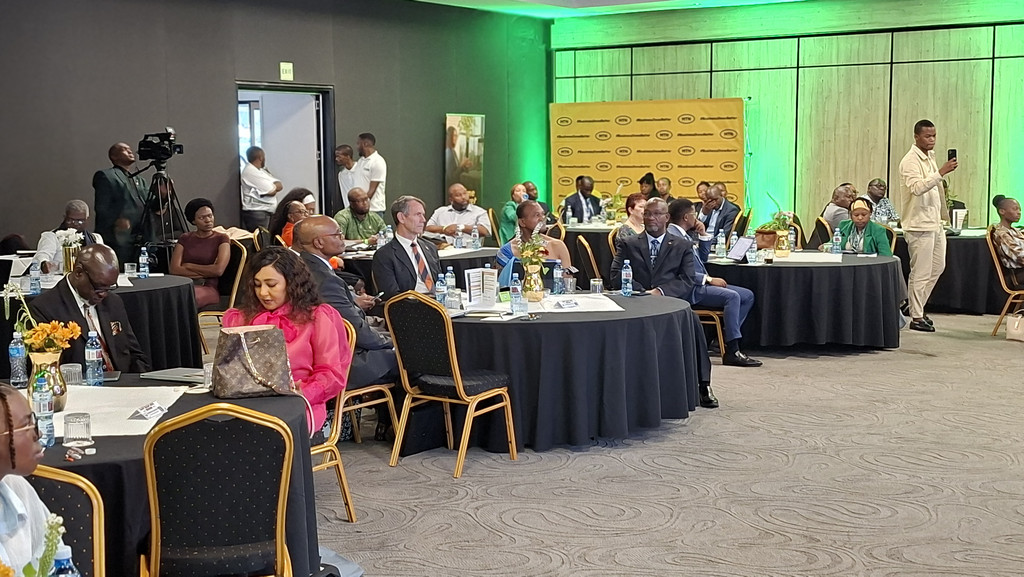
Creagh Sudding, a partner at KPMG in South Africa, presented the findings at the Family Business Summit at Happy Valley Hotel yesterday, arguing that succession is increasingly becoming a question of institutional resilience rather than hereditary entitlement. The implication for family capital is material: families may retain control of the ownership structure while handing operational responsibility to professional executives whose mandate is to preserve and grow enterprise value.
“Currently globally, 47 percent of the family businesses out there are family-run,” Sudding said. “By 2035, the estimation, well based on the feedback from the 2,000 family businesses that were surveyed, is that only 12 percent will be family run.”
The projected shift changes the economics of succession. Traditionally, transferring a family business has often been understood as transferring managerial authority from one generation to the next. The emerging model instead separates two assets that have historically traveled together: ownership and control. A family can retain its economic interest in an enterprise without assuming that bloodline should determine who occupies the executive suite.
That distinction is particularly relevant to lenders. A business whose continuity depends on an informal handover to an untested family member carries a different succession risk from one with an established management team, defined governance arrangements, and a credible transition plan. For banks, the issue is ultimately one of repayment capacity and institutional continuity rather than family preference.
Sudding was explicit on the point: “If they’re not the right person for the job, they shouldn’t be the next person to lead the business.”
He said stakeholders such as banks want visibility over what happens when the current generation leaves the business. “They like to see that succession plan, that transition plan, that your business will not fail just because you want to hand it over to the next-generation family member.”
For family businesses, this places succession planning much closer to financial risk management than to human resources administration. The absence of a credible transition plan can expose a company to leadership disruption, shareholder disputes, weakened lender confidence, and potentially forced asset sales precisely when the family is attempting to preserve its wealth.
The stakes are amplified by the economic weight of family enterprises. Sudding said KPMG Private Enterprise’s global research indicates that family-owned businesses support between 60% and 70% of global GDP. In South Africa, the research presented at the summit puts the contribution at about 60% of GDP, while family businesses employ between 50% and 60% of the employable population.
These figures place family enterprises firmly within the architecture of economic growth rather than treating them as a niche category of privately held companies. Their balance sheets, payrolls, procurement networks, and investment decisions have consequences well beyond the families that own them.
“You as the family business in the room are the crux of all economies: the Eswatini economy, the Southern Africa economy, the African economy, and the global economy,” Sudding said.
The regional data also illustrates why succession failures can have consequences beyond family wealth. Where a family-owned company is a major employer or supplier, a breakdown in ownership transition can transmit financial stress into households, suppliers, creditors, and local communities.
Sudding described this relationship through what he called the circular economy, arguing that family businesses have traditionally understood the commercial value of maintaining the communities in which they operate.
“If you support the communities and the environment where you live and where you work, and where your business operates, that community and environment will thrive,” he said. “And with that thriving community and environment, they will feed back into your business, and everyone thrives at the end of the day.”
The challenge, however, is that preserving an operating business is only one component of preserving family wealth. A family can successfully pass ownership from parents to children and still destroy value through fragmented decision-making, unsuitable management appointments, or poorly structured investments outside the core business.
Sudding’s framework therefore places wealth alongside growth, risk, transition, people, and governance. The six areas are interdependent: aggressive expansion without risk controls can destroy capital; wealth without a defined investment purpose can become fragmented; succession without competent people can weaken the operating business; and ownership without governance can turn family disagreements into corporate liabilities.
“We all want to make a lot of money. We all want that money to be multigenerational, not just for the current generation, but for the future generations,” Sudding said.
The question for family businesses is consequently not simply how to create wealth, but how to institutionalize it. That requires decisions over the ownership structure, investment vehicles, governance arrangements, and the division between family capital and operating capital. It also requires clarity over what the family intends its wealth to achieve across generations.
Risk presents an equally complicated problem because the enterprise can be exposed to conduct originating outside the company itself. In a family business, reputational capital can be inseparable from the reputation of the family.
Sudding cited an example from the Eastern Cape in which a family member published a politically controversial post on Facebook. Under the family’s social media policy, the individual was barred from using social media for six months because of the reputational damage the post had created for the family and businesses associated with it.
The example is a reminder that governance in a family enterprise extends beyond conventional corporate controls. The risk register may need to account for people who do not sit on the board, draw a salary, or hold an executive title, but whose conduct can nevertheless affect the value of the family’s corporate interests.

That is where family governance becomes financially consequential. Corporate governance determines how a company is directed; family governance determines how the owners themselves make decisions about that company. As ownership passes through generations, the latter can become increasingly important as the number of shareholders expands and their interests diverge.
“How does a family communicate and make decisions that align with the shared purpose of that family?” Sudding asked, pointing to family meetings and shareholders’ assemblies as mechanisms for maintaining alignment.
The objective is not to eliminate conflict. Sudding argued that conflict is inherent in families, particularly where relationships intersect with money and ownership. The financial risk arises when disagreement is allowed to migrate from the family sphere into the operating company without established mechanisms for resolution.
“With any family, whether there’s a business, or money involved or not, there’s always inherent conflict,” he said. The task, he added, is to identify that conflict early, establish processes to manage it, and seek a constructive outcome before disagreements become destructive.

For Eswatini’s family businesses, the emerging model carries a straightforward financial implication: succession should be treated as an exercise in preserving enterprise value, not merely transferring authority. The next generation may own the company without running it; professional managers may operate it without owning it; and family members may increasingly function as stewards of capital rather than executives.
That separation does not weaken the family business model. Properly structured, it changes what family ownership means. The family becomes the custodian of capital, while management becomes accountable for deploying that capital efficiently.
The more difficult question is whether today’s family businesses will build those structures before a succession event forces the issue. With the share of family-run enterprises projected to fall from 47% to 12% by 2035, the direction of travel is clear: the family business is becoming less about who sits in the corner office and more about whether family capital can survive after the family leaves it.

Other Articles

Banks Lend Against Cash Flow, While Convinced By Passion
Digital Readiness Becomes Public-Sector Cost Issue