





By: Nkosiyabusa Nsibande
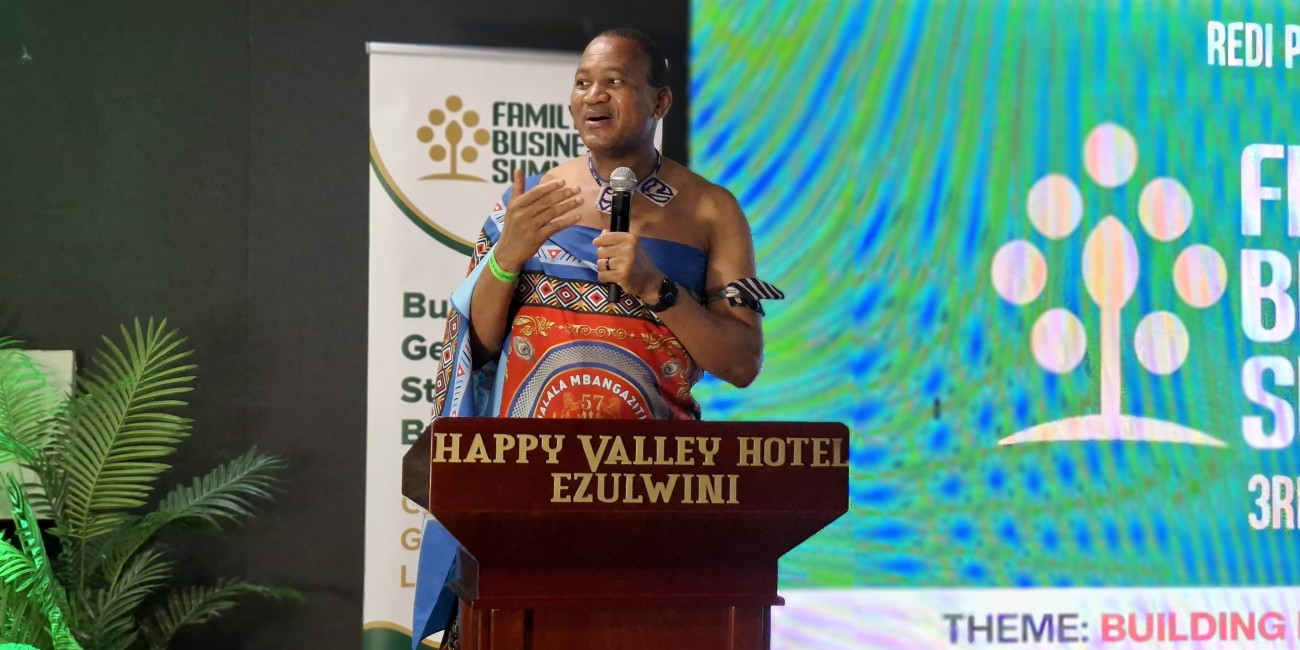
For family-owned businesses seeking debt finance, the quality of the story may open a banker’s ears, but it is the quality of the cash flow that ultimately determines whether the loan can be repaid. This was the central message from Standard Bank Eswatini Managing Director Mvuselelo Fakudze at the Family Business Summit held at Happy Valley Hotel, where he argued entrepreneurs must understand their numbers as intimately as they understand the businesses they operate.
The distinction is important in an economy where family businesses remain significant employers and generators of commercial activity, yet many operate at the intersection of strong entrepreneurial conviction and limited financial capacity. According to Fakudze, banks cannot assess lending proposals purely based on an entrepreneur’s confidence or ambition because the funds being advanced ultimately belong to depositors who expect their money to be available when required.

“When we lend, we lend against cash flows,” he said, explaining that a lender needs to establish how a business will generate sufficient cash to meet operating costs and still retain enough free cash flow to service its debt. The implication for business owners is straightforward: a loan application is not simply a request for capital, but a demonstration that the underlying business can convert its operations into predictable cash capable of supporting the proposed borrowing.
The Managing Director’s own experience of growing up in a family business illustrated why banks need to understand the commercial realities behind the numbers. After completing high school in 1990, he joined his father’s operations, which included a supermarket, bakery, and filling station. His responsibilities stretched from loading bakery deliveries at 5 a.m. and counting every loaf, leaving the operation to reconciling the filling station’s petrol attendants after its 11 p.m. closing time.
That experience, he said, shaped his understanding of the demands placed on family-business owners and informs the bank’s approach to entrepreneurs. “We try to position ourselves as a bank that listens to your story and partners with you and your businesses,” he said. But listening to the story does not remove the financial discipline required before a bank can commit capital.

For banks, the challenge is acute because the money being lent is not simply the institution’s own capital. “That money doesn’t belong to the bank. The bank is just a custodian,” the Managing Director said, highlighting the fundamental balance between supporting productive businesses and protecting the interests of depositors. A bank, therefore, has to determine whether the borrower can repay while ensuring that deposits remain accessible to customers when they need them.
This creates a practical distinction between entrepreneurial passion and bankability. Passion can demonstrate commitment to a business, but it cannot establish debt-servicing capacity. A business owner may have a compelling expansion plan, a strong personal conviction, or years of operating experience, yet the lender still needs evidence showing how the proposed debt will be repaid.
That is why financial understanding at the owner level becomes critical. “If your accountant understands your business better than you, you have not started running the business,” Fakudze said. The point goes beyond accounting competence. Business owners need to understand how revenue is generated, where costs arise, how working capital moves through the business, and, ultimately, how those activities translate into cash available for debt repayment.
For family businesses, this can be particularly important because ownership, management, and family relationships often overlap. A business may have substantial turnover while still experiencing tight liquidity if customers pay slowly, inventories absorb cash, or operating expenses rise faster than revenue. From a lender’s perspective, therefore, the headline size of a business is less important than the reliability and sustainability of the cash flows supporting its obligations.

The Managing Director also pointed to the regulatory responsibilities surrounding commercial lending. Banks operate within credit and regulatory frameworks that require documentation and evidence before financing can be approved. “We’re a very regulated entity, so unless we have all the documentation and we have ticked all the boxes, because we’re lending people’s monies, we need to ensure that we can satisfy the credit process before we can do any lending,” he said.
For entrepreneurs, those requirements can sometimes appear to be administrative obstacles, but they form part of the financial infrastructure underpinning the lending relationship. Financial statements, cash-flow projections, supporting documentation, and evidence of repayment capacity allow a lender to distinguish between a business with a financing need and a business with the financial capacity to absorb additional debt.
The Managing Director acknowledged that banks cannot finance every business that approaches them. He said the institution has a relatively small team of bankers and cannot serve every business through conventional relationship-banking channels, although digital platforms are increasingly being used to expand access and allow customers to interact with the bank more efficiently.

For family businesses, the financing relationship therefore begins before the loan application is submitted. Entrepreneurs who can explain how their business makes money, demonstrate historical and projected cash flows, maintain reliable financial records, and show precisely how additional borrowing will be serviced are better positioned to engage meaningfully with a lender’s credit process.
The broader economic significance of that relationship was also emphasized. Family businesses generate economic activity across the country, while their operations contribute to the tax base that finances public expenditure. “In this economy, the minister is looking for his taxes,” Fakudze said, pointing to the fiscal importance of businesses remaining productive and financially sustainable. “If we don’t contribute to the fiscal, this economy is not going to grow.”
The message places bank lending within a wider economic chain. Depositors provide the funding base, banks intermediate that capital, businesses deploy it into productive activity, and successful enterprises generate employment, taxes, and further economic activity. For that chain to work, however, borrowing has to be anchored in businesses capable of producing sufficient cash to honor their obligations.

The Managing Director’s message to family businesses was therefore ultimately less about convincing a banker through a compelling pitch and more about becoming financially legible to the institution providing the capital. “Tell your story with passion, with conviction,” he said, but added that a convincing business story must be supported by an owner who understands the economics of the enterprise.
For family businesses contemplating their next stage of growth, the distinction matters. Banks may listen to the story, but credit ultimately has to be repaid from cash generated by the business. In that sense, the most persuasive loan application is not necessarily the one with the most ambitious expansion plan, but the one that can clearly demonstrate where the money will come from to repay the money being borrowed..

Other Articles

Family Businesses Must Survive Their Founders to Preserve Wealth
47% Of Family Firms Are Still Family-Run. By 2035, KPMG Expects Just 12%