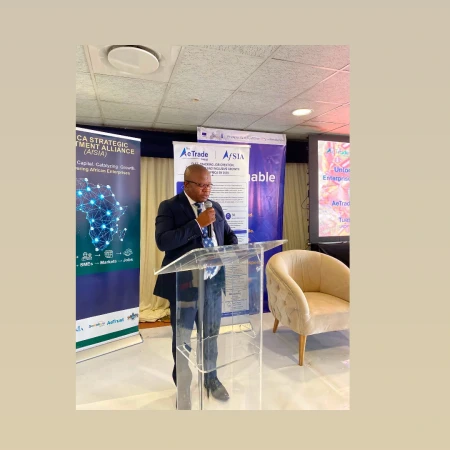







By: Nkosiyabusa Nsibande
The Central Bank of Eswatini’s latest assessment presents an economy that is expanding more rapidly than many analysts anticipated, yet one whose long-term sustainability will depend on balancing private sector growth with increasingly constrained public finances. While the headline figure of 6.1 percent annual GDP growth in the first quarter of 2026 signals renewed economic momentum, the broader financial indicators reveal an economy that is simultaneously creating investment opportunities and accumulating macroeconomic risks.
Perhaps the most encouraging development is the continued expansion of private sector lending. Credit extended to the private sector reached E23.9 billion by the end of May, representing an annual growth of 10.6 percent, while business borrowing increased to E13.2 billion. More importantly, the composition of this lending suggests that commercial banks are financing productive sectors of the economy rather than purely consumption-driven activities. Agriculture, construction, manufacturing, transport, and tourism all recorded higher borrowing levels, indicating that businesses are positioning themselves for increased production and future demand rather than simply refinancing existing obligations.
The recovery is equally reflected in the structure of economic growth. The secondary sector, particularly manufacturing and construction, became the principal engine of expansion after growing by 13.9 percent, contributing nearly three-quarters of total quarterly GDP growth. Manufacturing alone rebounded from contraction to 12.4 percent growth, supported by stronger demand for export-oriented industries including textiles, wood products, chemicals, and processed food. Construction activity also stimulated quarry production, electricity generation, and professional services, illustrating how investment in one sector creates multiplier effects across the broader economy.
The resilience of information and communication services further illustrates how the country’s economic structure continues to diversify beyond traditional industries. ICT expanded by an exceptional 59.6 percent, while accommodation and food services grew by 27.2 percent, signaling stronger business activity and recovering domestic demand. These sectors increasingly represent new sources of productivity and employment, reducing dependence on agriculture and commodity exports that remain vulnerable to climatic conditions and international price fluctuations.
Yet the Central Bank’s report also exposes vulnerabilities that investors cannot ignore. Public debt increased to E42.1 billion, equivalent to 40.4 percent of GDP, as both domestic and external borrowing continued to rise. Domestic debt alone reached E22.0 billion, reflecting additional Central Bank advances and increased issuance of Treasury Bills and Government bonds. While the current debt ratio remains manageable relative to many developing economies, its continued upward trajectory means a growing share of public resources will eventually be directed towards debt servicing rather than productive development expenditure.
Equally significant is the deterioration in the country’s external financial position. Gross official reserves declined to E8.1 billion, providing only 1.9 months of import cover, down from two months previously. The decline reflects government fiscal drawdowns, foreign exchange outflows, and transactions with commercial banks. Although Eswatini continues to operate within the Common Monetary Area, lower reserve levels reduce the country’s ability to cushion future external shocks, particularly if global commodity markets or exchange rates become more volatile.
The external sector continues to present mixed signals. Although the monthly trade deficit narrowed modestly to E198.8 million, exports declined for a third consecutive month as weaker international sugar prices continued to reduce export earnings. Sugar remains one of Eswatini’s largest foreign exchange earners, making prolonged weakness in global prices an important concern for both fiscal revenues and the country’s balance of payments. Encouragingly, machinery imports increased, suggesting businesses continue investing in productive capacity despite softer export conditions.
Inflation dynamics also provide a nuanced picture for businesses and consumers. Headline inflation accelerated to 2.7 percent, not because of broad domestic demand pressures, but largely due to higher fuel and energy costs linked to geopolitical tensions in the Middle East. Transport and housing costs increased sharply, while food prices remained in deflation for the third consecutive month. This divergence implies that households continue benefiting from lower food prices even as operating costs for transport-dependent businesses increase, creating uneven inflationary pressures across the economy.
For financial institutions, another encouraging development is that credit quality has remained broadly stable despite rapid loan growth. Although the value of non-performing loans increased to E1.4 billion, the NPL ratio edged down to 6.93 percent because total lending expanded more rapidly than impaired assets. This suggests that, for now, the banking sector’s increased appetite for lending has not translated into a proportional deterioration in asset quality, preserving financial system stability while supporting economic expansion.
Taken together, the Central Bank’s latest figures portray an economy that is entering a new phase of recovery led increasingly by private investment rather than public spending. Businesses are borrowing more, manufacturing is regaining momentum, construction activity remains robust, and several service industries continue expanding rapidly. However, the same report makes clear that sustaining this recovery will require careful management of rising public debt, rebuilding foreign exchange reserves and strengthening export competitiveness. The economy has demonstrated that growth has returned; the next challenge will be ensuring that equally resilient fiscal and external fundamentals support this momentum.