




By: Nkosiyabusa Nsibande
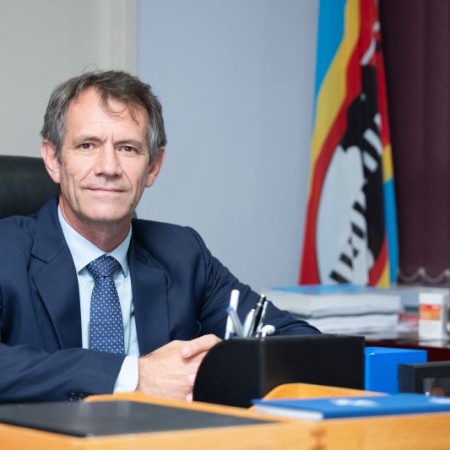
The debate over delays in government spending has shifted towards a fundamental public-finance question: when government has money in the budget, how quickly can that money be converted into actual goods, services, and economic activity? Finance Minister Neal Rijkenberg says the answer cannot be found simply by looking at when funds are released, arguing that the budget approval process and procurement process are separate stages of the public expenditure cycle.
Rijkenberg has rejected claims that the Ministry of Finance routinely holds back funding from government ministries, saying budget releases are processed frequently and that the Ministry understands the importance of making funds available for departments to implement their programs. “I don’t think in my eight years, I’ve taken longer than 24 hours to sign the budget releases,” he said.
According to the Minister, ministries submit requests to the Ministry of Finance, where the budget department assesses the applications, including whether sufficient cash is available and whether the request meets the necessary requirements. The requests are then presented for approval, with Rijkenberg saying this process takes place almost every week or every second week. Once a release has been approved, however, the ministry still has to undertake the necessary procurement procedures before the money can translate into actual expenditure.
This distinction is important from a fiscal management perspective because budget allocation does not equal cash expenditure. A ministry may have an approved allocation on its budget, and the funds may have been released, but the expenditure can still be delayed by tendering, evaluation, contracting, and other procurement requirements. Consequently, a delay in delivering medicines, equipment, or infrastructure does not necessarily mean that the Ministry of Finance has failed to release the money.

Rijkenberg said some historical examples of late budget releases need to be examined in the context of when the request was actually submitted and whether complications arose during the approval process. “We would never, as a Ministry of Finance, delay or have some kind of strange reason to cause trouble in a ministry,” he said.
The bigger constraint, according to the Minister, is often the procurement system itself. Government procurement is deliberately structured around multiple controls because public expenditure carries a different standard of accountability from private-sector spending. Every transaction ultimately represents taxpayers’ money, meaning the government must demonstrate that expenditure is authorized, transparent, competitively sourced, and represents reasonable value.
“What maybe needs to be clear is the procurement process is a long process and it is very intentional,” Rijkenberg said. He explained that the bureaucracy surrounding government purchasing exists to ensure that public officials do not misuse funds, adding that the system is designed to make sure “this money is spent right, that the money is spent transparently, and that it is not overpriced.”
However, while procurement controls protect the public purse, they can also create an efficiency cost when processes become excessively slow. Every month that an approved project remains unexecuted can represent delayed service delivery, delayed infrastructure investment, and delayed economic activity for businesses that would otherwise supply government. The policy challenge is, therefore, not simply to increase controls but to ensure that controls are proportionate and efficient.
This is particularly relevant to the health sector, where delays in procurement can have immediate consequences because hospitals and clinics require a continuous supply of medicines and other essential goods. Rijkenberg said the Ministry of Finance has historically supported emergency expenditure requests from the Ministry of Health when urgent requirements arise, even though emergency procurement can create its own financial and administrative complications.
“Whenever they request an emergency spend, for instance, we’ve always assisted and we’ve approved that,” he said. The Minister also pointed to multi-year supply contracts as another mechanism that can reduce repeated procurement requirements, noting that the Ministry of Health can secure arrangements covering three or four years where appropriate.

The health sector, nevertheless, illustrates the complexity of government procurement because of the sheer range of products required. Medicines and medical supplies involve numerous specifications, suppliers, and purchasing requirements, making procurement a more complicated process than simply having a budget allocation available. Rijkenberg said the Ministry of Finance’s position has been to support the health ministry while maintaining the financial controls applicable to public expenditure. “As a Ministry of Finance, we absolutely try to support and to try to assist,” he said.
The Ministry is now looking at whether technology can reduce the time between a ministry identifying a need and the government completing the procurement transaction. Rijkenberg said the government is reviewing legislation and considering greater use of e-procurement to make procurement more transparent while improving turnaround times.
The proposed reforms are significant because digital procurement can potentially improve both financial control and operational efficiency. A properly designed system can create clearer audit trails, improve visibility over tenders and purchasing decisions, reduce manual administration, and make it easier to monitor the movement of public funds from approval to final payment.
For government, the objective should therefore be to reduce the time and cost associated with procurement without removing the safeguards that protect public finances. A faster procurement system that weakens competition or oversight could ultimately increase fiscal risk, while an overly rigid system can leave approved budgets sitting idle and delay the delivery of services.
Rijkenberg also addressed concerns that financial and procurement decisions could be influenced by private interests. He rejected the suggestion that the Ministry of Finance uses its authority to interfere in markets or advance personal interests, arguing that government decisions are made after considering different policy and financial options.
One of the issues he addressed was the involvement of Montigny in speculation surrounding the health sector. Rijkenberg said the company should not be viewed as seeking a role in healthcare, stating that “Montigny would never want to get involved in the health space.” He said the company is focused on forestry and has no intention or expertise to operate in the health sector.

The Minister also clarified his previous association with the Luke Commission, saying he had served on its board before becoming Finance Minister in a pro bono capacity. He said he received neither a sitting fee nor an allowance and resigned from the board when he became a minister. His explanation was aimed at separating his previous voluntary involvement with the organization from his subsequent responsibilities as a government decision-maker.
Rijkenberg further confirmed that the government had previously explored whether private-sector participation could improve efficiency in certain areas of public service delivery. He said DISCIM was approached as part of this consideration, but the engagement did not result in a commercial arrangement after the government assessed the proposal.
“I do recall that at some point we were considering as a government, as a cabinet, to say, you know, do we consider bringing a private sector in?” he said. The Minister argued that the government has a legitimate reason to consider private-sector solutions where they can potentially deliver services more efficiently, although such options must ultimately pass a financial and policy assessment.
In the case of the DISCIM proposal, Rijkenberg said the assessment concluded that the option did not make financial or operational sense. “The option didn’t make sense. And it just died a death right there,” he said.
The financial significance of the broader debate is that government’s fiscal performance cannot be measured only by how much money is allocated in the budget. It must also be measured by how effectively those allocations are converted into infrastructure, healthcare, public services, and economic activity. A budget that is approved but remains tied up in administrative processes does not deliver the same economic impact as an expenditure that reaches its intended destination on time.
This makes procurement reform an important component of public financial management. If Eswatini can digitize procurement, reduce unnecessary administrative stages, and improve coordination between ministries while retaining transparency and oversight, the government could potentially improve the efficiency of every emalangeni spent.
The central issue, therefore, is no longer simply whether the government has released the money. It is whether the entire expenditure chain, from budget allocation and cash release to tendering, contracting, payment, and delivery, works efficiently enough to turn public money into measurable economic and social outcomes. Rijkenberg’s comments suggest that while the Ministry of Finance considers budget releases to be moving quickly, the next major efficiency gains will have to come from improving how the government procures and spends those funds.