







By: Nkosiyabusa Nsibande
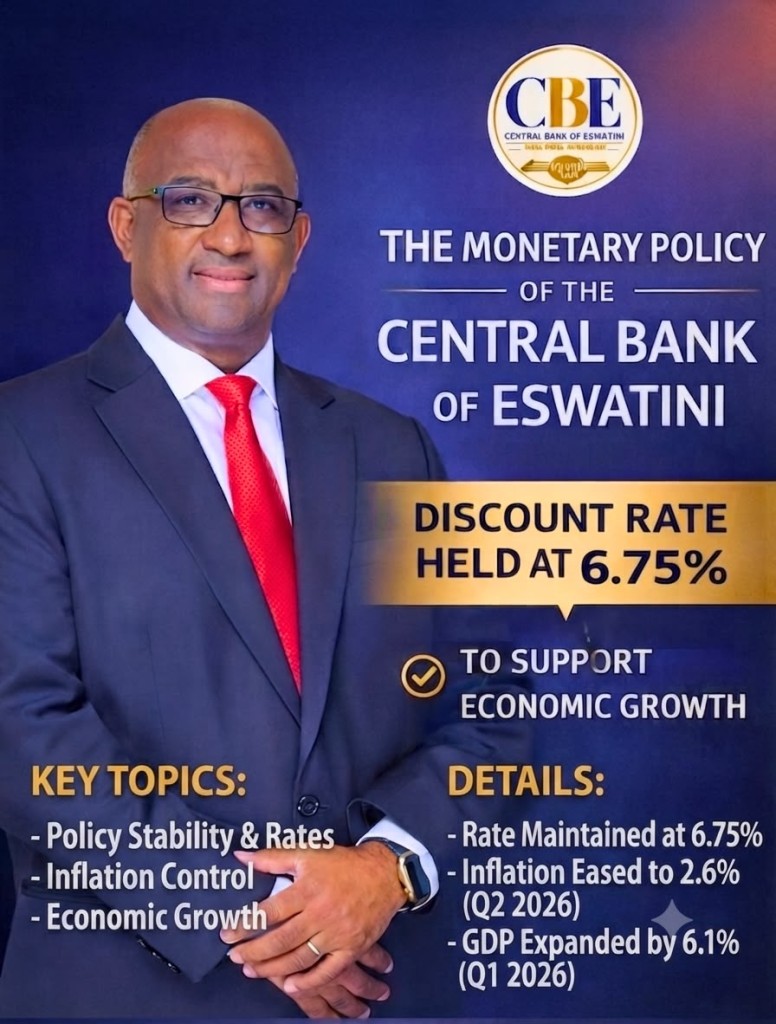
The Central Bank of Eswatini has opted for policy continuity, keeping the discount rate unchanged at 6.75 percent during its July Monetary Policy Consultative Committee meeting. The decision reflects growing confidence that the country’s economy is expanding at a healthy pace while inflation remains firmly under control. In practical terms, the policy stance means commercial banks are expected to maintain the prime lending rate at 10.25 percent, providing businesses and households with certainty over borrowing costs until the next monetary policy review.
The latest decision underscores the bank’s assessment that current economic conditions do not warrant either a reduction or an increase in interest rates. Monetary policy remains sufficiently accommodative to support investment and consumption, yet cautious enough to ensure inflation expectations remain anchored. For businesses, particularly those relying on bank financing for expansion, working capital, and capital investment, the decision offers predictability at a time when global financial markets continue to grapple with uncertainty.
One of the strongest indicators supporting the Bank’s position is the continued moderation in inflation. Headline inflation declined to 2.6 percent in June 2026, from 2.7 percent recorded in May, extending a period of relatively low price growth. Inflation at these levels preserves household purchasing power and reduces pressure on production costs for businesses. Stable prices also create a favorable environment for long-term planning, allowing firms to make investment decisions without the uncertainty associated with rapidly rising input costs.

Despite the encouraging inflation performance, the Central Bank has maintained a measured outlook. While price pressures remain subdued, policymakers recognize that external risks continue to pose challenges for a small, open economy such as Eswatini. Global geopolitical tensions, fluctuations in energy prices, international supply chain disruptions, and uncertainty surrounding global trade continue to present upside risks to inflation. Consequently, the Bank expects consumer prices to increase moderately over the remainder of the year. It has revised its 2026 inflation forecast to an average of 3.31 percent, a level that remains consistent with overall macroeconomic stability.
Alongside stable prices, the domestic economy continues to demonstrate notable resilience. Real Gross Domestic Product expanded by 6.1 percent during the first quarter of 2026 on a seasonally adjusted year-on-year basis, improving from the revised 5.8 percent growth recorded in the fourth quarter of 2025. The stronger growth performance suggests that productive sectors of the economy continue to recover and expand despite a difficult international environment characterized by slowing global demand and persistent geopolitical uncertainty.
The sustained pace of economic activity provides important evidence that domestic investment, consumer spending, and business confidence remain positive. Growth at these levels indicates that the economy is generating momentum without creating inflationary pressures that would normally require tighter monetary policy. It also reinforces confidence that Eswatini’s broader economic reform agenda and private sector investment initiatives are yielding measurable economic dividends.

For the financial sector, the decision sends an important signal of policy consistency. Banks can continue extending credit under stable interest rate conditions, while borrowers benefit from predictable financing costs. This stability is particularly valuable for sectors such as manufacturing, agriculture, construction, and retail, where access to affordable and predictable financing plays a significant role in supporting production, employment, and expansion.
Households are equally affected by the decision. Individuals servicing mortgages, vehicle finance, and personal loans linked to the prime lending rate are unlikely to experience changes in their monthly repayments before the next monetary policy meeting. Combined with low inflation, stable lending rates provide consumers with greater certainty when managing household budgets and planning major purchases.
The Central Bank’s cautious approach also reflects Eswatini’s monetary policy framework within the Common Monetary Area, where maintaining confidence in the Lilangeni’s parity with the South African Rand remains essential. Monetary policy therefore seeks to balance domestic economic conditions with regional financial developments, ensuring that price stability, financial sector resilience, and currency credibility are preserved simultaneously.
Ultimately, the July monetary policy decision projects confidence rather than complacency. The combination of stronger economic growth, subdued inflation, and stable interest rates suggests that Eswatini’s macroeconomic fundamentals continue to improve. However, by maintaining rather than easing monetary policy, the Central Bank has signaled that it remains attentive to evolving global risks and committed to safeguarding long-term economic stability. For investors, businesses, and consumers, the message is clear: the economy is strengthening, but sustainable growth will continue to be supported through prudent and disciplined monetary management.