






By: FinGuard Editorial Team
Financing is the lifeblood of any enterprise. Whether you are running a small startup or managing a large corporation, choosing the appropriate financial instrument can determine how smoothly your business grows and operates. Two of the most common options are the term loan and the overdraft facility. Both are valuable, but they serve very different purposes.
Term Loans: Structured Stability
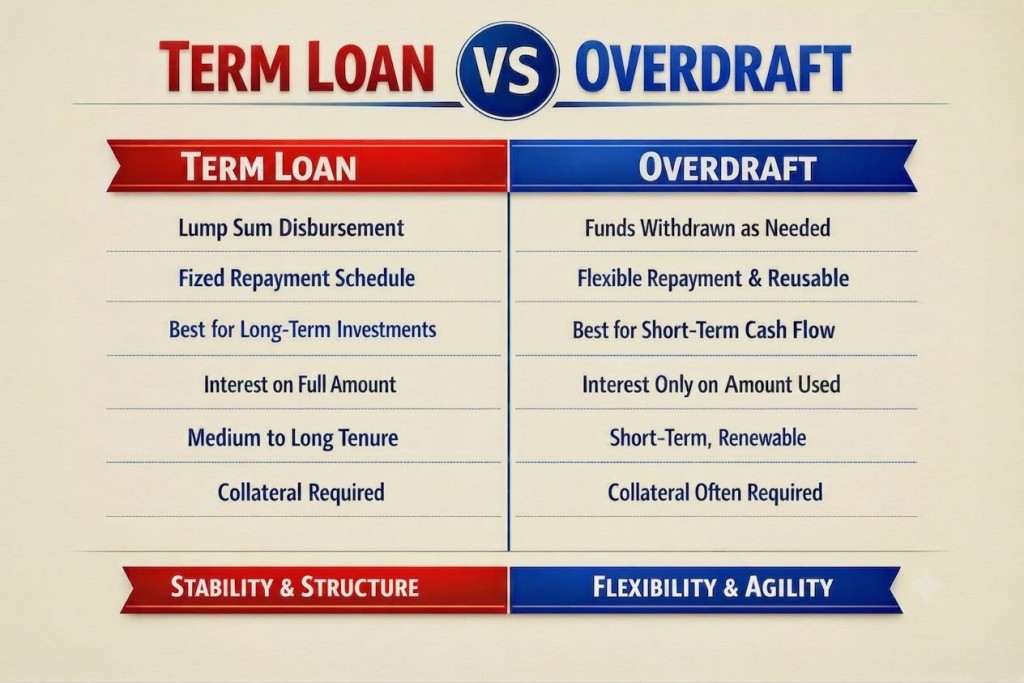
A term loan gives businesses a lump sum upfront, repaid over a fixed period with interest.
• Disbursement: Funds are released at once, enabling immediate investment.
• Repayment: Fixed monthly or quarterly installments provide predictability and discipline.
• Best Use: Long-term investments such as purchasing assets, expanding operations, or financing construction projects.
• Interest: Charged on the entire loan amount, regardless of usage.
• Tenure: Medium to long-term, ranging from one year to several decades for major projects.
• Security: Collateral is usually required, often in the form of property, equipment, or receivables.
Advice for Businesses
• Secure term loans when interest rates are favorable.
• Use them for projects that generate long-term returns.
• Always assess repayment capacity under different scenarios, including changes in market conditions.
Bottom line: Term loans are best for businesses with clear growth strategies and the ability to commit to structured repayments.
Overdrafts: Flexible Liquidity
An overdraft facility allows businesses to withdraw more than their account balance, up to an approved limit.
• Disbursement: Funds are drawn only when needed, reducing unnecessary debt.
• Repayment: Highly flexible, with the ability to repay and reuse the facility multiple times.
• Best Use: Short-term working capital needs, payroll, inventory purchases, or bridging receivables.
• Interest: Charged only on the amount utilized, making it cost-efficient for temporary needs.
• Tenure: Short-term, usually up to 12 months, renewable upon review.
• Security: Collateral is often required, similar to term loans.
Advice for Businesses
• Use overdrafts strategically, not habitually.
• Treat them as a buffer for cash flow gaps, not a permanent financing solution.
• Monitor usage closely to avoid over-reliance, which can signal deeper financial management issues.
Bottom line: Overdrafts are a lifeline for businesses needing agility in managing day-to-day operations and unpredictable cash flows.
Term Loan vs Overdraft: A Clear Comparison
Expert Advice
• Blend Both Instruments: Use term loans for strategic expansion and overdrafts for operational resilience.
• Plan Ahead: Match financing to the nature of your business needs. Long-term projects require structured funding, while short-term gaps need flexible solutions.
• Governance Matters: Strong financial management ensures that borrowing strengthens rather than weakens your business.
• Diversify Funding Sources: Do not rely solely on one instrument. Combining bank loans with overdrafts and other facilities reduces risk.
Smart borrowing is not just about choosing between a term loan and an overdraft – it is about aligning financing with your business model. A term loan builds the foundation for expansion, while an overdraft keeps operations fluid. Together, they form a balanced strategy that supports growth, stability, and resilience.