






By: Nkosiyabusa Nsibande
Eswatini entered 2026 from a significantly stronger economic position than it held a year earlier, with preliminary estimates showing real Gross Domestic Product (GDP) expanded by 5.6% in 2025, compared with 3.0% in 2024. The acceleration represents a meaningful improvement in economic activity. Still, the composition of that growth is particularly important for businesses, investors, and households because it reveals where income-generating activity is expanding and where underlying vulnerabilities remain. According to the Central Bank of Eswatini’s Annual Economic Review Report 2025/26, the strongest contribution came from the tertiary sector, which expanded by 7.6%, while the primary and secondary sectors grew by 2.8% and 4.4%, respectively.
The performance of the tertiary economy provides one of the clearest indications of where economic momentum was concentrated in 2025. Wholesale and retail trade expanded by 9.7%, recovering from a 3.3% contraction in 2024, while financial services recorded an even stronger turnaround, growing by 11.8% after declining by 3.2% in the previous year. The Central Bank attributes part of the improvement in domestic demand to public-sector salary adjustments and relatively low inflation, which generated real wage gains during the second half of the year. For financial institutions, insurers, and pension funds, the performance also points to increased economic activity within financial intermediation and longer-term savings products.
The financial services performance is particularly relevant from a financial development perspective because it suggests that economic growth was not confined to physical production. The expansion of insurance and pension fund activities indicates stronger activity in financial products that mobilize savings and provide risk protection. At the same time, growth in information and communication technology and professional and technical services reflects the increasing importance of service-based economic activity. For households and businesses, however, the sustainability of this growth will ultimately depend on whether increased economic activity translates into higher disposable incomes, productive investment, and improved access to finance.
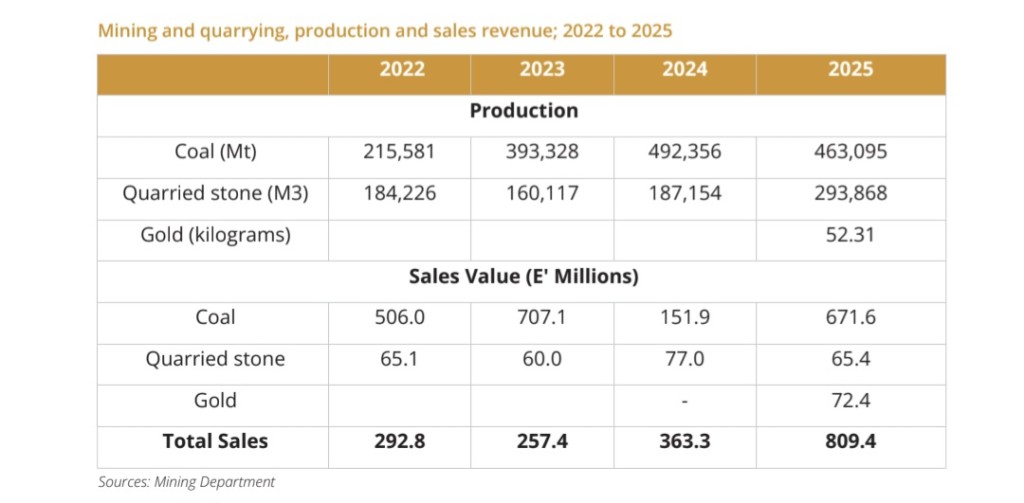
The primary sector presented a more uneven picture. It grew by 2.8%, down slightly from 3.1% in 2024, with mining and quarrying remaining particularly exposed to developments in South Africa’s industrial economy. Coal production declined by 5.9% to 463,095 metric tonnes, reflecting disruptions in South Africa’s ferrochromium industry during the first half of 2025. However, the weakness in coal was partly offset by stronger gold and quarrying activity. Gold production increased by 42.2% to 53 kilograms, while quarried stone production surged by 57.1% to 293,868 cubic meters, supported by increased construction activity.
The financial significance of the mining figures becomes clearer when measured through sales rather than production volumes alone. Total reported sales from mining and quarrying increased substantially to approximately E809.4 million in 2025, from E363.3 million in 2024. Coal sales accounted for E671.6 million, while quarried stone contributed E65.4 million and gold E72.4 million. This illustrates an important distinction for economic analysis: production volumes do not always move in the same direction as industry revenues, meaning investors and policymakers need to examine both output and value when assessing a sector’s contribution to the economy.
Agriculture, meanwhile, continued to provide an important production base despite significant risks. Maize output increased by 3.6% to 77,640 metric tonnes, sugarcane production rose to 5.63 million tonnes, and cotton production increased by 3.0% to 619 tonnes. Yet livestock production remained under pressure from the foot-and-mouth disease outbreak, which disrupted cattle supply and resulted in a ban on beef exports to the European market from May 2025. The poultry industry also faced supply-chain constraints linked to highly pathogenic avian influenza in South Africa and Brazil, demonstrating how external shocks can quickly move through regional agricultural supply chains and ultimately affect domestic food security and prices.

The secondary sector grew by 4.4% in 2025, but its performance was weaker than the 6.6% recorded in 2024. Manufacturing growth slowed sharply to 2.9% from 7.8%, reflecting softer external demand and uncertainty in key export markets. Textiles and wearing apparel, for example, expanded by 5.3%, compared with 8.4% in 2024, while chemicals and chemical products contracted marginally by 0.4%. The moderation is significant for Eswatini because manufacturing remains closely linked to export markets, making the sector particularly sensitive to tariffs, trade policy, and shifts in international demand.
Not all manufacturing segments weakened. Production linked to construction recorded substantial gains, with cement, glass, and other non-metallic mineral products increasing by 124.5%, while wood and paper products expanded by 17.8%, and other manufacturing grew by 18.4%. These figures demonstrate the economic multiplier effect of infrastructure spending: investment in major projects not only creates activity at construction sites but can generate demand for quarrying, cement, manufacturing, transport, wholesale trade, and financial services. The Central Bank specifically links part of this industrial expansion to public-sector investment, including the construction of the E2.7 billion Mpakeni Dam.
Energy production also strengthened. Local electricity generation increased by 18.6% in 2025, helping reduce electricity imports from 1,026.8 GWh in 2024 to 969.2 GWh. At the same time, the number of electricity customers increased by 4.6% to 309,852. However, electricity consumption increased by only 0.2%, while sales to irrigation, industrial bulk, and commercial customers declined by 0.1%. This divergence between generation capacity and industrial consumption is an important signal for the economy: expanding energy supply is valuable, but the full economic return depends on whether productive sectors have sufficient demand and investment capacity to use that energy.

Water consumption presented a similar contrast. Total treated water sales declined by 10.7% to 3.42 million kiloliters, despite the number of connections increasing by 2.0% to 69,093. Commercial water sales fell by 16.6%, while residential sales declined by 4.3%. From a financial and economic management perspective, declining consumption alongside expanding connections raises questions about business activity, household demand, and the utilization of economic infrastructure.
The strongest growth story, however, came from the services economy and its interaction with domestic demand. Tourism recorded more than 1.03 million international arrivals, representing a 7.0% increase and exceeding the one-million mark for the first time since the COVID-19 pandemic. Yet the number of bed-nights sold fell by 12.6% to 457,588. This shows that visitor volumes alone are not sufficient to measure tourism’s economic contribution. The financial value of tourism depends heavily on how long visitors stay, how much they spend, and how effectively that spending reaches accommodation providers, restaurants, transport operators, retailers, and other businesses.
The Central Bank now expects the economy to expand by 5.2% in 2026, before moderating to an average of 3.8% between 2027 and 2030. The forecast points to a shift in the drivers of growth, with the primary and secondary sectors expected to perform more strongly while tertiary-sector growth moderates. Construction is projected to be a major engine, with growth of 31.4% expected in 2026 as large public and private infrastructure projects accelerate.
The scale of the investment pipeline gives substance to that forecast. Projects identified by the Central Bank include the E2.7 billion Mpakeni Dam, E2.6 billion in MR14 and MR21 road construction, a E5.3 billion Strategic Oil Reserve, a E2.9 billion 75MW solar plant, a E2.9 billion new Central Bank headquarters, and the E1.2 billion Lower Maguduza hydro project. Together, these listed projects represent more than E17.6 billion in planned investment. Their economic impact could extend well beyond construction, creating demand for suppliers, transport companies, manufacturers, financial institutions, engineering firms, and professional services.
The major question is, therefore, not simply whether these projects can generate GDP growth, but whether the country can secure and manage the financing required to complete them. The Central Bank explicitly identifies the availability of financing as a key condition for the continuation of major infrastructure projects. Fiscal pressures, uncertainty around Southern African Customs Union receipts, and delays in external financing could constrain capital expenditure. Inefficiencies in project execution could also reduce the economic return on public investment, making financial discipline and project governance central to the growth outlook.
For households, the improving GDP numbers must also be considered alongside the changing inflation environment. Headline inflation averaged 3.1% in 2025, down from 4.0% in 2024, while food inflation declined to 2.1% and transport inflation fell to just 0.2%. Lower inflation provided some relief to consumers and helped support real wage growth, particularly when combined with public-sector salary adjustments. However, lower inflation does not mean that the cost of living has fallen; it means prices increased at a slower rate than before.
The inflation environment has already started changing in 2026. Headline inflation averaged 1.9% during the first quarter, but higher international oil prices and domestic utility costs are creating new pressure. Fuel prices increased sharply between April and May, with cumulative increases of E5.82 per liter for petrol, E11.75 for diesel, and E12.08 for paraffin. An average electricity tariff increase of 11.74% approved by the Eswatini Energy Regulatory Authority is also expected to feed into business operating costs and household expenditure.

These developments explain why the Central Bank revised its annual inflation forecast for 2026 upward to 3.31%, from 3.27%. The forecast for 2027 was also increased to 3.74%, while the 2028 projection was revised to 3.30%. For consumers, businesses, and investors, this means financial planning cannot rely solely on the relatively benign inflation experienced in 2025 and early 2026. Fuel, electricity, transport, and imported goods remain exposed to international commodity prices and exchange-rate movements.
The broader economic picture is therefore one of stronger growth, accompanied by a more complicated risk environment. Eswatini has demonstrated the capacity to generate significantly faster economic growth, with 5.6% recorded in 2025 and 5.2% projected for 2026. But the durability of that performance will depend on whether infrastructure investment can be financed and executed efficiently, whether export-oriented industries can maintain market access, whether agricultural production can withstand climate and disease shocks, and whether financial conditions remain supportive of the private sector.
Growth becomes economically meaningful when investment creates productive capacity, businesses generate sustainable cash flows, households build purchasing power, and financial institutions effectively channel savings into productive economic activity. Eswatini’s 2025 performance shows a stronger economic base. Still, the E17.6 billion-plus project pipeline and emerging inflation pressures will test whether that momentum can translate into durable wealth creation over the next several years.

Other Articles

Made in Eswatini Brands Get Umhlanga Platform