






By: Nkosiyabusa Nsibande
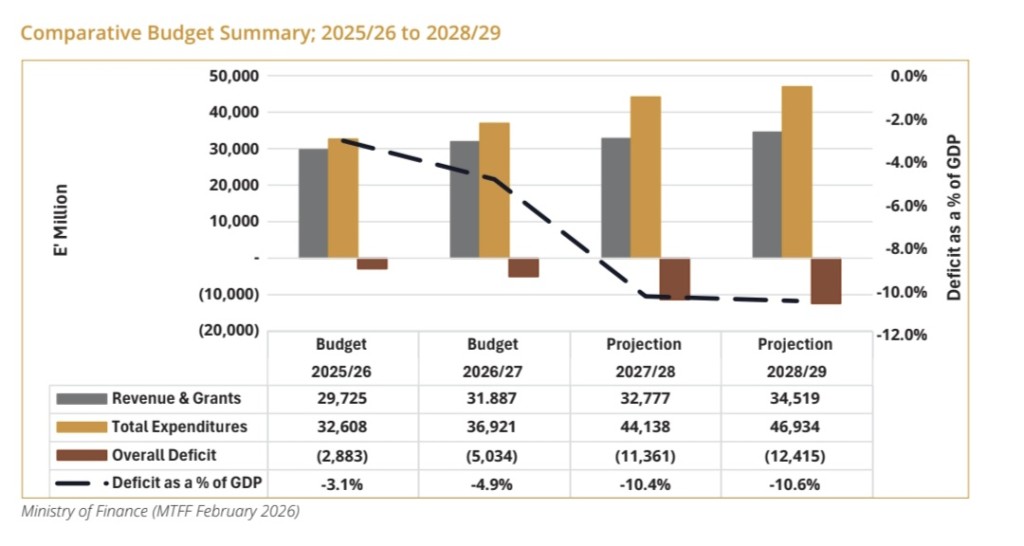
Eswatini’s public finances are heading into the 2026/27 financial year under a combination of higher revenue expectations, expanding expenditure commitments and a significantly larger financing requirement. According to the Central Bank of Eswatini’s Annual Economic Review Report 2025/26, government has budgeted for revenue and grants of E31.9 billion, against total expenditure of E36.9 billion, producing a projected deficit of approximately E5.0 billion, or 4.9 per cent of GDP. The deficit is wider than the E2.9 billion, or 3.1 per cent of GDP, originally budgeted for 2025/26, although it remains below the preliminary 2025/26 outturn deficit of 6.4 per cent of GDP.
The numbers point to a fiscal position in which government is attempting to finance a larger spending programme while simultaneously strengthening domestic revenue collection. The Central Bank reports that revenue and grants are expected to increase by 7.3 per cent, from the E29.725 billion budgeted for 2025/26 to E31.887 billion in 2026/27. The improvement is expected to come from both domestic revenue and Southern African Customs Union (SACU) receipts, with SACU revenue projected to rebound by 12.9 per cent following a sharp 20.4 per cent contraction in 2025/26. Government also plans to channel E343 million into the Revenue Stabilisation Fund, providing a buffer against future volatility in SACU receipts.
Domestic revenue is expected to provide an increasingly important contribution to the financing of government operations. According to the Central Bank’s report, domestic revenue is projected to rise by 13.9 per cent to E19.0 billion, supported by broad-based growth across major tax categories. Corporate income tax is projected to increase by 5.9 per cent, while PAYE collections are expected to grow by 11.7 per cent, partly reflecting salary adjustments for civil servants. Taxes on goods and services are projected to increase by 17.8 per cent, with VAT collections expected to rise by a substantial 24.8 per cent as tax administration improves and economic activity strengthens.
The projected increase in consumption-related taxation also carries a direct implication for households and businesses. The Central Bank estimates that excise duties, particularly on alcohol and tobacco, will increase by 45.6 per cent, reflecting recent tax adjustments, including the increase in the levy on imported alcohol from 7 per cent to 10 per cent during the 2025/26 financial year. At the same time, fuel levy collections are expected to decline marginally by 0.3 per cent, with global supply disruptions likely to constrain fuel volumes. For consumers, this combination illustrates how fiscal consolidation can affect household spending through indirect taxation even when the broader objective is to strengthen government revenue.
On the expenditure side, government has budgeted for E36.9 billion, representing a 13.2 per cent increase from the E33.6 billion budgeted for 2025/26. According to the Central Bank, recurrent expenditure is expected to increase by 14.7 per cent, while capital expenditure is projected to rise by 8.0 per cent. A substantial portion of the recurrent budget will be absorbed by compensation of employees, which accounts for 33.7 per cent of the expenditure composition, while capital expenditure represents 21.1 per cent. Interest payments account for another 10.0 per cent, demonstrating that the cost of servicing existing obligations has become a significant component of the public budget.
The pressure on expenditure is being driven by both policy commitments and the cost of maintaining government operations. The Annual Economic Review reports that the civil servants’ salary review, higher debt-servicing obligations and the accelerated implementation of capital projects are among the principal factors behind the expansion in spending. Government is also financing major infrastructure and development projects, including Phase 1 of the Mkhondvo-Ngwavuma Water Augmentation Programme, the Mpakeni Dam, the Strategic Oil Reserve project, road infrastructure improvements and other major developments. New projects for 2026/27 include the MR14 and MR21 road projects, the Accelerating Sustainable and Clean Energy Access Transformation programme and institutional housing developments.

The financing of this expenditure programme remains one of the most important financial issues emerging from the 2026/27 budget. According to the Central Bank, government has presented a fully financed budget, meaning that funding sources have been identified for the projected E5.0 billion deficit. Domestic financing will continue to rely on government securities, including Treasury Bills, Treasury Bonds and Infrastructure Bonds, while external financing will comprise project loans, budget support and potential issuance through the Johannesburg Stock Exchange-listed bond programme. This borrowing strategy means that the cost and structure of government debt will remain closely linked to the sustainability of public finances.
That concern is underscored by the latest debt figures. The Central Bank reports that total public debt reached E42.3 billion at the end of March 2026, equivalent to 40.6 per cent of GDP, up from E36.2 billion, or 38.0 per cent of GDP, a year earlier. This represents a 17.0 per cent year-on-year increase, with both domestic and external debt contributing to the expansion. Domestic debt increased by 7.6 per cent, while external debt rose by a much sharper 28.4 per cent. The pace of external debt growth is particularly significant because it increases government’s exposure to foreign financing conditions, project-loan disbursements and movements in external borrowing markets.
External public debt stood at E20.9 billion, equivalent to 20.1 per cent of GDP, at the end of March 2026. According to the Central Bank, multilateral loans remain the dominant component, accounting for 67.3 per cent of external debt, while bilateral loans account for 28.5 per cent and commercial bank loans 3.3 per cent. The increase in external debt was attributed to drawdowns on new and ongoing project loans, the JSE bond programme and budget support loans, although favourable exchange-rate movements provided some relief by reducing the domestic-currency burden of servicing foreign debt.

Domestic debt, meanwhile, stood at E21.285 billion, representing 7.0 per cent growth from E19.923 billion in March 2025. The Central Bank’s debt analysis shows that Treasury Bonds remain the largest component, increasing by 14.0 per cent to E13.710 billion, while Treasury Bills increased by 17.0 per cent to E3.881 billion. The outstanding Central Bank advance to government declined by 21.9 per cent to E2.323 billion, while domestic loans fell by 17.0 per cent to E1.370 billion. The composition shows a continued shift towards market-based government borrowing through securities rather than relying solely on central bank advances or domestic loans.
The investor appetite for government securities provides an important counterpoint to the increase in public debt. According to the Central Bank’s Treasury Bills analysis, the average subscription rate increased from 108 per cent to 153 per cent during 2025/26, while the average allotment rate rose from 99 per cent to 112 per cent. The 364-day Treasury Bill was the strongest-performing instrument, recording a subscription rate of 199 per cent and an allotment rate of 142 per cent. This indicates that domestic investors continue to demonstrate considerable demand for government paper, giving government access to a relatively deep pool of domestic financing.
However, stronger demand for government securities does not remove the underlying fiscal cost of borrowing. The Central Bank reports that Treasury Bill yields declined across all maturities during the review period, with the 364-day yield falling from 10.391 per cent to 9.406 per cent, while the 91-day yield declined from 9.153 per cent to 8.418 per cent. The decline is consistent with an easing interest-rate environment, but the yields remain material from a public finance perspective because every additional issuance creates future interest obligations. As government increases its reliance on domestic markets to finance deficits, debt-service costs will increasingly compete with other expenditure priorities.
The government bond market is also being positioned as a longer-term financing mechanism. According to the Central Bank, Treasury Bonds outstanding increased to E13.709 billion during 2025/26, while the reintroduction of the Infrastructure Bond Programme generated E398 million from E400 million offered to the market. Medium- to long-term government securities attracted strong investor interest, with the average bid-to-cover ratio improving from 150 per cent to 210 per cent. Government also raised E1.877 billion from E1.400 billion offered through public bond auctions during the year.

For 2026/27, government plans to raise E1.5 billion through its bond issuance programme, comprising E1.1 billion under the Plain Vanilla Bond Programme and E400 million through Infrastructure Bonds. The Central Bank reports that a notable development is the introduction of a new 15-year benchmark bond, designed to extend the maturity profile of domestic debt while creating longer-term investment opportunities for pension funds and insurance companies. The strategy provides institutional investors with additional fixed-income instruments while allowing government to spread repayment obligations over a longer period.
The maturity structure of existing government bonds, however, highlights an immediate refinancing challenge. According to the Central Bank’s maturity analysis, total government bond maturities amount to approximately E8.306 billion, with 61 per cent concentrated in the short term. The 2026/27 financial year alone accounts for 34 per cent of total maturities, followed by 2028/29 at 15 per cent and 2027/28 at 12 per cent. This concentration means that government will need to manage refinancing carefully while simultaneously funding the new fiscal deficit, because maturing obligations and new borrowing requirements can place competing demands on the domestic capital market.
For households, businesses and investors, the broader financial message is that Eswatini’s fiscal trajectory will remain an important economic variable over the coming years. Higher tax collections can strengthen government’s ability to finance services and investment, but rising expenditure and debt obligations require those revenues to be managed efficiently. For businesses, government borrowing can influence domestic interest rates and the availability of financing. For investors, the expansion of government securities creates more opportunities for fixed-income investment, particularly for institutions seeking longer-duration assets.
The central challenge, therefore, is not simply the size of the E5.0 billion deficit or the E42.3 billion debt stock in isolation. The more important question is whether borrowed resources generate sufficient economic returns to support future revenue growth and debt repayment. Capital expenditure directed towards productive infrastructure, water security, energy access, transport networks and industrial development has the potential to expand the economy’s productive capacity. Conversely, persistent expenditure growth without a corresponding expansion in the revenue base would increase the pressure on future budgets.
Eswatini’s 2026/27 fiscal position therefore presents a balancing act between revenue mobilisation, development spending and debt sustainability. As reported by the Central Bank of Eswatini, government has identified additional revenue through VAT, corporate taxation, PAYE, excise duties and SACU receipts, while simultaneously expanding its borrowing programme to finance infrastructure and other priorities. The effectiveness of this strategy will ultimately depend on whether higher public spending translates into stronger economic activity, a broader tax base and sufficient future revenue to service the debt being accumulated today.