





By: Nkosiyabusa Nsibande
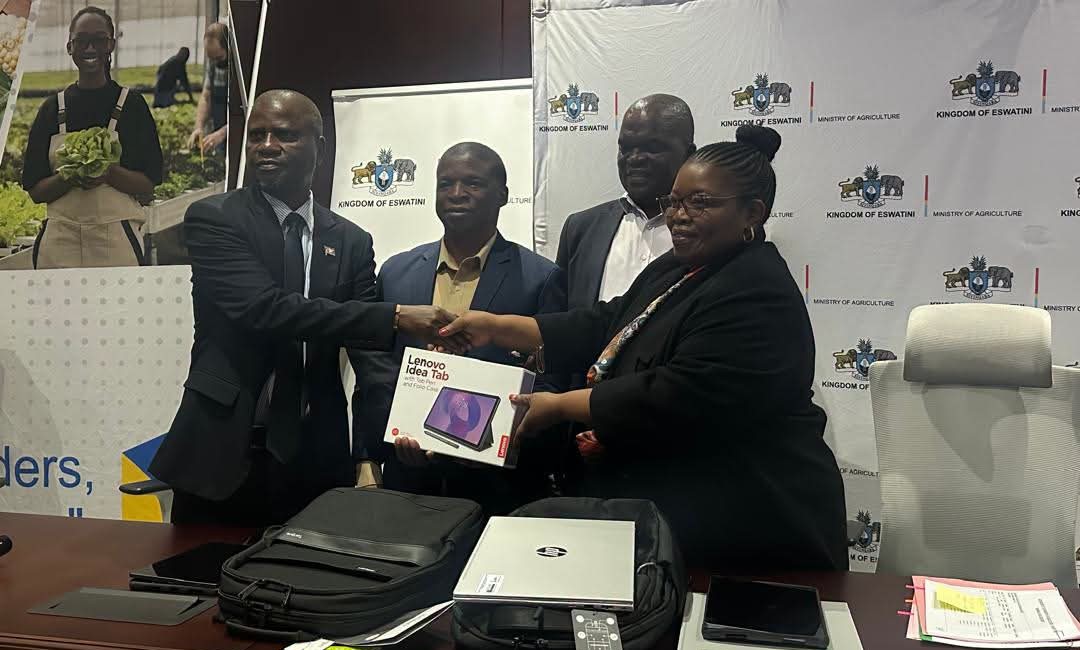
The delivery of digital equipment valued at more than E300,000 to the Ministry of Agriculture marks an investment in the systems used to track the financial and economic performance of one of Eswatini’s key smallholder agriculture programs. The Eswatini Water and Agricultural Development Enterprise (EWADE), to support Monitoring and Evaluation (M&E) activities under the Smallholder Agricultural Productivity Enhancement and Marketing Project (SAPEMP), has provided the equipment, comprising iPads and laptops.
SAPEMP has been under implementation for approximately one year, with its broader objective centered on transforming rural economies by increasing agricultural productivity among smallholder farmers and strengthening their access to markets. At this stage of the project, the ability to generate reliable information becomes increasingly important because policymakers and project managers need to determine whether the resources committed to agricultural development are translating into measurable economic outcomes.
The financial importance of M&E lies in its ability to connect expenditure with results. Agricultural development projects require substantial resources, from infrastructure and equipment to farmer support and market interventions. Without accurate information on how these resources are being used and what outcomes they are producing, it becomes difficult to assess whether spending is achieving value for money or whether adjustments are required.
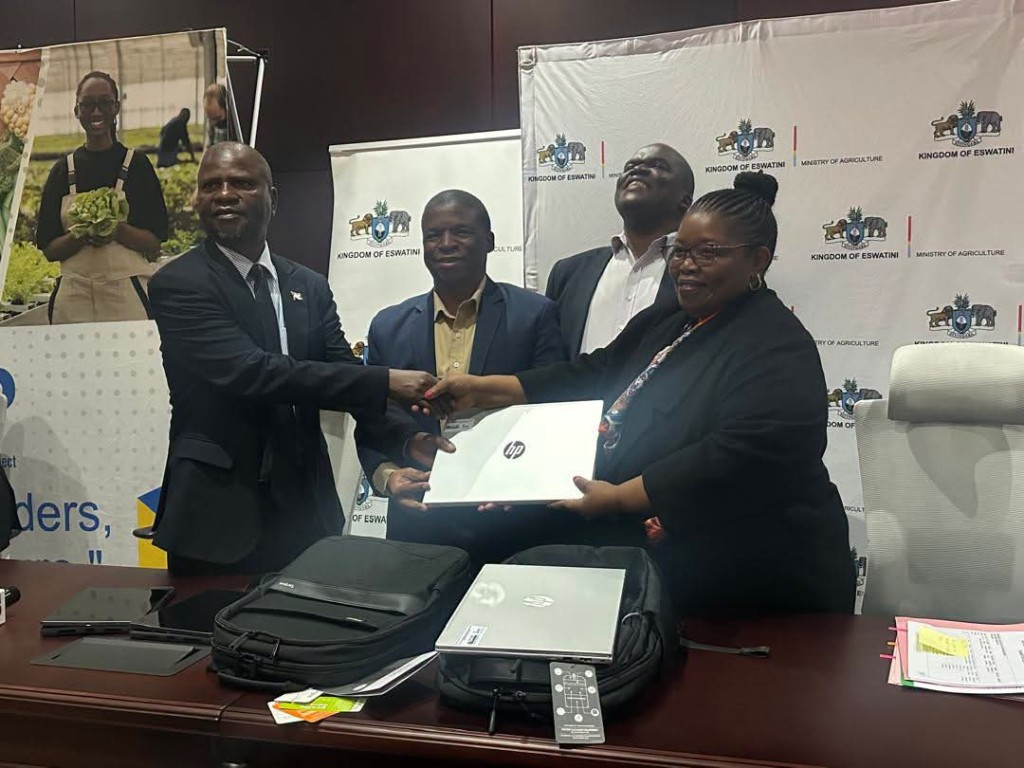
The new digital equipment is expected to strengthen the collection, processing, and reporting of information from project activities. For officials working in the field, access to mobile devices and computers can make it easier to capture information closer to where agricultural activities are taking place while improving the speed at which that information reaches project managers and decision-makers.
For SAPEMP, this could have direct implications for financial management. Reliable project data can help identify areas where implementation is progressing as planned and those where resources or interventions may not be producing the expected results. This allows management to decide based on evidence rather than assumptions, particularly when determining where future resources should be concentrated.
The investment also comes when the economic contribution of smallholder agriculture remains an important consideration for Eswatini. For rural households, farming is not only a source of food but also an income-generating activity. Increasing productivity can therefore affect household earnings, local economic activity, and the supply of agricultural products to markets.
However, higher production alone does not necessarily result in stronger farmer incomes. Farmers must also be able to access markets and sell their produce at commercially sustainable prices. This makes SAPEMP’s marketing component financially significant because the ultimate measure of agricultural support should extend beyond production volumes to include farmers’ ability to participate effectively in value chains and generate income from their output.

A stronger M&E system can help determine whether that transition is taking place. Data on production, market access, farmer participation, and project outcomes can provide a clearer picture of whether interventions are creating sustainable economic benefits. Over time, such information can also help policymakers identify structural challenges preventing smallholder farmers from moving from subsistence-oriented production towards more commercially viable agriculture.
The quality of this information is important for financial institutions and other stakeholders involved in agricultural financing. One of the challenges in agricultural finance is accurately assessing the performance and risks associated with smallholder production. Better project-level information can contribute to a stronger understanding of what is working, where risks exist, and which interventions can produce sustainable returns.
The E300,000-plus investment should therefore be viewed beyond the value of the equipment itself. Its greater significance lies in the potential to strengthen the information infrastructure supporting agricultural investment. If the devices improve the accuracy and timeliness of project reporting, they can contribute to better resource allocation and stronger accountability throughout the implementation of SAPEMP.
The challenge now is to ensure that the technology produces useful intelligence rather than simply becoming another project asset. The effectiveness of the investment will ultimately depend on how consistently the equipment is used, the quality of information collected, and whether that information is incorporated into financial and operational decision-making.

For EWADE and the Ministry of Agriculture, the next phase of SAPEMP will therefore require a stronger focus on measurable outcomes. It will be important to establish whether farmers are increasing production, accessing better markets, improving their incomes, and generating sufficient economic activity to justify the resources committed to the program.
As SAPEMP progresses, these indicators will provide a clearer assessment of the project’s financial and economic performance. The E300,000 digital investment may be modest compared with the overall resources required to transform smallholder agriculture. Still, if it strengthens accountability, improves decision-making, and helps ensure that agricultural spending reaches its intended outcomes, it could become an important supporting investment in Eswatini’s rural economic development.

Other Articles