







By: Nkosiyabusa Nsibande
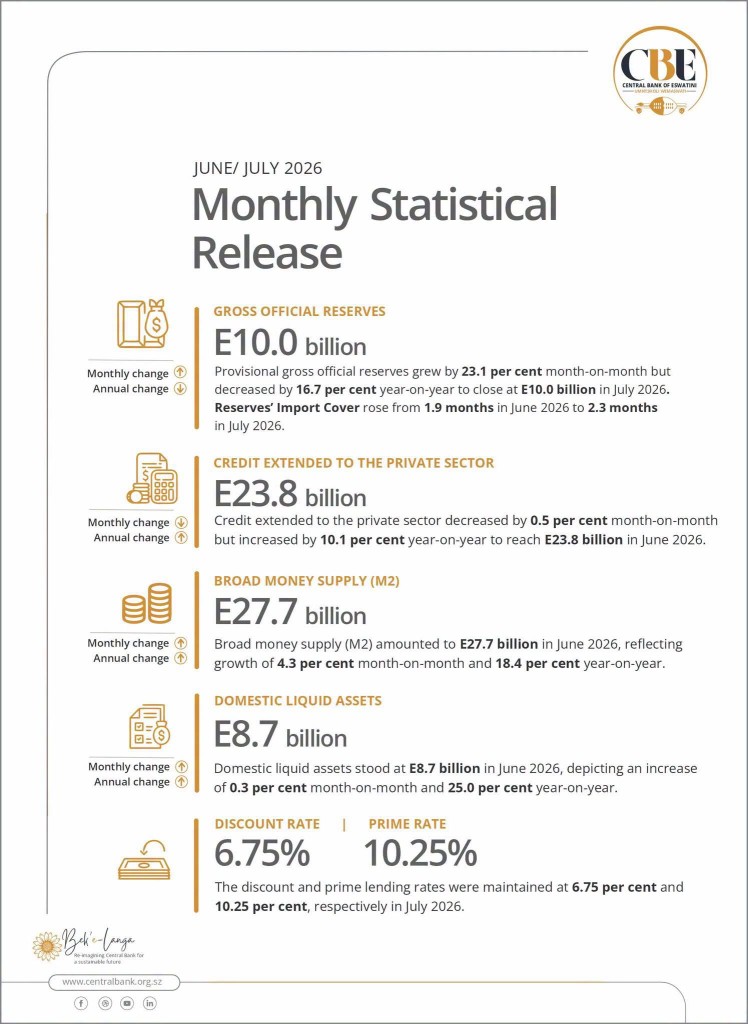
Eswatini’s financial system recorded stronger monetary liquidity in June and an improvement in the country’s external reserve position in July, although the latest Central Bank of Eswatini statistics show that credit growth remains uneven across businesses and economic sectors.
Private-sector credit stood at E23.8 billion at the end of June 2026, representing a 10.1% increase from the same period last year. On a monthly basis, however, credit declined by 0.5%, mainly because of weaker lending to businesses, which outweighed continued growth in household borrowing and credit extended to other sectors of the domestic economy.
Business-sector credit amounted to E12.9 billion, increasing 10.2% year-on-year but declining 1.9% between May and June. The monthly contraction was driven by reduced lending to several industries, most notably manufacturing, where credit fell 27.1%. Agriculture and forestry lending declined by 5.7%, while community, social and personal services fell 2.5% and transport and communication decreased by 1.5%.
The decline in some sectors was partly offset by stronger lending elsewhere in the economy. Credit to distribution and tourism increased by 27.4% during the month, while mining and quarrying rose 7.4%, construction increased 4.6% and real estate grew 1.2%. The contrasting movements indicate that the expansion in annual business credit has not been broad-based, with financing conditions differing considerably between industries.
The distribution of credit between SMEs and large enterprises presents another significant feature of the latest statistics. Lending to SMEs declined 7.5% month-on-month, although it remained 3.6% higher than a year earlier. SMEs accounted for 29.7% of total credit extended to businesses in June, compared with 70.3% for large enterprises.
Large-enterprise credit increased 0.6% month-on-month and 13.2% year-on-year to E9.1 billion. The figures show that the majority of bank credit to businesses remains concentrated among larger firms, while SME lending experienced a substantial monthly contraction.
The movement in business credit is important because the availability and allocation of finance influence the ability of companies to invest, maintain working capital and expand operations. While the 10.1% annual increase in private-sector credit points to greater financial intermediation compared with a year earlier, the monthly decline in business lending and the sharper contraction in SME credit suggest that the expansion is not occurring evenly across the productive economy.
Household borrowing continued to move in the opposite direction. Credit to households and non-profit institutions serving households reached E9.9 billion in June, representing growth of 0.8% month-on-month and 11.6% year-on-year. Motor vehicle loans increased 3.4% to E1.5 billion, while other personal unsecured loans rose 1.1% to E4.1 billion. Housing loans declined marginally by 0.4% to E4.3 billion.
The expansion in household credit therefore came largely through motor vehicle and unsecured personal borrowing rather than housing finance. This distinction is significant because different forms of household credit have different implications for consumption, household balance sheets and longer-term asset accumulation.
At the monetary level, broad money supply increased substantially during the review period. M2 rose 4.3% month-on-month and 18.4% year-on-year to E27.7 billion in June. The increase reflected growth in both quasi-money and narrow money. Quasi-money reached E17.5 billion after increasing 6.7% over the month and 19.8% over the year, while narrow money increased 0.4% month-on-month and 16.1% year-on-year to E10.1 billion.

Time deposits accounted for a significant portion of the growth in quasi-money, rising 8.1% to E15.3 billion, while savings deposits declined 2.2% to E2.2 billion. The increase in time deposits points to a greater accumulation of funds in fixed-term banking instruments during the month, although the monetary statistics do not establish how much of this additional liquidity was subsequently channelled into productive lending.
The banking sector itself remained highly liquid. Domestic liquid assets reached E8.7 billion in June, representing an increase of 25.0% year-on-year and 0.3% month-on-month. The Central Bank attributed the increase to higher cash holdings and greater balances maintained by banks with the Central Bank. Despite the increase in liquid assets, the liquidity ratio declined from 33.0% in May to 31.9% in June as domestic liabilities increased more rapidly than liquid assets.
The banking-sector balance sheet provides further context. Total liquid assets stood at E8.707 billion against required liquidity of E5.951 billion, leaving a surplus of approximately E2.756 billion. At the same time, the loans-to-deposits ratio declined to 79.9% in June from 84.1% in May and 86.6% a year earlier. The lower ratio indicates that lending had not increased at the same pace as deposits, despite the banking system maintaining a sizeable liquidity buffer.
Government’s position within the banking system also weakened during June. Net claims on Government increased from E2.1 billion in May to E2.2 billion, with the Central Bank attributing the increase to a 4.7% rise in claims following an additional advance to Government. Government deposits increased by 3.5% to E6.6 billion, largely reflecting the proceeds of the advance being credited to Government accounts.

The country’s external liquidity position improved sharply in July, supported by the quarterly inflow of SACU revenue. Gross official reserves increased by 23.1% month-on-month to E10.0 billion, lifting import cover from 1.9 months in June to 2.3 months in July.
Despite the monthly improvement, the reserve position remained weaker than a year earlier. Gross official reserves were 16.7% lower year-on-year, with July 2025 reserves recorded at approximately E11.95 billion compared with E9.96 billion in July 2026. The improvement in July should therefore be viewed against both the immediate SACU-related increase and the longer-term annual decline.
The reserve increase also does not necessarily represent a permanent improvement in the country’s external position. The Central Bank specifically linked the monthly rise to the quarterly SACU revenue inflow, while noting that the July reserve figure remains provisional pending the official closure of its accounts. Import-cover figures are also subject to revision because the import data used have a three-month lag.
Interest rates remained unchanged in July, with the discount rate maintained at 6.75% and the commercial banks’ prime lending rate at 10.25%. The absence of a rate adjustment means the movements recorded in credit, deposits and liquidity occurred against a stable policy-rate environment during the review period.
Overall, the latest monetary statistics point to a financial system with substantially higher liquidity and money supply than a year earlier, alongside stronger annual private-sector credit and an improved reserve position in July. However, the composition of these gains remains important. Business lending contracted during June, SME credit fell sharply, and manufacturing experienced one of the largest sectoral declines in borrowing, while large enterprises continued to account for the majority of business credit.
The figures therefore present a mixed picture of financial conditions. Liquidity is available within the banking system, deposits are expanding and private-sector credit remains above its level a year earlier, but the movement of finance into businesses is uneven. How effectively this liquidity is converted into productive investment, particularly among SMEs and sectors such as manufacturing and agriculture, will remain an important indicator of the financial system’s contribution to broader economic activity.