





BY FINGUARD MAGAZINE
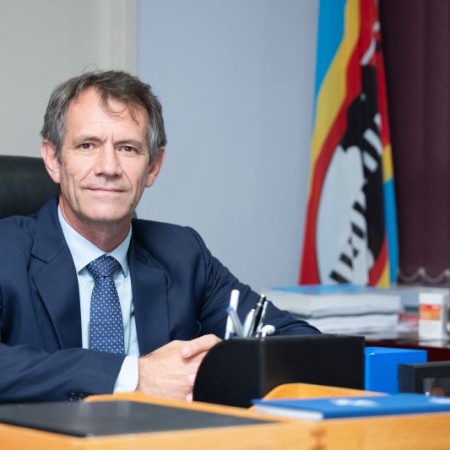
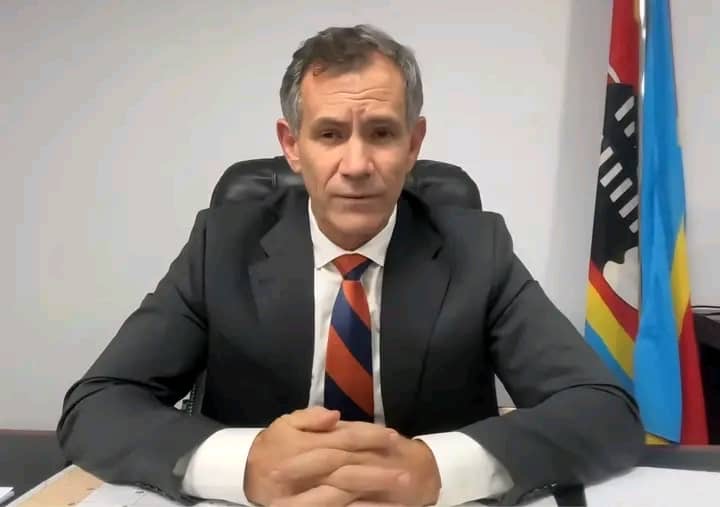
Eswatini’s Minister of Finance, Neal Rijkenberg, has sought to reassure the public that the
country’s fiscal position remains stable despite government’s plans to raise additional borrowing,
while simultaneously warning emaSwati about a growing wave of artificial intelligence-
generated investment scams using his image and voice.
Speaking during the latest edition of Finance in Focus, the Minister addressed concerns
surrounding public debt, supplier payments, government cash flow and new trade facilitation
initiatives, while cautioning citizens against fraudulent investment promotions circulating on
social media.
The Minister opened his remarks by warning that criminals are increasingly exploiting artificial
intelligence to manipulate footage from Finance in Focus in an attempt to convince members of
the public to invest in fraudulent schemes. Rijkenberg stressed that the fake videos falsely
portray him endorsing private investment products, something he said would be both unethical
and inappropriate for a serving Minister of Finance. “Please remember, I’ll never do that. I’ll
never say, ‘Invest exactly in this private investment fund.’ I’ll speak very broadly. I’ll try and help
emaSwati on what to consider, but never, never speaking to specific funds in the private sector. It
would be very wrong of me to do as a minister.” He urged the public to immediately regard any
such videos as scams, adding that government officials should never promote one private
investment product over another.
The warning comes as financial scams become increasingly sophisticated across global markets,
with generative AI enabling fraudsters to replicate voices, facial expressions and video footage
with remarkable accuracy. For investors, the Minister’s comments reinforce the importance of
verifying financial advice through official government communication channels rather than
relying on viral social media content that promises guaranteed investment returns or exclusive
opportunities.
Beyond the fraud warning, Rijkenberg highlighted government’s efforts to strengthen trade
logistics through PutuMoney, a courier business operating under the Eswatini Posts and
Telecommunications Corporation (EPTC). While the company already competes within the
domestic courier market, government is expanding its role to simplify cross-border commerce by
assisting consumers purchasing goods online as well as businesses importing larger
consignments into the country. According to the Minister, the service is intended to improve
market access for both households and businesses by reducing logistical barriers that often
increase the cost and complexity of international trade. He explained that government is also
working with PutuMoney South Africa to facilitate the movement of larger shipments from
overseas, saying the initiative would eventually enable importers to move containerised cargo
into Eswatini more efficiently. “PutuMoney will be continuing to roll out their programme, and
in time, I think it can be very helpful towards anyone importing anything into Eswatini… to make
access to the world a whole lot easier from Eswatini than what it currently is.”
The Minister also addressed public concerns regarding Eswatini’s debt position following recent
media reports suggesting that government borrowing was becoming excessive. He acknowledged
that government continues to borrow while simultaneously servicing existing obligations but
insisted that debt remains within prudent limits. “We are taking on more debt as a country. We do
continue to take loans, we continue to pay loans, and we try to always manage our debt around
the 45% debt-to-GDP ratio.” He explained that government is currently seeking additional
financing primarily to settle outstanding supplier payments and ease cash flow pressures without
compromising long-term fiscal sustainability.
Providing further context, Rijkenberg said Eswatini’s current debt-to-GDP ratio of approximately
45 percent remains significantly below regional benchmarks and well within internationally
accepted sustainability thresholds. He noted that many African economies operate with
considerably higher debt burdens, while the Southern African Development Community has
adopted a guideline encouraging member states to remain below a 60 percent debt-to-GDP ratio.
“At the moment, we are still in very safe territory. We’d actually like to keep it that way as a
country. We don’t want to go too high.” Maintaining a conservative debt profile, he argued,
strengthens Eswatini’s credibility among international lenders and creates favourable borrowing
conditions not only for government but also for state-owned enterprises and private sector
businesses seeking access to capital.

Another factor supporting Eswatini’s debt sustainability, according to the Minister, is the
composition of its external borrowing. Rather than relying on expensive commercial financing
from international capital markets, government continues to finance its foreign obligations
almost entirely through concessional loans, which typically offer lower interest rates and longer
repayment periods. “We don’t have commercial debt with international entities. One of the very
few countries on the continent where all of our foreign debt is concessional debt, and that stands
us in good stead when it comes to repaying our debt.” Lower financing costs, he said, reduce
pressure on public finances while preserving fiscal space for development spending.
Rijkenberg also provided an update on government’s payment programme for suppliers,
confirming that approximately E500 million was paid out around month-end. However, he
acknowledged that supplier obligations remain a moving target as new invoices continue to enter
the payment system. “We managed to pay about half a billion Emalangeni worth of suppliers.
But unfortunately, you pay suppliers, more payments come through. It’s a constant rolling of
suppliers.” He said government is therefore raising additional funding to further reduce arrears
and improve payment timelines, particularly as delayed payments can constrain business cash
flow and weaken confidence among companies that depend on government contracts.
The Minister further indicated that liquidity constraints have affected the pace of several
government capital projects, although he expects the additional financing currently being
arranged to restore momentum. He explained that part of the planned borrowing will support
both supplier settlements and infrastructure expenditure, allowing delayed projects to proceed
while improving overall fiscal cash flow management. “The money we’re busy raising now will
hopefully bring that under control too, and bring all our capital projects up to speed where they
should be.”
Taken together, the Minister’s remarks present government’s current fiscal strategy as one
focused on balancing liquidity management with long-term sustainability. While borrowing is
expected to increase in the short term, Treasury maintains that debt remains within manageable
levels, financing costs remain favourable and additional funding will be directed towards settling
arrears, supporting infrastructure delivery and strengthening confidence across the broader
economy. At the same time, Rijkenberg’s warning on AI-enabled financial fraud serves as a
timely reminder that protecting public finances increasingly extends beyond fiscal policy to
safeguarding consumers against increasingly sophisticated digital scams.