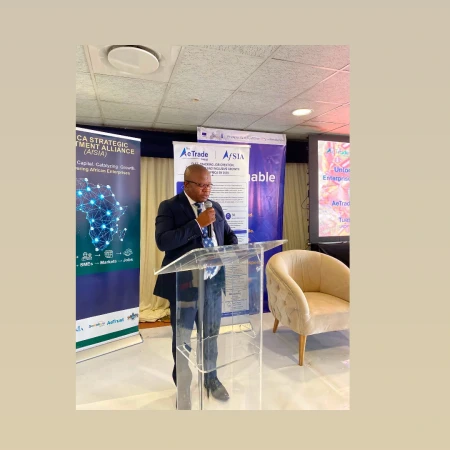







By: Nkosiyabusa Nsibande
The Ministry of Information, Communication and Technology spent E69.27 million during the first quarter of the 2026/27 financial year, but the significance of the expenditure lies beyond the amount absorbed from the national budget. The central financial issue is whether the infrastructure, systems and services being financed are creating sufficient economic value to justify continued public investment.
According to the ministry’s First Quarter Performance Report, E90.60 million was released for recurrent activities between April and June 2026, of which E69.27 million had been spent by 30 June. This represents a 76% absorption rate, leaving E21.33 million unspent. Against the ministry’s annual recurrent allocation of E356.97 million, first-quarter expenditure accounted for approximately 19.4% of the full-year budget.
The expenditure rate indicates that implementation was underway, but budget absorption on its own is not a measure of value for money. In public finance, the critical distinction is between spending money and generating an outcome from that spending. A ministry can achieve a high absorption rate while the economic benefits of its programmes remain limited if infrastructure is underutilised, digital platforms have low uptake or assets require repeated expenditure because of poor maintenance and vandalism.

This distinction is particularly relevant to ICT expenditure because much of the ministry’s investment is directed towards infrastructure whose returns are expected to accumulate over several years. Fibre networks, telecommunications infrastructure, international bandwidth and digital government platforms may not generate an immediate cash return to the Treasury, but they can create economic value through lower transaction costs, improved productivity, expanded market access and greater efficiency in government services.
Minister Savannah Maziya told Parliament that “robust infrastructure and affordable connectivity remain central to our work”, outlining a first quarter that placed considerable emphasis on strengthening the country’s digital infrastructure.
One of the largest developments was the progress recorded by EPTC’s infrastructure rebuild project, which had reached 96% completion by the end of June. The prepaid data service had also been commissioned and was operational. The project is expected to increase the capacity and utilisation of telecommunications infrastructure while improving the flexibility with which consumers purchase data services.
The ministry also reported continued fibre-to-the-X deployment, increasing coverage to 26,528 home passes. This infrastructure has economic significance because broadband connectivity is increasingly becoming a productive input for businesses rather than merely a household communication service. A reliable connection enables businesses to conduct digital payments, access online markets, use cloud-based systems, communicate with customers and suppliers and maintain operations that depend on digital platforms.

Minister Maziya told Parliament that fibre-to-the-X “extends high-speed broadband, enabling the education, commerce and digital government opportunities to more EmaSwati.” The statement captures the economic rationale behind the infrastructure expenditure: the return is expected to come through the activity enabled by the network rather than simply through the sale of connectivity itself.
However, the financial assessment of such infrastructure should eventually move beyond the number of homes passed. Government needs to know how many of those connections become active, how many businesses are using them, what additional economic activity is being enabled and whether improved connectivity is reducing costs for households, enterprises and government.
The same issue applies to the country’s international connectivity. During the quarter, a key cross-border link was upgraded from 1Gbps to 10Gbps, increasing total cross-border capacity to 120Gbps.
Minister Maziya emphasised the significance of the upgrade in Parliament, saying it would improve “the speed and resilience of the country’s international internet gateways for all users.”
From an economic perspective, greater international bandwidth can support business continuity, digital trade, online financial transactions and access to international markets. It can also reduce the risks associated with congestion and limited connectivity capacity. However, the economic return will ultimately depend on utilisation. Capacity that remains underused represents a sunk public investment with a lower-than-expected return.
This is why the next stage of ICT investment should increasingly be accompanied by performance indicators that connect technical outputs to financial and economic outcomes. The number of home passes, gigabits of capacity and infrastructure sites completed are useful operational indicators, but they do not by themselves establish whether taxpayers are receiving adequate value from the investment.

The ministry’s revenue performance provides one of the clearest financial indicators in the first-quarter report. Revenue collected through EBIS, libraries and the Eswatini National Archives and Records Services increased to E1.43 million from E180,904 during the corresponding quarter of the previous financial year. This represents an increase of approximately 688%.
The increase is substantial, although it would be misleading to treat the E1.43 million as a direct return on the ministry’s E69.27 million expenditure. The institutions generating the revenue have public-service mandates that extend beyond commercial activity. Nevertheless, the improvement demonstrates that better utilisation of public institutions and services can strengthen their revenue-generating capacity.
The more important question is whether this improvement can be sustained and whether other public assets under the ministry can be managed in ways that improve both service delivery and financial performance.
Eswatini Post provides another indication of how digitalisation is changing the commercial value of public infrastructure. Through its partnership with the Eswatini Revenue Service, all 34 post offices were operationalised for the collection of non-tax government revenue, bringing selected government payment services closer to communities.
Minister Maziya told Parliament that EmaSwati can now access these government payment services “at any post office nationwide”, reducing the need for citizens to travel to meet government obligations.
The economic benefit of such a system extends beyond the revenue collected. By bringing payment services closer to citizens, government can reduce transaction costs associated with accessing public services, while a broader collection network can improve convenience and potentially strengthen compliance.
Eswatini Post is also positioning itself within the expanding e-commerce market. The ministry reported that volumes handled through its last-mile e-commerce service more than doubled, while cross-border e-commerce parcels delivered through Putumani Couriers increased by 30%.

This development is particularly relevant to small businesses. An online marketplace cannot function efficiently without a reliable logistics network capable of moving goods from sellers to customers. The growth in parcel volumes therefore indicates that the country’s postal infrastructure is becoming part of the wider digital commerce value chain.
For local enterprises, the economic return can come indirectly through increased market access, while for Eswatini Post, higher volumes create the possibility of stronger commercial revenue from logistics services.
Digital government is another area where public expenditure has the potential to generate savings rather than direct revenue. During the quarter, the Government in Your Hand mobile application was expanded with six new payment services covering travel documents, passports, birth certificates, marriage certificates, death certificates and trading licence renewals.
The financial value of such a system should not be measured only by the amount of money collected through the platform. Its economic return can also come from reduced paperwork, fewer physical visits to government offices, shorter processing times, improved payment tracking and lower administrative costs.
The ministry has consequently conducted awareness campaigns and developed a marketing plan aimed at increasing public adoption of the application. This will be important because a digital service generates limited economic value if citizens continue relying predominantly on expensive and time-consuming manual processes.
The ministry should therefore increasingly report on transaction volumes, active users, processing times and estimated costs saved through digital government services. Such indicators would make it easier for Parliament and taxpayers to determine whether digitalisation is actually producing efficiency gains.
The potential returns from ICT investment are also threatened by the cost of infrastructure theft and vandalism. Minister Maziya told Parliament that “theft and vandalism of critical infrastructure continue unabated”, warning that this was adversely affecting the delivery of critical services.

For government, the financial implications are significant. When infrastructure financed through public funds is stolen or vandalised, additional resources have to be allocated to repairs, replacement and restoration of services. This effectively reduces the useful life of the original investment and lowers its economic return.
Infrastructure protection should therefore be treated as part of investment management. The value of a fibre network, transmitter, telecommunications site or government technology platform depends not only on its construction but also on its ability to remain operational for the period over which its economic benefits are expected to accrue.
The ministry’s first-quarter expenditure also needs to be considered alongside its capital programme. It was allocated E47.50 million for four capital projects during the financial year, of which E46.27 million had been released. While the report indicates that expenditure was still being processed, the financial performance of these projects will ultimately have to be assessed through the assets created and the services those assets deliver.
The completion of the Klanj Library, for example, represents a tangible infrastructure output. But the broader public-finance assessment should also consider whether completed infrastructure is being adequately utilised and maintained and whether the services it provides justify its lifecycle costs.
Digital skills development presents a similar challenge. During the first quarter, 473 EmaSwati, including adults and learners, were capacitated in basic computer and digital citizenship skills. The ministry also provided devices and assistive technologies to vulnerable groups and learners with disabilities.

The economic return from such programmes is not immediately captured in revenue figures. The investment becomes economically meaningful if those trained acquire employment, establish businesses, access markets, improve productivity or become more capable users of digital government and financial services.
For that reason, the ministry’s future reporting should ideally track what happens after training rather than stopping at the number of people reached.
The first-quarter financial performance therefore presents a mixed but potentially significant picture. Government is committing substantial resources to the digital infrastructure required to support a modern economy, and there are already measurable signs of increased activity, particularly in e-commerce, government payment access, revenue collection and telecommunications capacity.

However, the E69.27 million expenditure cannot be judged solely on implementation statistics.
The 26,528 fibre home passes, 120Gbps international capacity and 96% completion of the EPTC infrastructure rebuild demonstrate that physical and technological capacity is being created. The more important financial question is how much economic activity that capacity is generating.
Similarly, the 688% increase in revenue collected through selected ministry institutions is encouraging, but it remains small relative to the ministry’s expenditure. It should therefore be treated as evidence of improving revenue performance rather than proof that the broader ICT investment has already paid for itself.
The same principle applies to the more than doubling of e-commerce last-mile volumes and the 30% growth in cross-border parcels. These figures indicate increasing economic activity around digital commerce, but the next step is to establish the value of the transactions being facilitated and the contribution of this growth to business revenues, employment and the broader tax base.Every major project should have a measurable economic objective. Connectivity projects should demonstrate their impact on businesses and productivity. Digital government should demonstrate administrative savings and transaction growth. E-commerce infrastructure should demonstrate commercial volumes and revenue. Digital-skills programmes should demonstrate outcomes beyond training numbers. Infrastructure protection should demonstrate reduced losses and service interruptions.
This approach would allow Parliament and the public to move from asking whether government spent its budget to asking whether government created value from that budget.
Eswatini’s digital economy will require continued investment, and cutting ICT expenditure simply because it does not immediately generate large Treasury receipts could be financially short-sighted. Digital infrastructure is capable of producing returns indirectly through productivity, private-sector growth, innovation and reduced transaction costs.
But continued investment must be accompanied by stronger measurement.
The first-quarter report shows that the Ministry of Information, Communication and Technology is building capacity. It shows improving revenue performance, expanding digital infrastructure and growing commercial activity around e-commerce. What remains less clear is the monetary value of the economic activity being enabled relative to the public resources committed.
That is the financial benchmark that should become increasingly important during the remainder of the 2026/27 financial year, not merely how much Eswatini spends on digital transformation, but how much economic value that transformation produces for households, businesses and the public purse.